


Introduction
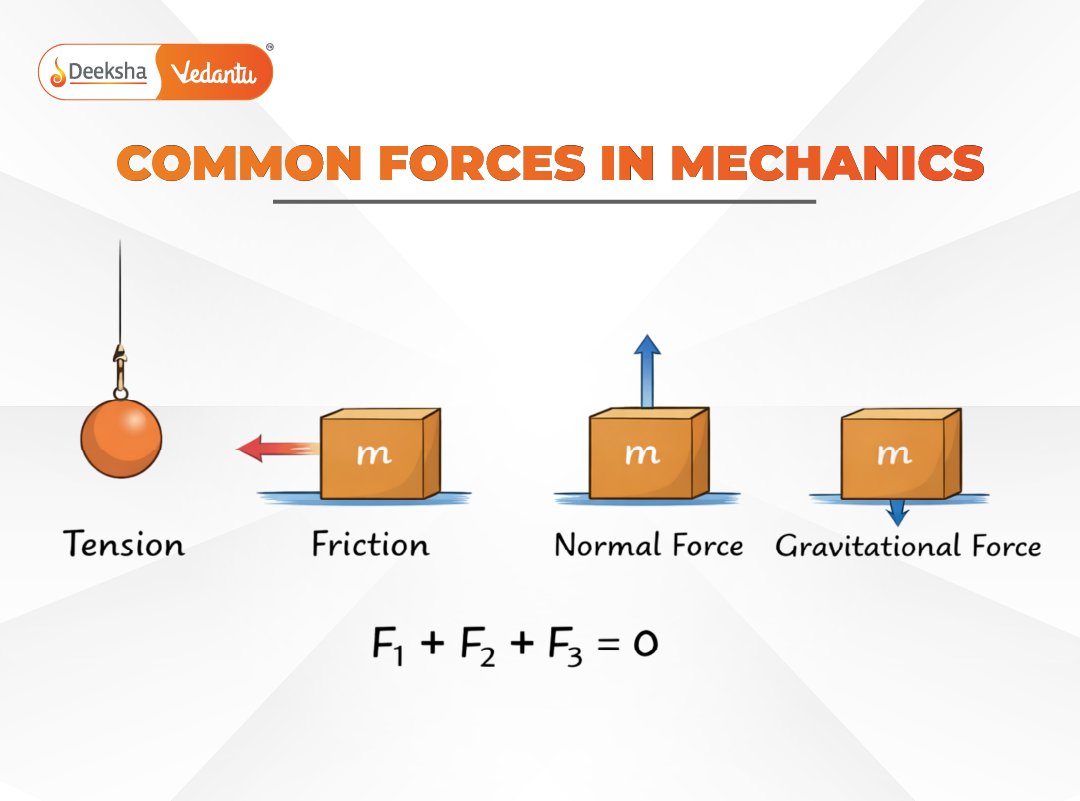
In mechanics, we encounter several kinds of forces in everyday life. Every object that we observe or interact with is influenced by the gravitational force of the Earth. Gravity is a non-contact force that acts at a distance without the need for any physical contact or intervening medium. Along with gravity, almost every real mechanical situation involves forces that arise due to direct contact between bodies.
Understanding the nature, origin, and characteristics of these commonly occurring forces is essential before applying Newton's Laws of Motion, conditions of equilibrium, or principles of dynamics. The correct identification of forces is the foundation for drawing accurate free body diagrams and analysing motion or equilibrium situations reliably. At Deeksha Vedantu, strong emphasis is placed on developing this skill early, as it forms the backbone of mechanics problem-solving for JEE.
Contact and Non-Contact Forces
Forces encountered in mechanics can be broadly classified based on whether physical contact between bodies is required.
Non-Contact Forces
Non-contact forces act without physical contact between interacting bodies. In classical mechanics, the most important non-contact force is the gravitational force. Gravitational force governs falling motion, projectile motion, planetary motion, and plays a role in almost all terrestrial phenomena.
Contact Forces
Contact forces arise only when two bodies are in physical contact with each other. These forces are extremely common in mechanical systems involving surfaces, strings, springs, supports, and constraints. Most forces encountered in mechanics problems belong to this category.
Gravitational Force (Weight)
The gravitational force exerted by the Earth on a body is called the weight of the body. This force always acts vertically downward, towards the centre of the Earth, irrespective of the body's motion or orientation.
The magnitude of weight is given by:

where  is the mass of the body and
  is the acceleration due to gravity.
Important points regarding weight:
- Weight acts at the centre of mass of the body
- It is independent of the state of motion of the body
- It provides the driving force for vertical motion, free fall, and frictional effects
- In equilibrium problems, weight is often balanced by normal reaction or tension
Normal Reaction Force
When a body is placed in contact with a surface, the surface exerts a contact force on the body. The component of this contact force that acts perpendicular to the surface of contact is known as the normal reaction.
Key characteristics of normal reaction:
- It always acts perpendicular to the surface
- Its magnitude adjusts automatically according to the situation
- It prevents interpenetration of the two bodies in contact
For a body resting on a horizontal surface in equilibrium:

However, on inclined planes or accelerating surfaces, the normal reaction is generally not equal to the weight and must be determined using force balance.
Tension in a String
Tension is the force exerted by a stretched or taut string, rope, or cable on the bodies attached to it. Tension arises due to the restoring forces within the material of the string when it is stretched.
Important features of tension:
- Tension always acts along the length of the string
- It always pulls the body; a string cannot push
- In an ideal string (massless, inextensible, and frictionless pulleys), the tension remains the same throughout
Tension is frequently encountered in systems of rigid bodies connected by strings and pulleys, making it a key force in mechanics problems.
Spring Force
When a spring is stretched or compressed, it exerts a restoring force that tends to bring it back to its natural, unstressed length.
According to Hooke's Law, for small deformations, the restoring force is proportional to the extension or compression:

Here,  is the spring constant and
  is the displacement from the natural length. The negative sign indicates that the spring force always acts opposite to the direction of displacement. This restoring nature of spring force is central to equilibrium situations and forms the basis of oscillatory motion.
Frictional Force
Friction is a contact force that arises when two surfaces are in contact and there is relative motion or a tendency of relative motion between them. Friction always opposes the relative motion or the impending motion between the surfaces.
Static Friction
Static friction acts when there is no relative motion between the surfaces but a tendency of motion exists. It is a self-adjusting force that increases with the applied force and can take any value up to a maximum known as the limiting friction.
Kinetic Friction
When the applied force exceeds the maximum value of static friction, the body begins to slide. The friction acting during relative motion is called kinetic friction. Kinetic friction is generally smaller than the maximum static friction.
Friction plays an essential role in daily life, enabling walking, gripping, braking, and controlled motion of vehicles.
Rolling Friction
When a body rolls over a surface, the resistive force encountered is called rolling friction. Rolling friction is much smaller than sliding friction, which is why wheels, rollers, and ball bearings are widely used in machines to reduce energy losses and wear.
Origin of Contact Forces
Although contact forces such as normal reaction, tension, friction, and spring force appear different in nature, they all fundamentally arise from electrical forces at the microscopic level between atoms and molecules of interacting bodies.
In nature, there are four fundamental forces: gravitational, electromagnetic, strong nuclear, and weak nuclear. In classical mechanics, only gravitational and electromagnetic forces are relevant. All contact forces are manifestations of electromagnetic interactions between charged particles at the atomic scale.
Free Body Diagrams and Force Identification
A free body diagram (FBD) is a visual representation of all the external forces acting on a body after isolating it from its surroundings. FBDs form the most important step in applying Newton's Laws correctly.
Guidelines for drawing free body diagrams:
- Include only forces acting on the chosen body
- Exclude reaction forces exerted by the body on other objects
- Clearly indicate the direction and point of application of each force
At Deeksha Vedantu, students are trained to list and analyse forces systematically before writing equations, which significantly reduces conceptual and numerical errors in JEE problems.
Importance of Common Forces in Mechanics for JEE
This topic is extremely important for JEE preparation because:
- Every mechanics problem begins with correct force identification
- Incorrect force representation leads to incorrect equations of motion
- It strengthens free body diagram skills
- It prepares students for advanced topics such as friction, circular motion, constraints, and rotational mechanics
Common Conceptual Errors (JEE Perspective)
Students often make mistakes such as:
- Assuming the normal reaction is always equal to the weight
- Ignoring the restoring nature and direction of spring force
- Misidentifying the direction of friction in impending motion cases
- Missing forces or adding non-existent forces in free body diagrams
Avoiding these errors improves accuracy, speed, and confidence in mechanics problem-solving.
FAQs
Q1. What are common forces in mechanics?
They are forces frequently encountered in mechanical systems such as weight, normal reaction, tension, friction, spring force, and rolling friction.
Q2. Is a normal reaction always equal to weight?
No. The normal reaction depends on the orientation of the surface and the motion of the body.
Q3. Why does friction oppose motion?
Friction opposes relative or impending motion due to interactions between microscopic surface irregularities.
Q4. Why is rolling friction smaller than sliding friction?
Because rolling significantly reduces relative motion between surfaces in contact.
Q5. Why is force identification important for JEE?
Because correct force identification is essential for drawing accurate free body diagrams and solving mechanics problems correctly.
Conclusion
Common forces in mechanics form the foundation of force analysis in physics. By developing a clear understanding of gravitational force, normal reaction, tension, spring force, friction, and rolling friction, students can analyse motion and equilibrium situations accurately. For JEE aspirants, mastery of these forces is essential for building strong conceptual foundations and solving mechanics problems with confidence. A structured, concept-driven approach, as emphasised at Deeksha Vedantu, ensures clarity, accuracy, and long-term success in competitive examinations.



Get Social