


Introduction
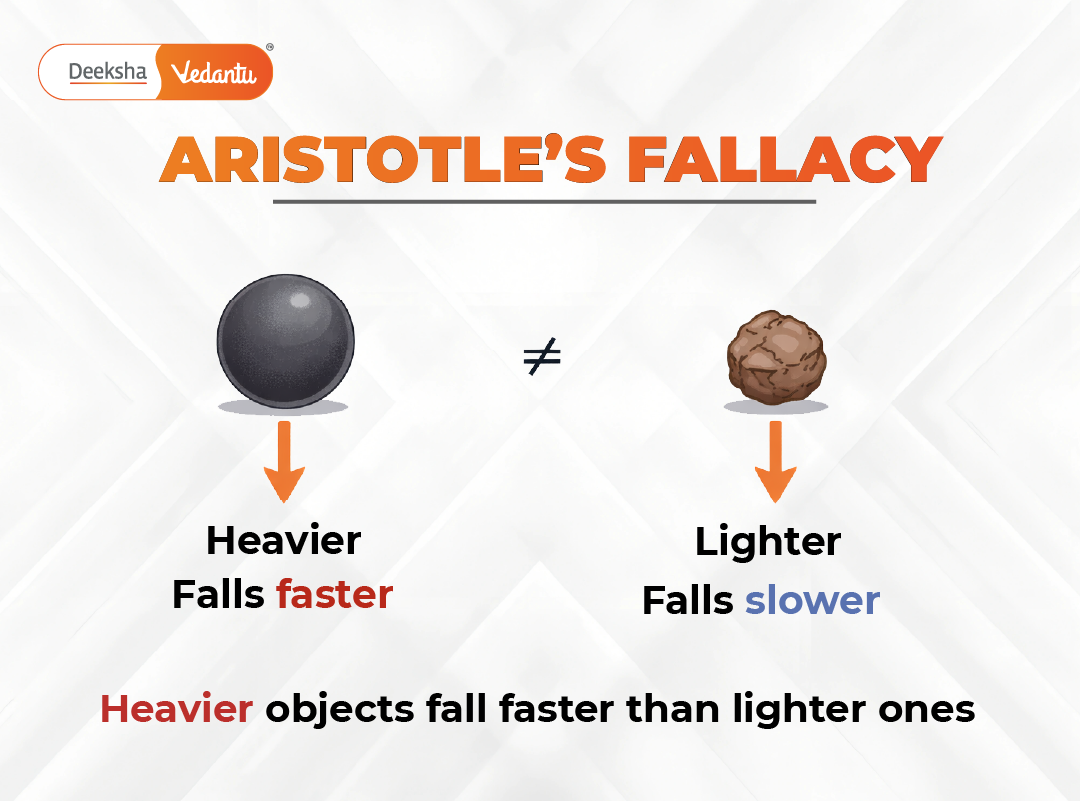
In the early development of ideas related to motion, several explanations were based on everyday observations rather than systematic experiments. One such idea, proposed by the Greek philosopher Aristotle, led to a major misconception about the nature of motion. This incorrect belief is known as Aristotle’s Fallacy.
Aristotle’s Fallacy plays an important role in understanding the evolution of mechanics because it highlights the difference between intuitive thinking and scientific reasoning. For JEE aspirants, studying this fallacy helps in developing a correct conceptual understanding of force, motion, and inertia. At Deeksha Vedantu, this topic is used to help students unlearn common intuitive errors and replace them with accurate physical principles.
Aristotle’s View on Motion
According to Aristotle, an external force is required to keep a body in motion. He believed that if the force acting on a body is removed, the body would naturally come to rest. In this view, continuous motion was possible only as long as a continuous force acted on the object.
Based on this reasoning, Aristotle explained motion in the following way:
- Objects remain at rest unless a force is applied
- Objects in motion require a continuous force to keep moving
- Heavier objects require a greater force to move with the same speed
These ideas appeared reasonable because they matched everyday experiences such as pushing a cart or rolling a ball on the ground.
What Is Aristotle’s Fallacy?
Aristotle’s Fallacy refers to the incorrect belief that a force is necessary to maintain motion. The fallacy lies in assuming that motion naturally stops when the applied force is removed.
This belief arises from observing motion in the presence of resisting forces like friction and air resistance. When a force is removed, objects slow down and eventually stop, leading to the mistaken conclusion that force is required to sustain motion.
Why Aristotle’s Reasoning Was Incorrect
The error in Aristotle’s reasoning lies in ignoring the role of opposing forces. In real-life situations, surfaces are rough and air resistance is present. These forces oppose motion and cause objects to slow down.
If these resisting forces were absent, an object once set in motion would continue to move with constant velocity indefinitely. Thus, it is not the absence of force that causes an object to stop, but the presence of opposing forces.
This distinction between maintaining motion and changing motion is fundamental to mechanics.
Role of Friction in Creating the Fallacy
Friction plays a key role in reinforcing Aristotle’s Fallacy. When an object moves on a rough surface, friction acts opposite to the direction of motion and gradually reduces its speed.
Because friction is almost always present in daily life, it creates the illusion that motion requires a continuous force. However, friction is not responsible for motion itself; instead, it resists motion.
Understanding the role of friction helps clarify why Aristotle’s conclusions, though intuitive, were physically incorrect.
Correction of Aristotle’s Fallacy
The incorrect ideas proposed by Aristotle were later challenged through careful experimentation and reasoning. Scientists showed that the natural tendency of a body is not to come to rest, but to continue in its state of motion unless acted upon by an external force.
This correction laid the foundation for the modern understanding of motion and inertia.
Connection to the Law of Inertia
The resolution of Aristotle’s Fallacy led to the formulation of the Law of Inertia, which states that a body remains at rest or in uniform straight-line motion unless acted upon by a net external force.
This principle explains that force is required to change the state of motion, not to maintain it. Uniform motion does not require any force when no opposing forces are present.
This idea is central to Newton’s First Law of Motion and forms the basis of classical mechanics.
Importance of Aristotle’s Fallacy for JEE
Understanding Aristotle’s Fallacy is important for JEE preparation because:
- It strengthens conceptual clarity regarding force and motion
- It explains why force is not needed to maintain uniform motion
- It helps in correctly applying Newton’s First Law
- It prevents common conceptual mistakes in mechanics problems
At Deeksha Vedantu, special emphasis is placed on identifying and correcting such misconceptions early in preparation.
Common Misconceptions Among Students
Students often subconsciously believe ideas similar to Aristotle’s Fallacy, such as:
- A moving object must have a force acting in the direction of motion
- Motion naturally dies out when force is removed
- Greater speed always requires greater force
Recognising these misconceptions helps in building a strong foundation in mechanics.
FAQs
Q1. What is Aristotle’s Fallacy?
It is the incorrect belief that a continuous external force is required to keep a body in motion.
Q2. Why did Aristotle believe force is required to maintain motion?
Because he observed motion in the presence of friction and resistance, which cause objects to slow down.
Q3. What is the main mistake in Aristotle’s reasoning?
He ignored the role of opposing forces such as friction and air resistance.
Q4. How was Aristotle’s Fallacy corrected?
Through experimental observations showing that objects continue moving in the absence of opposing forces.
Q5. Why is this concept important for JEE?
Because it forms the conceptual basis of Newton’s First Law and helps avoid common errors in mechanics problems.
Conclusion
Aristotle’s Fallacy highlights how intuitive reasoning based on everyday experience can sometimes lead to incorrect conclusions in physics. The modern understanding of motion shows that force is not required to maintain uniform motion, but only to change it. For JEE aspirants, clearly understanding and rejecting this fallacy is essential for mastering the Laws of Motion. A concept-driven approach, as followed at Deeksha Vedantu, ensures strong fundamentals and accurate problem-solving in mechanics.



Get Social