
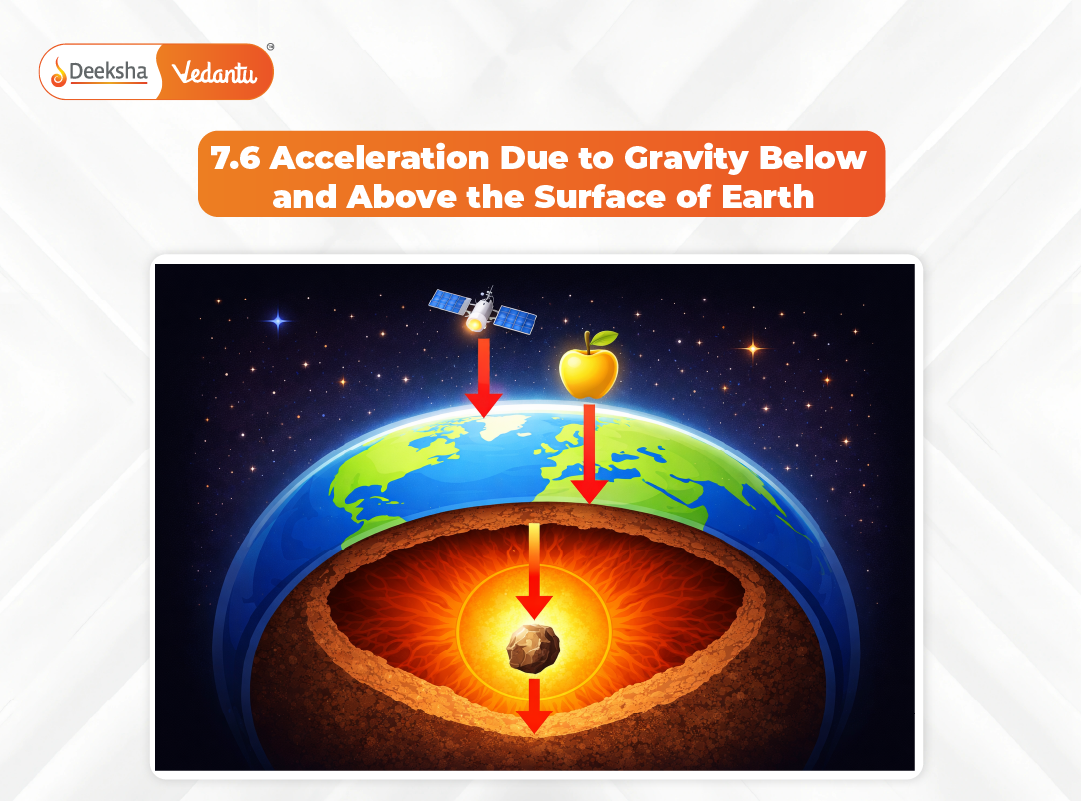


Acceleration due to gravity is not constant everywhere. While we often approximate  near Earth's surface, its actual value depends on the distance from the Earth's center. As we move upward (altitude) or downward (depth), the gravitational acceleration changes according to well-defined mathematical relations.
This topic is extremely important for JEE Main and JEE Advanced because many conceptual, graphical, and multi-step numerical problems are based on the variation of  with position.
In this section, we will:
- Derive the exact expression for variation of
 with height
 - Derive the expression for variation of with depth
- Compare inside and outside behavior
- Analyze graphical representation
- Connect depth variation with simple harmonic motion
- Solve important proportional and JEE-style problems
1. Variation of g Above Earth's Surface (With Altitude)
Consider a body at a height  above Earth's surface.
Distance from Earth's center becomes:

Where:
 = Radius of Earth
 = Height above surface
 = Radius of Earth
From Newton's Universal Law of Gravitation, gravitational acceleration at that height is:

At Earth's surface:

Taking ratio:

This is the exact expression for variation of gravity with height.
1.1 Approximation for Small Heights
If  , we use binomial approximation:

Thus:

Important conclusion:
For small heights, gravity decreases approximately linearly with height, and the fractional decrease is twice the fractional increase in height.
1.2 Special Numerical Case
If  :
:

Thus at a height equal to Earth's radius, gravity becomes one-fourth of its surface value.
1.3 Physical Interpretation
- As height increases, distance from Earth's center increases.
- Since gravitational force follows inverse square law, decreases rapidly with altitude.
- At very large distances, approaches zero asymptotically.
This explains why satellites still experience gravitational pull even though astronauts feel weightless – they are in continuous free fall.
2. Variation of g Below Earth's Surface (With Depth)
Now consider a body at depth  below Earth's surface.
Distance from Earth's center becomes:

Inside Earth, gravitational force depends only on the mass enclosed within radius  .
.
Assuming Earth has uniform density, enclosed mass is proportional to volume:

Acceleration at radius becomes:

Substituting for  :
:

Since surface gravity is:
We get:

Replacing :

This is the exact linear variation inside Earth (assuming uniform density).
2.1 Important Conclusions for Depth Variation
- decreases linearly with depth.
- At Earth's center (
 ),
),
 ),
),
This occurs due to perfect symmetry – gravitational forces cancel in all directions.
2.2 Example Calculation
If  :
:

Thus gravity becomes half of its surface value at half-radius depth.
3. Combined Graph of Variation
The variation of with radial distance from Earth's center is:
- Linear increase from center to surface
- Maximum at surface
- Inverse square decrease outside surface
Graphically:
- From
 to
to  : straight line
 - From outward: curved decreasing function
 to
to  : straight line
This combined graph is a favorite JEE Advanced conceptual question.
4. Comparison Between Height and Depth Variation
For small values:
At height :
At depth :
Thus:
- Gravity decreases twice as fast (fractionally) with height compared to depth.
- Depth variation is linear.
- Height variation follows inverse square behavior.
5. Connection with Simple Harmonic Motion (Advanced Insight)
Inside Earth:

Thus force on mass  becomes:

This resembles restoring force form:

Thus motion of a particle inside a frictionless tunnel through Earth behaves like simple harmonic motion.
Angular frequency:

Time period:

Remarkably, this time period is equal to the orbital period of a low Earth satellite.
This is an advanced conceptual connection frequently tested in JEE Advanced.
6. JEE-Oriented Numerical Illustration
If a satellite orbits at height , then:

Orbital speed becomes:

These proportional manipulations save significant time in objective exams.
7. Conceptual JEE Insights
- Gravity decreases more rapidly with height than with depth.
- At Earth's center, weight becomes zero but mass remains unchanged.
- Inside Earth, gravitational force behaves like restoring force.
- Satellite motion occurs in reduced but non-zero gravity.
- Variation graphs are commonly asked in matching-type questions.
FAQs
Q1. Why does g decrease with height?
Because gravitational force decreases with increasing distance from Earth's center according to inverse square law.
Q2. Why does g decrease linearly with depth?
Because only enclosed mass contributes, and enclosed mass decreases proportionally with radius under uniform density assumption.
Q3. Why is g zero at Earth's center?
Because gravitational pulls from all directions cancel symmetrically.
Q4. Why do astronauts feel weightless if gravity exists in orbit?
Because they are in continuous free fall along with their spacecraft.
Q5. Why is motion inside Earth similar to SHM?
Because gravitational force inside Earth is proportional to displacement from center.
Conclusion
Acceleration due to gravity varies significantly as we move above or below Earth's surface. Outside Earth, it follows inverse square law. Inside Earth, it decreases linearly with depth (under uniform density assumption).
The combined graphical interpretation and the SHM connection inside Earth make this topic conceptually rich and highly important for JEE Main and JEE Advanced.
Mastering these variations enables students to solve multi-step gravitational and orbital problems efficiently while developing a deeper understanding of central force motion.



Get Social