
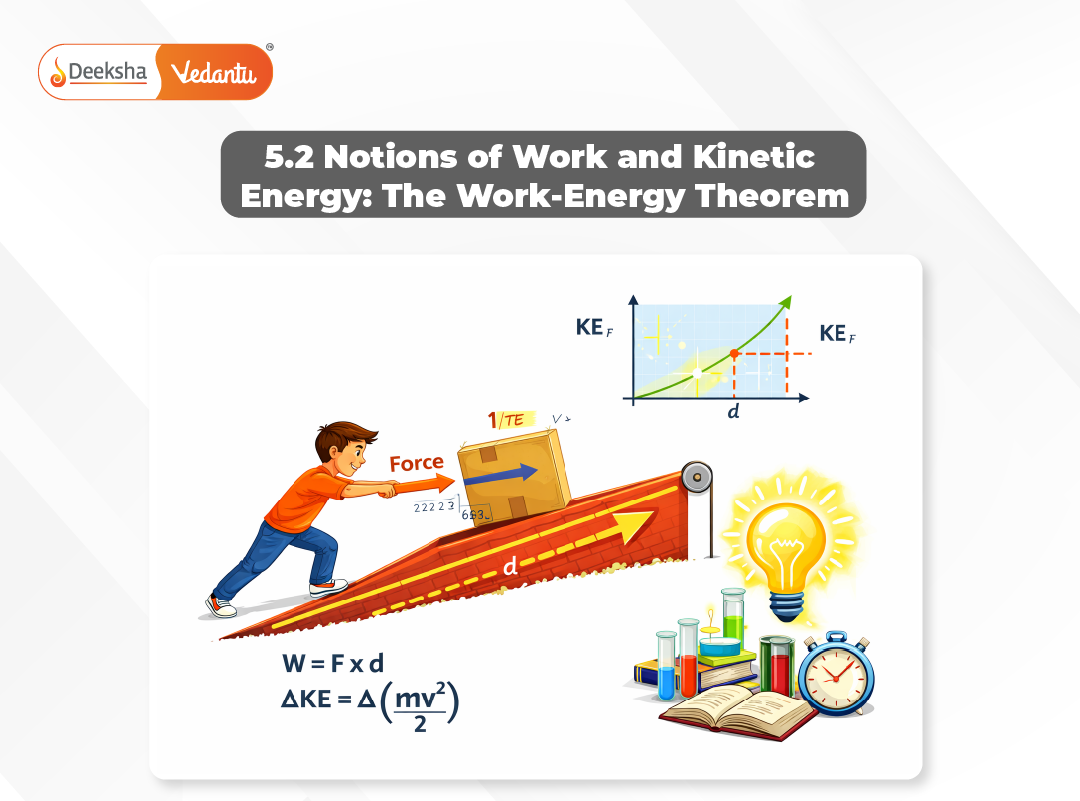


Section 5.2 is one of the most important conceptual and mathematical sections in the entire chapter of Work, Energy and Power. While 5.1 introduced energy as the capacity to do work, this section establishes the rigorous mathematical connection between force, displacement, and kinetic energy. The central outcome of this section is the derivation and understanding of the Work-Energy Theorem.
At Deeksha Vedantu, we emphasize not only memorising the formula but understanding how it emerges directly from Newton's Laws. This clarity becomes extremely powerful in board exams and competitive exams like JEE and NEET.
Revisiting the Definition of Work
Work is defined as the scalar product of force and displacement. Only the component of force along the direction of displacement contributes to work.

Where:
 = magnitude of applied force
 = displacement
 = angle between force and displacement
Important Observations
- If
 , then
  (maximum work)
 - If
 , then
  (no work)
 - If
 , then
  (negative work)
 , then
  (maximum work)
 , then
  (no work)
 , then
  (negative work)
This definition immediately tells us that work is a scalar quantity.
Connecting Newton's Second Law to Energy
To derive kinetic energy mathematically, we start with Newton's Second Law:

From kinematics, we know:

Rearranging:

Substituting into Newton's Second Law:

Multiplying both sides by :

But  is work done.
Thus,

This equation leads directly to the definition of kinetic energy.
Definition of Kinetic Energy
Kinetic energy is the energy possessed by a body due to its motion.

The change in kinetic energy is therefore:

This shows that work done on a body changes its kinetic energy.
Statement of the Work-Energy Theorem
The Work-Energy Theorem states:
The net work done on a particle equals the change in its kinetic energy.

Or,

This theorem applies whether the force is constant or variable.
Derivation Using Calculus
For variable force, we use differential form.
From Newton's Second Law:

Multiply both sides by velocity  :
:

But  , so:
, so:

Multiplying by  :
:

Integrating both sides:

Thus,

This proves that the theorem holds even for variable forces.
Graphical Interpretation
Work done equals the area under the force-displacement graph.
If the graph is linear, work equals triangular area. If non-linear, integration is required. This interpretation is important in JEE problems involving graphical data.
Physical Interpretation of the Theorem
- If net work is positive, kinetic energy increases.
- If net work is negative, kinetic energy decreases.
- If net work is zero, kinetic energy remains constant.
For example, when friction acts opposite to motion, work done by friction is negative, reducing kinetic energy.
Special Cases
Object Starting from Rest
If  :
:

All work done becomes kinetic energy.
Object Brought to Rest
If  :
:

Negative work removes kinetic energy.
Motion with Constant Velocity
If  :
:

This explains why no net work is done when velocity remains constant.
Applications in Real Systems
The Work-Energy Theorem is widely used in:
- Motion on inclined planes
- Systems with friction
- Blocks connected by strings
- Vertical motion under gravity
- Spring-block systems
In many cases, solving using Newton's Laws becomes lengthy. Energy methods reduce complexity.
Comparison: Newton's Method vs Work-Energy Method
| Newton's Method | Energy Method |
| Uses | Uses |
| Vector calculations | Scalar calculations |
| Step-by-step analysis | Direct initial-final comparison |
| Time-consuming | Time-efficient |
For competitive exams, the energy method is often superior.
Conceptual Errors to Avoid
Students frequently make mistakes such as:
- Confusing work with force
- Ignoring the cosine factor
- Forgetting that net work must be considered
- Applying energy conservation when non-conservative forces exist
- Mixing vector reasoning with scalar equations
Clarity in fundamentals prevents these errors.
Importance for JEE and NEET
This section frequently generates:
- MCQs on work sign
- Numerical problems on inclined planes
- Friction-based stopping distance problems
- Variable force integration questions
- Graph-based work calculations
Almost every advanced mechanics chapter uses the Work-Energy Theorem.
Key Formula Summary
| Concept | Formula |
| Work | |
| Kinetic Energy | |
| Change in KE | |
| Work-Energy Theorem | |
| Variable Force Work |  |
FAQs
Q1. What does the Work-Energy Theorem state?
— Net work done equals change in kinetic energy.
Q2. Does it apply to variable forces?
Yes. Using , the theorem holds for variable forces.
Q3. Can work be negative?
Yes. When force opposes displacement, work is negative.
Q4. Is kinetic energy a vector?
No. Kinetic energy is a scalar quantity.
Q5. Why is this theorem powerful in competitive exams?
Because it simplifies multi-force problems into direct energy comparisons, reducing calculation time.
Conclusion
Section 5.2 establishes the fundamental bridge between force and energy. The Work-Energy Theorem is one of the most powerful analytical tools in mechanics. At Deeksha Vedantu, we ensure students master both the derivation and its applications so that they can confidently handle board-level and competitive-level problems.



Get Social