
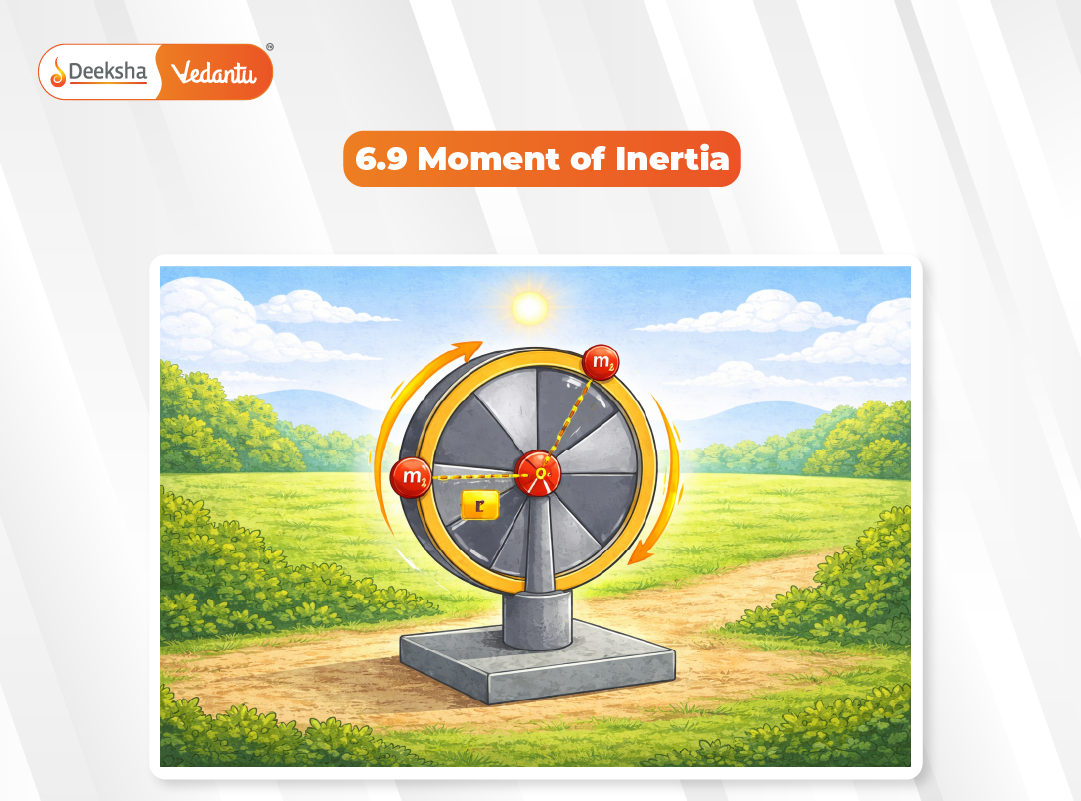


After studying torque and angular momentum, we now arrive at one of the most central quantities in rotational mechanics — the moment of inertia. Just as mass determines resistance to change in linear motion, moment of inertia determines resistance to change in rotational motion.
However, unlike mass, moment of inertia does not depend only on the amount of matter present. It depends strongly on how that mass is distributed relative to the axis of rotation. This dependence on geometry makes it one of the most conceptually rich topics in rotational dynamics.
Moment of inertia is deeply connected with angular acceleration, rotational kinetic energy, rolling motion, conservation of angular momentum, and rigid body dynamics. For JEE Main and JEE Advanced, this topic carries very high importance.
1. Rotational Analogy with Linear Motion
In translational motion, Newton's second law is:

Here mass  measures resistance to change in linear velocity.
In rotational motion, the corresponding equation becomes:

Where:
 is torque
 is angular acceleration
 is moment of inertia
 is torque
 is angular acceleration
Thus moment of inertia plays the same role in rotation that mass plays in translation.
Greater  means smaller angular acceleration for the same torque.
2. Definition of Moment of Inertia
2.1 Discrete System
For a system of particles rotating about a fixed axis:

Where:
 is mass of the
  particle
 is perpendicular distance from axis
 is mass of the
  particle
 is perpendicular distance from axis
Each mass contributes proportionally to the square of its distance from the axis.
2.2 Continuous Body
For a continuous mass distribution:

This integral form is used to derive standard results.
Important observation:
Mass farther from the axis contributes much more due to the square dependence.
3. Physical Interpretation
- If mass is concentrated near the axis → small .
- If mass is distributed far from the axis → large .
- For the same mass and radius, a ring has greater than a disc.
This explains why flywheels are designed with mass concentrated at the rim.
4. Radius of Gyration
Moment of inertia can be expressed as:

Where:
 is total mass
 is radius of gyration
 is radius of gyration
Thus,

The radius of gyration represents the distance from the axis at which the entire mass could be assumed concentrated without changing the moment of inertia.
This concept simplifies comparison of bodies.
5. Derivation: Uniform Thin Rod About Centre
Let rod length be  and mass
  .
.
Linear mass density:

Take the element at distance  from the centre.

Moment of inertia:

Substitute:

Solving:

This is a standard result.
6. Derivation: Uniform Disc About Central Axis
Consider the disc of radius  and mass .
Surface mass density:

Take a thin ring of radius  and thickness
  .
.
Area of ring:

Mass element:

Moment of inertia:
Substitute:


Evaluating integral:

Substituting  :
:

7. Standard Results (High-Yield for JEE)
Thin Rod (centre):
Thin Rod (end):

Ring (central axis):

Disc (central axis):
Solid Sphere (diameter):

Hollow Sphere (diameter):

Rectangular Lamina (about centre):

8. Parallel Axis Theorem
If  is moment of inertia about centre of mass axis, then about a parallel axis at distance
  :
:

This theorem saves integration effort.
Example: Rod about end

9. Perpendicular Axis Theorem
For planar lamina in xy-plane:

Applicable only to flat bodies.
For disc:

Thus:

10. Rotational Kinetic Energy
Rotational kinetic energy is:

For rolling without slipping:

Total kinetic energy:

Substituting:

Thus acceleration of the rolling body depends on its moment of inertia.
11. Acceleration of Rolling Bodies Down Incline
For body rolling down incline:

For ring:

For disc:

Thus the disc accelerates faster than the ring.
12. Angular Momentum of Rigid Body
For rigid body rotating about fixed axis:

If no external torque:

This explains the ice-skater problem and collapsing stars.
13. Advanced JEE Insights
- Moment of inertia is minimum about the centre of mass axis.
- Shifting axis increases .
- Symmetry simplifies integration.
- Combine energy conservation and rotational equations in rolling problems.
- Compare
 ratios for ranking accelerations.
 ratios for ranking accelerations.
Many JEE Advanced problems mix rotational kinetic energy, conservation laws, and rolling constraints.
FAQs – 6.9 Moment of Inertia
Q1. What is the moment of inertia?
Moment of inertia is defined as and measures resistance to rotational acceleration.
Q2. Does moment of inertia depend on the axis?
Yes. Changing the axis changes perpendicular distances and hence changes .
Q3. What is the radius of gyration?
It is defined by and represents an equivalent distance from the axis.
Q4. Why is the moment of inertia minimum about the centre of mass axis?
Because parallel axis theorem shows any shift adds positive term  .
.
Q5. Why does a ring roll slower than a disc?
Because the ring has a larger moment of inertia  , so less translational acceleration.
Conclusion
Moment of inertia is the rotational analogue of mass and governs angular acceleration, rotational kinetic energy, and angular momentum.
The key relations
form the core of rigid body dynamics.
A deep understanding of mass distribution, axis theorems, and rolling motion applications is essential for mastering advanced rotational mechanics in JEE examinations.



Get Social