
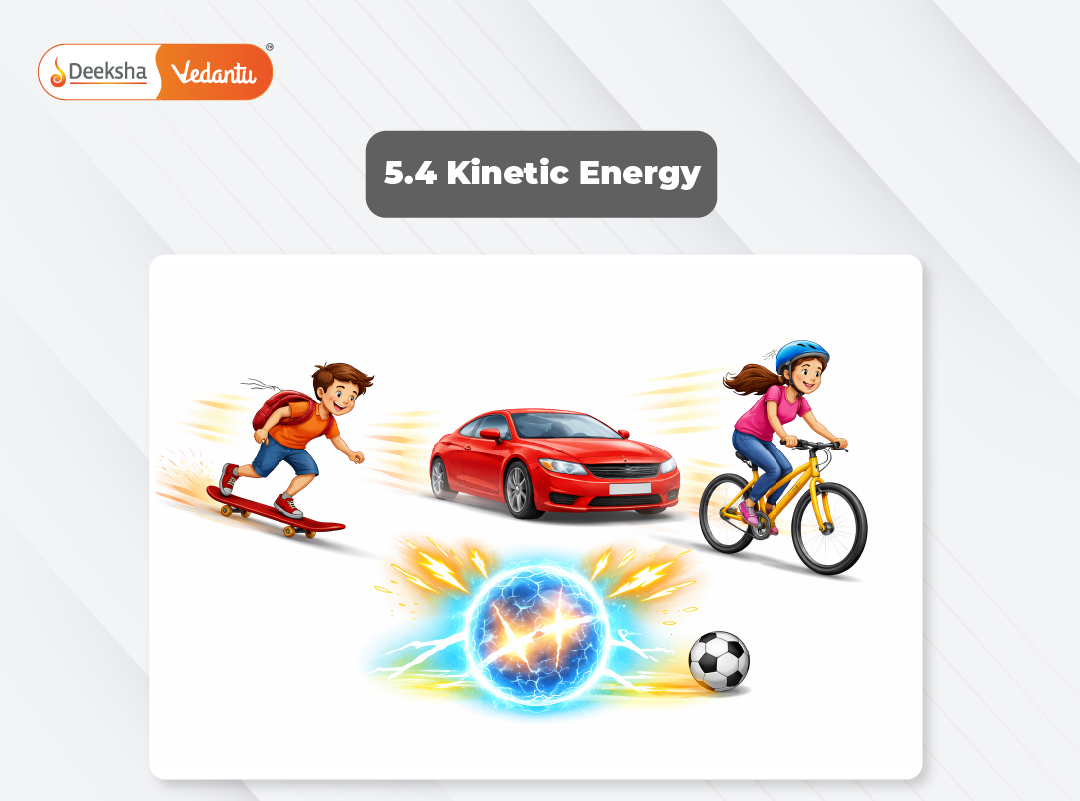


Section 5.4 develops a deeper and more rigorous understanding of kinetic energy, one of the most fundamental concepts in mechanics. While Section 5.2 established the Work–Energy Theorem and introduced the mathematical expression for kinetic energy, this section expands the concept, explores its properties, connects it with momentum, and applies it to multiple real-life and exam-oriented situations.
At Deeksha Vedantu, we emphasize conceptual clarity over rote memorization. Kinetic energy is not just a formula; it is a measurable representation of motion itself. Understanding its derivation, behavior under different physical situations, and limitations prepares students for advanced mechanics, collision theory, rotational motion, and energy conservation principles.
Definition of Kinetic Energy
Kinetic energy is defined as the energy possessed by a body due to its motion.
Mathematically,

Where:
 = mass of the body
 = velocity of the body
Since velocity is squared, kinetic energy is always non-negative. Even if velocity direction changes, kinetic energy remains positive because it depends on  .
.
This makes kinetic energy a scalar quantity.
Derivation of Kinetic Energy from Newton's Laws
To understand the origin of this expression, we derive it using Newton's Second Law.
From Newton's Second Law:

From kinematics:

Rearranging for acceleration:

Substituting into :

Multiplying both sides by displacement  :
:

But  represents work done.
Thus,

This shows that work done on a body equals change in its kinetic energy.
Hence we define:
And change in kinetic energy:

This derivation proves that kinetic energy emerges naturally from Newtonian mechanics.
Alternative Derivation Using Calculus (Advanced View)
Starting from:

Multiply both sides by velocity :

Since  ,
,

Multiplying by  :
:

Integrating:

Thus,

This proves the Work–Energy Theorem for variable forces.
Important Properties of Kinetic Energy
1. Scalar Nature
Although velocity is a vector, kinetic energy is scalar because it depends on .
2. Always Non-Negative
 always.
3. Depends on Square of Velocity
If velocity becomes  :
:

Thus, kinetic energy increases four times.
This quadratic dependence explains why high-speed vehicles have disproportionately large energy.
4. Linear Dependence on Mass
If mass doubles while velocity remains same:

Mass dependence is linear; velocity dependence is quadratic.
Relation Between Kinetic Energy and Momentum
Momentum is defined as:

Expressing velocity as:

Substituting into kinetic energy formula:


This form is extremely useful in collision problems and advanced JEE numericals.
Kinetic Energy of a System of Particles
If a system contains multiple particles:

Kinetic energy is additive for systems.
This concept is extended in rotational motion and center of mass theory.
Kinetic Energy in Different Physical Situations
Free Fall Motion
If a body falls from height  (ignoring air resistance):

This gives velocity at ground level.
Motion on an Inclined Plane
Loss in potential energy equals gain in kinetic energy (if no friction).
Braking Distance Under Friction
Friction does negative work equal to initial kinetic energy:

This formula is used to calculate stopping distance.
Spring-Block Systems
When a block compresses a spring:

Kinetic energy converts into elastic potential energy.
Kinetic Energy in Collisions
Elastic Collision

Both momentum and kinetic energy are conserved.
Inelastic Collision
Momentum conserved, kinetic energy not conserved.
Energy is transformed into heat, sound, or deformation.
This distinction is extremely important in JEE.
Graphical Interpretation via Work
Since:

Area under force-displacement graph equals change in kinetic energy.
Thus, graphical work problems directly relate to kinetic energy change.
Dimensional Formula of Kinetic Energy

Same as work and potential energy.
Units of Kinetic Energy
SI Unit:

CGS Unit:

Conceptual Insights for Competitive Exams
- Velocity dependence is quadratic.
- Momentum conservation does not imply energy conservation.
- Energy conservation requires absence of non-conservative forces.
- Negative work reduces kinetic energy.
These ideas frequently appear in tricky MCQs.
Common Mistakes to Avoid
- Forgetting square of velocity
- Confusing
 and
and 
- Applying energy conservation in presence of friction incorrectly
- Assuming kinetic energy is vector
 and
and 
Careful reasoning prevents conceptual errors.
Key Formula Summary
| Concept | Formula |
| Kinetic Energy | |
| Change in KE | |
| Momentum Relation | |
| Work–Energy Relation | |
| Free Fall Relation | |
FAQs
Q1. What is the formula for kinetic energy?
Q2. Why is kinetic energy always positive?
Because it depends on , which is always non-negative.
Q3. What happens to kinetic energy if velocity doubles?
It happens four times.
Q4. Is kinetic energy conserved in all collisions?
No. Only in elastic collisions.
Q5. Why is kinetic energy important for competitive exams?
Because it forms the basis of collision problems, energy conservation, braking distance, and motion analysis questions.
Conclusion
Section 5.4 builds a complete and mathematically rigorous understanding of kinetic energy. From its derivation using Newton's laws to its applications in collisions, spring systems, and gravitational motion, kinetic energy serves as a central pillar of mechanics.
At Deeksha Vedantu, we ensure students move beyond memorizing and truly understand its derivation, physical meaning, and exam-level applications. This clarity becomes the foundation for mastering advanced topics like conservation of mechanical energy, power, and rotational dynamics.



Get Social