
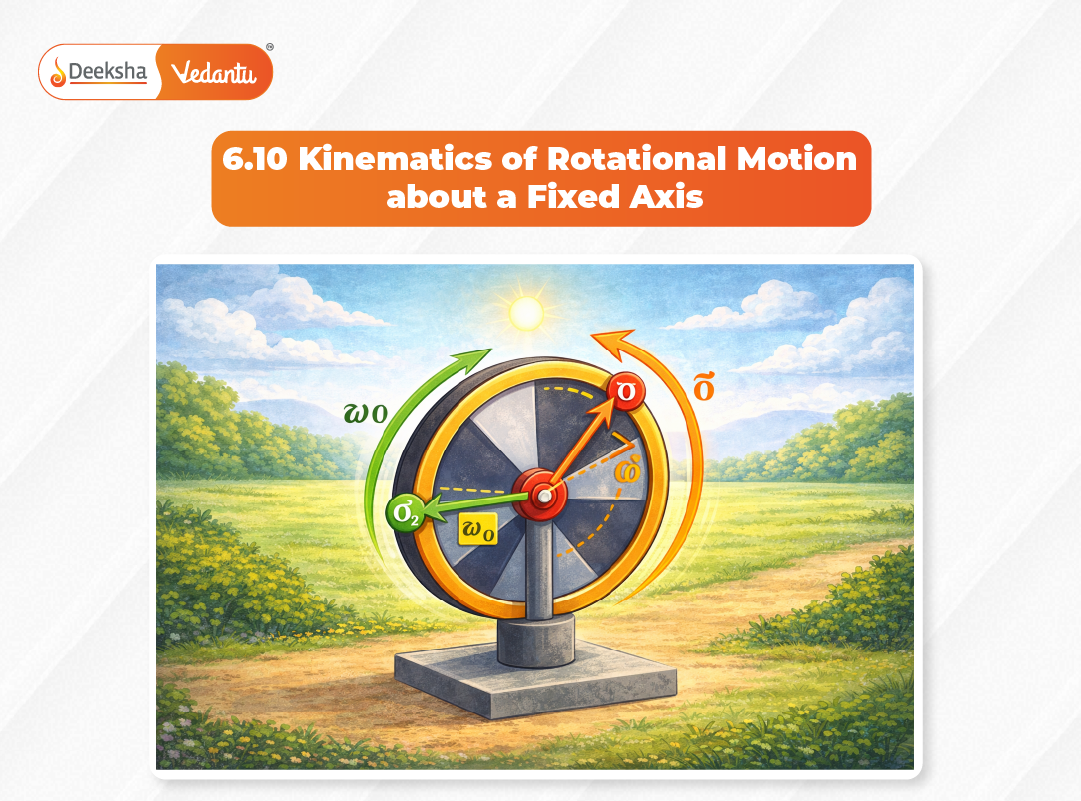


After developing the ideas of torque and moment of inertia, we now study the kinematics of rotational motion about a fixed axis. Kinematics deals only with motion — it describes how angular displacement, angular velocity, and angular acceleration change with time, without discussing the forces or torques causing them.
Just as linear kinematics forms the foundation of translational motion, rotational kinematics forms the mathematical backbone of rigid body dynamics. A clear understanding of these relationships is essential before studying rotational dynamics, rolling motion, and energy methods in advanced problems.
This section builds a one-to-one correspondence between linear motion and rotational motion. These parallels are extremely powerful and frequently tested in JEE Main and JEE Advanced.
1. Angular Displacement
When a rigid body rotates about a fixed axis, every particle of the body moves in a circular path whose centre lies on the axis of rotation.
If the body rotates through an angle  , this angle is called angular displacement.
Angular displacement is measured in radians. One radian is defined as the angle subtended at the centre of a circle by an arc whose length equals the radius.
The fundamental relation connecting linear and angular displacement is:

Where:
 is the arc length
 is the distance from axis
 is angular displacement in radians
Important observations:
- All particles of a rigid body undergo the same angular displacement.
- Linear displacement depends on distance from axis.
- Angular displacement is dimensionless (radian has no physical dimension).
For small angular displacement, is approximately equal to  .
.
2. Angular Velocity
Angular velocity is defined as the rate of change of angular displacement:

It is a vector quantity.
Direction is determined by the right-hand rule. Curl the fingers of your right hand in the direction of rotation; the thumb gives the direction of angular velocity vector.
Unit: rad/s.
2.1 Average Angular Velocity

2.2 Instantaneous Angular Velocity

2.3 Relation with Linear Velocity
For a particle at distance  from axis:

This shows:
- Linear speed increases with distance from axis.
- Angular velocity is same for all particles.
In full vector form:

This cross-product expression ensures velocity is tangential to circular path.
3. Angular Acceleration
Angular acceleration is defined as the rate of change of angular velocity:

Unit: rad/s².
3.1 Average Angular Acceleration

3.2 Instantaneous Angular Acceleration

If  is constant, the motion is uniformly accelerated rotational motion.
4. Linear Acceleration of a Point in a Rotating Body
A particle in rotational motion has two acceleration components.
4.1 Tangential Acceleration
Due to change in angular velocity:

This changes the magnitude of linear velocity.
4.2 Centripetal (Radial) Acceleration
Due to change in direction of velocity:

Directed toward the centre.
4.3 Total Acceleration
Since tangential and centripetal components are perpendicular:

Thus rotational motion combines linear and circular motion principles.
5. Rotational Equations of Motion (Constant Angular Acceleration)
The equations of rotational motion are directly analogous to linear equations.
5.1 First Equation

5.2 Second Equation

5.3 Third Equation

Where:
 is initial angular velocity
 is final angular velocity
- is constant angular acceleration
- is angular displacement
 is initial angular velocity
These equations are valid only when angular acceleration is constant.
6. Analogy Between Linear and Rotational Quantities
Linear Quantity → Rotational Analogue
 →
→
 →
→ 
 →
→
 →
→ 
 →
→ 
 →
→ 
This analogy simplifies learning and helps solve mixed problems.
7. Uniform Circular Motion as Special Case
If angular velocity is constant:

But centripetal acceleration still exists:
Thus even without angular acceleration, velocity direction changes continuously.
8. Time Period, Frequency and Angular Velocity
If time period is  :
:

Frequency  is:
is:

Thus:

This relation is important in circular motion and SHM.
9. Rolling Motion Connection
For rolling without slipping:

If angular acceleration exists:

These constraints connect translational and rotational motion.
Rolling problems combine rotational kinematics with Newton's laws or energy conservation.
10. Advanced JEE Applications
10.1 Rotating Disc with Increasing Speed
If is constant:
Linear displacement of rim point:
10.2 Particle at Rim with Both Accelerations
Magnitude:

Such vector combinations are common in JEE Advanced.
10.3 Multi-Step Concept
If angular velocity varies linearly with time:

Then:

Angular displacement:

This shows how calculus connects with rotational kinematics.
11. Important Conceptual Points
- Angular quantities are the same for all particles of a rigid body.
- Linear quantities depend on distance from the axis.
- Centripetal acceleration exists even when angular velocity is constant.
- Rotational equations are valid only for constant angular acceleration.
- Rolling condition must be checked before applying
 .
.
 .
.FAQs
Q1. What are the three rotational equations of motion?
They are:
Q2. How is linear velocity related to angular velocity?
Through .
Q3. What are the components of acceleration in rotational motion?
Tangential:
Centripetal:
Q4. When can rotational equations be used?
Only when angular acceleration is constant.
Q5. Why do outer points move faster in rotation?
Because linear speed depends on radius through .
Conclusion
Kinematics of rotational motion about a fixed axis establishes the mathematical structure of angular displacement, angular velocity, and angular acceleration.
The fundamental equations
form the basis for analyzing rotational motion before introducing torque and dynamics.
A strong conceptual understanding of these relation



Get Social