
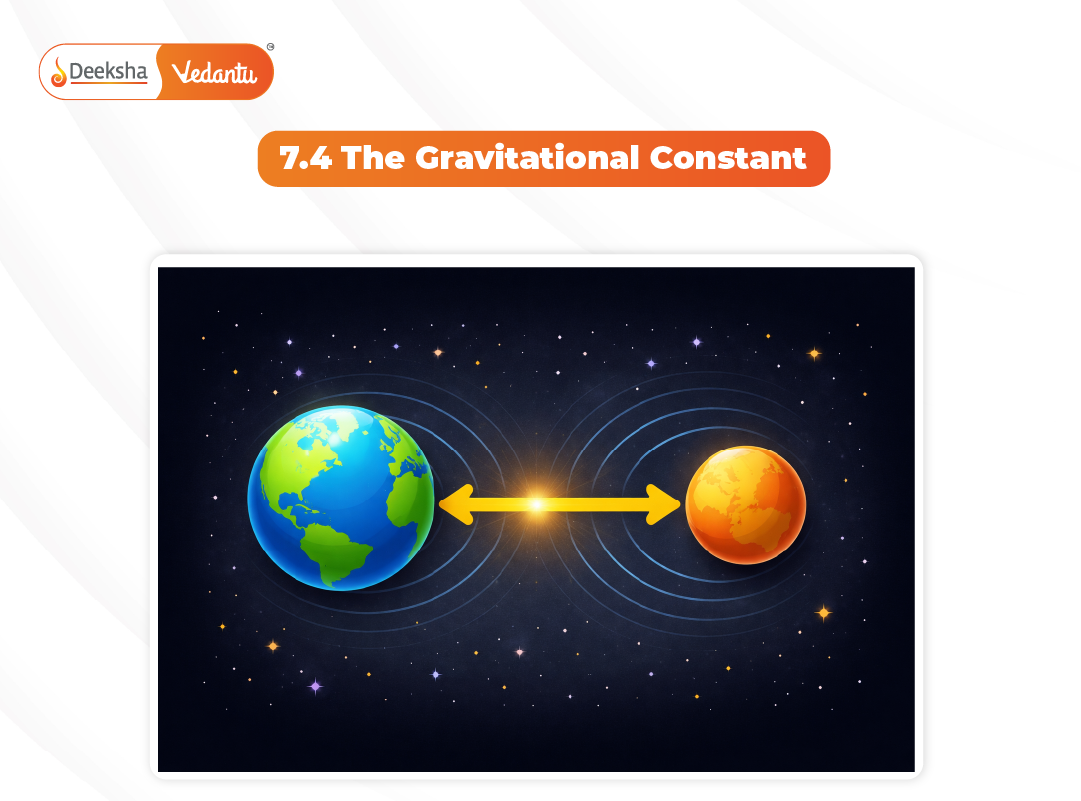


The gravitational constant, denoted by  , is one of the most fundamental constants in classical physics. It appears in Newton's Universal Law of Gravitation and determines the strength of the gravitational interaction between two masses. Although Newton formulated the law of gravitation in 1687, the numerical value of was not known during his lifetime. It was experimentally measured more than a century later by Henry Cavendish in 1798.
The constant plays a central role in astrophysics, planetary science, satellite mechanics, and cosmology. Without knowing its value, we would not be able to determine the mass of Earth, the mass of the Sun, or predict satellite motion accurately.
For JEE Main and JEE Advanced, conceptual clarity about – its units, dimensions, physical meaning, and distinction from  – is extremely important.
1. Definition of the Gravitational Constant
From Newton's Universal Law of Gravitation:

The proportionality constant is called the universal gravitational constant.
It is defined as the gravitational force between two unit masses placed at unit distance apart in vacuum.
If:


Then:

Thus, numerically represents the gravitational force between two 1 kg masses separated by 1 meter in vacuum.
This definition shows that directly measures the intrinsic strength of gravitational interaction.
2. Numerical Value of G
The experimentally measured value of the gravitational constant is:

This value is extremely small.
To understand its smallness, consider two 1 kg masses separated by 1 meter. The gravitational force between them is only:

This is far too small to be felt in everyday life. That is why gravitational attraction between ordinary objects is negligible compared to other forces like friction or electromagnetic forces.
The small value of explains why gravity becomes noticeable only when at least one of the masses involved is extremely large, such as a planet or star.
3. Units of the Gravitational Constant
From the equation:
Rearranging for :

Substituting SI units:
- Force in Newton (N)
- Distance in meter (m)
- Mass in kilogram (kg)
We obtain:

Since:

Thus in base units:

These unit transformations are commonly tested in objective exams.
4. Dimensional Formula of G
Starting from:
Dimension of force:

Rearranging for :

Substituting dimensions:


Thus, the dimensional formula of gravitational constant is:

This is a high-frequency question in JEE examinations.
5. Cavendish Experiment – Measurement of G
Henry Cavendish performed a landmark experiment using a torsion balance apparatus.
Apparatus
- A light horizontal rod suspended by a thin torsion wire
- Two small lead spheres attached at the ends of the rod
- Two large lead spheres placed near the small spheres
Due to gravitational attraction between large and small spheres, a tiny torque was produced, twisting the suspension wire.
Working Principle
The gravitational force between masses produced a torque:

Where d is the perpendicular distance from the axis.
The torsion wire resisted twisting according to:

Where:
 = torsional constant
 = angle of twist
By measuring  and knowing
  , Cavendish calculated the gravitational force and hence determined .
This experiment is historically significant because it allowed scientists to compute Earth's mass for the first time.
6. Determination of Earth's Mass Using G
Using the relation:

We can calculate Earth's mass:

Substituting known values of:
 (acceleration due to gravity)
 (Earth's radius)
 (Earth's radius)
We obtain Earth's mass.
Similarly, by studying orbital motion of satellites, we can determine masses of other celestial bodies.
This shows the immense importance of measuring .
7. Why G is Called Universal
The gravitational constant is termed universal because:
- It has the same value everywhere in the universe.
- It does not depend on the medium.
- It is independent of temperature, pressure, or location.
- It applies equally to terrestrial and astronomical scales.
This universality ensures that gravitational laws are consistent throughout the cosmos.
8. Difference Between G and g
Students often confuse with .
Gravitational constant :
- Universal constant
- Same everywhere
- Scalar quantity
- Very small numerical value
Acceleration due to gravity :
- Depends on planet
- Depends on height and depth
- Vector quantity
- Approximately
 on Earth
 on Earth
Relationship:

This equation clearly shows that depends on but is not equal to it.
This distinction is frequently tested in JEE conceptual questions.
9. Importance of Small Value of G
The extremely small value of implies:
- Gravitational force is much weaker than electric force.
- Large astronomical masses are required for significant gravitational effects.
- Gravity dominates at cosmic scales but is negligible at atomic scales.
For example, electrostatic force between proton and electron is enormously larger than gravitational attraction between them.
Thus gravity becomes dominant only when enormous masses are involved.
10. Advanced JEE Insights and Applications
- The Dimensional formula of is frequently asked.
- Confusion between and is a common trap.
- Escape velocity can be derived using .
- Orbital period formulas depend directly on .
- Mass of planets and stars can be determined using gravitational constant.
Understanding the physical meaning of helps in solving multi-step problems involving gravitation, satellites, and energy conservation.
FAQs
Q1. What does the gravitational constant represent?
It represents the gravitational force between two 1 kg masses separated by 1 meter in vacuum.
Q2. Why is G extremely small?
Because gravitational interaction is inherently weak compared to electromagnetic and nuclear forces.
Q3. Does G vary with location?
No. It is universal and constant throughout the universe.
Q4. What is the dimensional formula of G?
Q5. How did Cavendish measure G?
By measuring the tiny torsional deflection produced due to gravitational attraction between known masses using a torsion balance.
Conclusion
The gravitational constant is a cornerstone of gravitational physics. It determines the strength of gravitational interaction across the universe. Though extremely small in magnitude, its significance is enormous – it allows us to determine planetary masses, analyze satellite motion, and understand cosmic structures.
A strong conceptual grasp of , including its units, dimensions, measurement, and applications, is essential for mastering gravitation in Class 11 Physics and excelling in JEE Main and JEE Advanced.



Get Social