
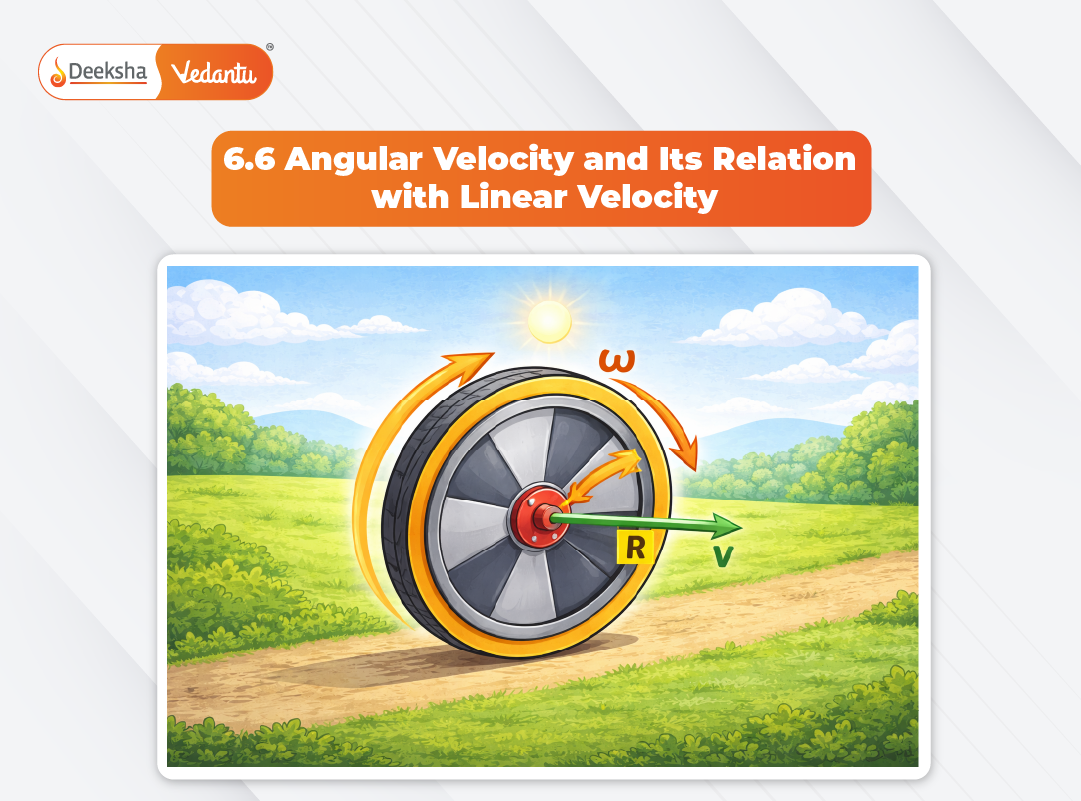


After developing the mathematical foundation of the vector product, we are now ready to study one of the central ideas of rotational motion – angular velocity and its relationship with linear velocity. This section builds the bridge between circular motion (already studied earlier) and rigid body rotation.
In translational motion, velocity measures the rate of change of position. In rotational motion, angular velocity measures the rate of change of angular position. The remarkable fact is that these two apparently different quantities are deeply connected through a simple and elegant vector equation:

This equation forms the backbone of rotational kinematics and is heavily used in JEE Main and JEE Advanced problems.
Understanding this topic conceptually and mathematically is essential before proceeding to torque and angular momentum.
1. Angular Displacement
Consider a particle moving in a circular path of radius  about a fixed point.
If the particle moves from one point to another, it sweeps an angle  at the centre. This is called angular displacement.
Angular displacement is measured in radians.
The relation between arc length and angular displacement is:

This equation connects linear displacement with angular displacement.
2. Angular Velocity
Angular velocity is defined as the rate of change of angular displacement with respect to time:

Even though appears to be scalar, angular velocity is treated as a vector quantity.
Direction of Angular Velocity
The direction of  is perpendicular to the plane of rotation and is determined by the right-hand rule.
If fingers curl in direction of rotation, the thumb gives direction of angular velocity.
Thus:
- Anticlockwise rotation →
 upward.
 - Clockwise rotation → downward.
Angular velocity has SI unit rad/s.
3. Scalar Relation Between Linear and Angular Velocity
Consider a particle rotating with angular velocity  .
.
Arc length travelled in time  :
:

Linear velocity is:

Substituting:

Therefore:

This relation gives magnitude only and applies when the direction of motion is known to be tangential.
4. Complete Vector Derivation of 
Let the position vector of the particle be  .
.
If the particle rotates through small angle  about axis defined by unit vector
  , the change in position vector is perpendicular to .
This small change can be written as:

Dividing by :

Since:

We obtain:
This compact vector equation automatically gives:
- Correct magnitude
- Correct direction
- Tangential nature of velocity
Magnitude becomes:

Thus scalar and vector relations are consistent.
5. Angular Acceleration
Angular acceleration is defined as:

If angular velocity changes in magnitude or direction, angular acceleration exists.
Unit: rad/s².
6. Linear Acceleration in Rotational Motion
Differentiating velocity:

Using the product rule, acceleration consists of two components.
6.1 Tangential Acceleration
Due to change in magnitude of angular velocity:

Direction is tangential.
6.2 Centripetal (Radial) Acceleration
Due to continuous change in direction of velocity:

It always points toward the centre of rotation.
Vector form of centripetal acceleration:

Thus total acceleration:

This decomposition is extremely important in pulley and rolling problems.
7. Rigid Body Rotation About a Fixed Axis
In a rigid body rotating about a fixed axis:
- All particles share the same angular velocity .
- Linear velocity depends on distance from the axis.
If two points are at distances  and
and  :
:


Thus outer points move faster than inner ones.
However, angular velocity remains the same everywhere.
This distinction between uniform angular velocity and varying linear velocity is fundamental in rotational dynamics.
8. Rolling Motion Connection
For rolling without slipping condition:

This connects the translational velocity of the centre of mass with angular velocity of the rotating body.
In rolling motion:
- The top point has velocity
 .
. - The bottom point has velocity
 relative to ground.
 .
. relative to ground.
These results are derived using:

This equation appears frequently in JEE Advanced problems.
9. Advanced Conceptual Insights for JEE
- Angular velocity is the same for the entire rigid body.
- Linear velocity is maximum at farthest point from the axis.
- Tangential acceleration depends on angular acceleration.
- Centripetal acceleration depends on the square of angular velocity.
- Vector relation simplifies 3D rotational motion problems.
Developing strong intuition about allows solving multi-step rotational problems efficiently.
10. Sample JEE-Oriented Concept Questions
If angular velocity doubles, linear velocity becomes:

If radius doubles while angular velocity remains constant, linear velocity also doubles.
If angular acceleration is zero but angular velocity is non-zero, centripetal acceleration still exists.
These conceptual ideas are frequently tested.
FAQs
Q1. What is angular velocity?
Angular velocity is the rate of change of angular displacement, given by .
Q2. How is linear velocity related to angular velocity?
Through the vector relation .
Q3. Why is velocity perpendicular to radius?
Because cross product ensures  is perpendicular to both and .
Q4. What are the two components of acceleration in circular motion?
Tangential acceleration and centripetal acceleration .
Q5. Do all points of a rotating body have same angular velocity?
Yes. In rigid body rotation, angular velocity is same for all particles.
Conclusion
Angular velocity provides the rotational analogue of linear velocity and forms the core of rotational kinematics. The elegant vector relation
connects circular motion with rigid body rotation in a unified manner.
Understanding the scalar and vector derivations, acceleration components, and rolling motion applications prepares students for torque, angular momentum, and full rotational dynamics in the next sections of Chapter 6.



Get Social