
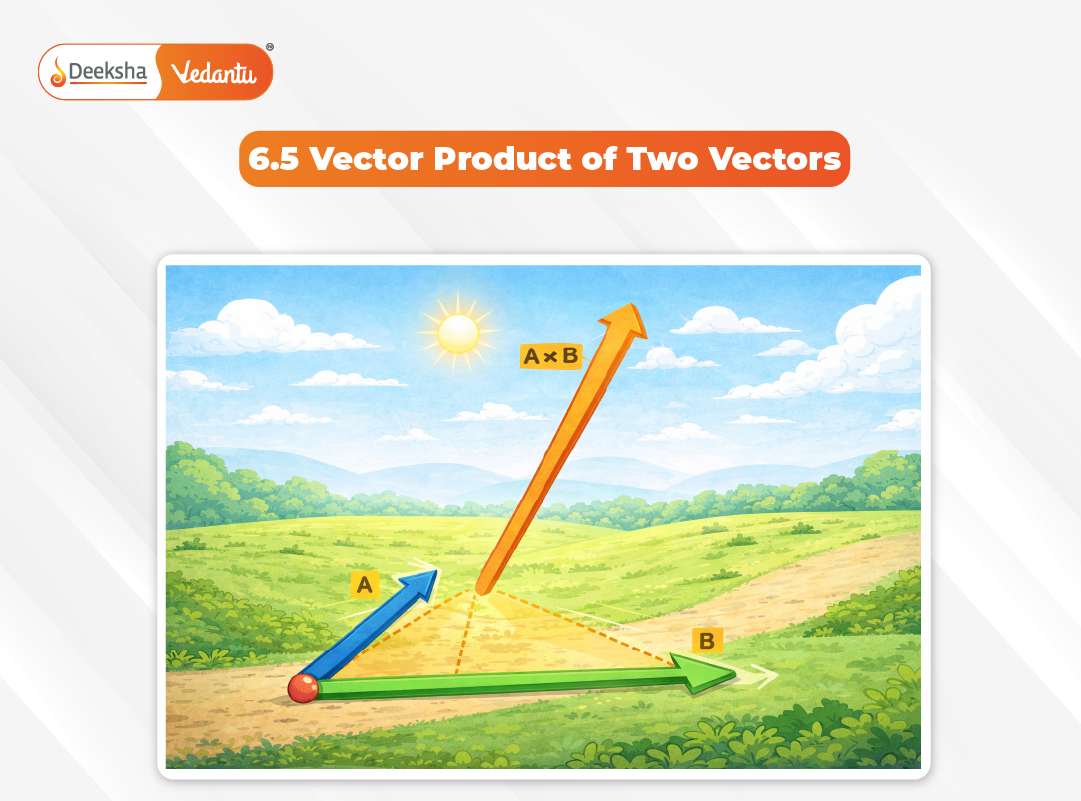


Before we begin studying torque, angular momentum, and rotational dynamics, we must understand a powerful mathematical operation known as the vector product or cross product. Unlike the dot product, which produces a scalar, the cross product produces another vector. This new vector captures rotational tendency and perpendicular effects in physical systems.
In Class 11 Physics and especially in JEE Main and JEE Advanced, the cross product is not treated as an isolated mathematical idea. It becomes the foundation for defining torque, angular momentum, magnetic force, and rotational motion. A deep understanding of both its geometry and algebra is essential for solving advanced mechanics problems.
1. Definition of the Vector Product
Let  and
and  be two vectors separated by an angle
  .
.
The vector product of and is defined as:

The magnitude of the cross product is:

where:
 and
and  are magnitudes of the vectors
 is the smaller angle between them
 and
and  are magnitudes of the vectors
Thus, the magnitude depends only on the perpendicular component of either vector.
The direction of  is perpendicular to the plane containing and .
This perpendicular nature makes the cross product ideal for representing rotational effects.
2. Direction of Cross Product – Right-Hand Rule
The direction of  is determined by the right-hand rule.
If the fingers of your right hand rotate from toward through the smaller angle, the thumb points in the direction of the cross product.
This directional rule introduces an important property:

Thus, the cross product is anti-commutative.
This property has major implications in torque and angular momentum sign conventions.
3. Geometrical Interpretation
The magnitude of the cross product represents the area of the parallelogram formed by and :

Special cases:
If  or
or  (parallel vectors):

If  (perpendicular vectors):

Thus, only the perpendicular component contributes to the cross product. This is why torque depends only on perpendicular force.
Geometrically, if vectors lie in the xy-plane, their cross product points along the z-axis.
4. Algebraic or Component Form of Cross Product
Let


Expanding the determinant:

This algebraic expansion is extremely important in coordinate-based JEE problems where torque or angular momentum must be computed in vector form.
5. Properties of the Cross Product
5.1 Anti-Commutative Property
5.2 Distributive Property

5.3 Scalar Multiplication

5.4 Cross Product of Parallel Vectors
5.5 Self Cross Product

5.6 Not Associative

However, vector triple product identity exists:

This identity appears in advanced rotational mechanics.
6. Cross Products of Unit Vectors
Fundamental cyclic relations:


Reversing order introduces negative sign:


These cyclic relations are frequently used in solving vector algebra questions quickly.
7. Physical Applications of Cross Product
7.1 Torque
Torque is defined as:

Magnitude:

Thus only the perpendicular component of force contributes to rotation.
This explains practical situations such as pushing a door near hinges versus far from hinges.
7.2 Angular Momentum
Angular momentum of a particle is:

Since momentum is  ,
,

Thus rotational motion naturally emerges from cross product definition.
7.3 Magnetic Force (Advanced Insight)
Magnetic force on moving charge is given by:

This shows cross product governs perpendicular forces in electromagnetism as well.
8. Conceptual Insights for JEE Advanced
- Cross product measures rotational tendency.
- Magnitude depends only on the perpendicular component.
- Direction strictly follows the right-hand rule.
- Anti-commutative nature affects sign conventions.
- The determinant method is fastest in coordinate geometry problems.
Students must develop both geometric visualization and algebraic speed for mastery.
FAQs
Q1. What is the vector product of two vectors?
It is a vector defined as with magnitude  and direction perpendicular to both vectors.
Q2. When does the cross product become zero?
When vectors are parallel or anti-parallel, i.e., or .
Q3. Is cross product associative?
No. It is not associative, though vector triple product identity exists.
Q4. Why is cross product important in rotational mechanics?
Because torque and angular momentum are defined using cross product.
Q5. What does the magnitude of cross product represent geometrically?
It represents the area of the parallelogram formed by the two vectors.
Conclusion
The vector product of two vectors is a fundamental mathematical tool that describes perpendicular and rotational effects in physics. Its magnitude gives the measure of rotational influence, and its direction captures orientation in space.
From torque and angular momentum to magnetic forces, the cross product plays a central role in mechanics and beyond. A thorough understanding of both its geometric meaning and algebraic manipulation is essential before progressing into full rotational dynamics in Chapter 6.



Get Social