
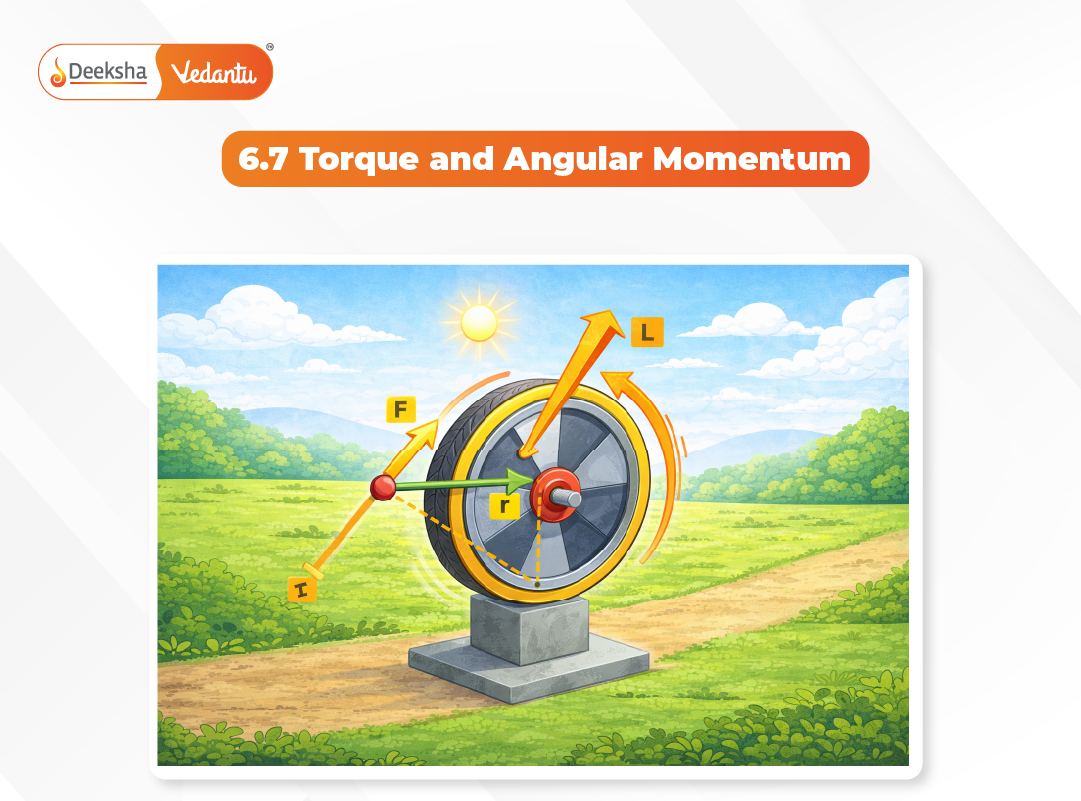


Rotational motion follows laws that are beautifully parallel to translational motion. In linear motion, force produces acceleration and linear momentum governs motion. In rotational motion, torque produces angular acceleration and angular momentum governs rotational behavior.
Understanding torque and angular momentum is essential for mastering rigid body dynamics, planetary motion, rotational equilibrium, and conservation principles. This topic is one of the most important sections of Chapter 6 and carries significant weight in JEE Main and JEE Advanced.
In this expanded discussion, we will develop the complete mathematical structure, physical interpretation, conservation laws, and advanced problem-solving insights.
1. Torque (Moment of a Force)
Torque measures the turning effect of a force about a fixed point or axis.
It is defined as the vector product of position vector and force:

Where:
 is the position vector from the reference point to the point of application of force.
 is the applied force.
Torque is therefore inherently a vector quantity.
1.1 Magnitude of Torque
The magnitude is:

Here  is the angle between
  and
and  .
.
Thus, only the perpendicular component of force contributes to torque.
If force acts along the line of position vector (radially), then:

This explains why pushing directly toward the hinge does not rotate a door.
1.2 Lever Arm Interpretation
Torque can also be written as:

Where  is the perpendicular distance (lever arm) from axis to the line of action of force.
This interpretation is extremely useful in equilibrium problems and practical applications.
Longer lever arm → greater torque for the same force.
1.3 Direction of Torque
The direction is determined by the right-hand rule. If fingers rotate from toward , thumb gives direction of  .
.
Torque is perpendicular to the plane containing and .
This perpendicular nature becomes important in 3D vector problems.
2. Angular Momentum of a Particle
Angular momentum is the rotational analogue of linear momentum.
For a particle about a fixed origin:

Since linear momentum is:

We obtain:

2.1 Magnitude of Angular Momentum

If velocity is perpendicular to radius vector (circular motion):

Using  :
:

This form becomes the building block for rigid body rotation where  generalizes into moments of inertia.
2.2 Physical Meaning
Angular momentum measures rotational motion about a point.
If motion is radial (along radius), then and  are parallel:

Thus purely radial motion has no angular momentum about that point.
3. Derivation of Rotational Form of Newton's Second Law
Starting from definition:
Differentiate with respect to time:

Using product rule of differentiation:

Since:

And , we have:

Thus:

Using Newton's second law:

Hence:

But 
Therefore:

This is the rotational analogue of Newton's second law.
It tells us that torque produces change in angular momentum.
4. Conservation of Angular Momentum
If net external torque is zero:

Then:

Therefore:

This is the Law of Conservation of Angular Momentum.
4.1 Central Force Case
For central forces (force always along ):

Thus torque is zero and angular momentum remains conserved.
This explains Kepler's second law of planetary motion.
4.2 Ice Skater Example
For a rotating skater:

If the moment of inertia decreases (arms pulled inward), angular velocity increases so that angular momentum remains constant.
This principle also explains stellar collapse and formation of neutron stars.
5. Angular Momentum of a System of Particles
For a system of particles:

Differentiating:

Internal torques cancel in pairs if forces are central.
Thus:

If external torque is zero, total angular momentum remains conserved for the entire system.
This extends conservation law to complex multi-particle systems.
6. Angular Momentum About Centre of Mass
Total angular momentum of system can be written as sum of:
- Angular momentum due to motion of the centre of mass.
- Angular momentum due to motion about the centre of mass.
This decomposition becomes crucial in rigid body dynamics.
It allows separation of translational and rotational motion.
7. Advanced Conceptual Insights for JEE
- If force acts through the axis, torque is zero.
- Angular momentum depends on the reference point.
- Conservation requires zero external torque, not zero force.
- Linear momentum can change while angular momentum remains constant.
- Angular momentum can be non-zero even if velocity is constant.
Students must carefully analyze axis choice in JEE problems.
8. Sample JEE-Oriented Applications
8.1 Particle in Circular Orbit
If radius halves:
 becomes four times (if
  constant and angular momentum conserved).
8.2 Central Force Motion
Since , angular momentum remains constant.
This implies motion lies in a plane.
8.3 Collision About Fixed Axis
If no external torque about the axis during collision, angular momentum about that axis is conserved.
This idea appears frequently in JEE Advanced problems.
FAQs
Q1. What is torque in rotational motion?
Torque is the turning effect of force defined as .
Q2. What is angular momentum?
Angular momentum is defined as .
Q3. What is the relation between torque and angular momentum?
.
Q4. When is angular momentum conserved?
When the net external torque acting on the system is zero.
Q5. Why is angular momentum conserved in planetary motion?
Because gravitational force is central and produces zero torque.
Conclusion
Torque and angular momentum provide the complete rotational analogue of force and linear momentum. The equation
connects rotational cause and effect in a precise mathematical form.
Conservation of angular momentum explains phenomena from spinning tops to planetary motion and stellar collapse. A strong conceptual and mathematical command of this topic is essential before moving to moment of inertia and rotational kinetic energy in the subsequent sections of Chapter 6.



Get Social