
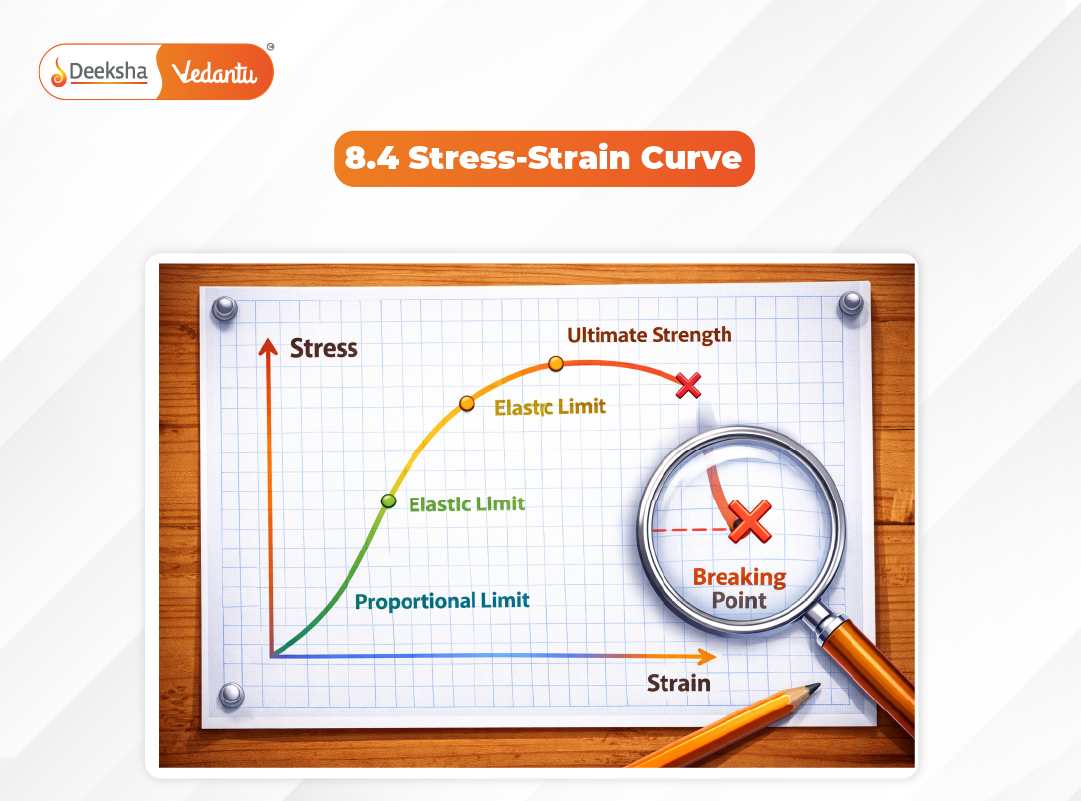


The stress-strain curve is one of the most powerful graphical representations in the study of mechanical properties of solids. It gives a complete description of how a material responds when subjected to gradually increasing tensile stress. By analysing this curve, we can understand elasticity, plasticity, strength limits, toughness and fracture behaviour of materials.
When a tensile test is performed on a metallic wire or rod and the applied force is increased slowly, the corresponding deformation is measured. Stress is calculated using  and strain using
  . Plotting stress versus strain produces a characteristic curve that reveals several critical mechanical properties.
For JEE Main and JEE Advanced, this topic is extremely important because questions often require interpretation of different regions of the graph, comparison of materials, calculation of energy density, and understanding elastic versus plastic behaviour.
1. Experimental Basis of the Stress-Strain Curve
In a tensile testing experiment:
- A cylindrical rod or wire is clamped firmly at one end.
- A gradually increasing tensile force is applied at the other end.
- The extension
 is measured precisely.
 - Stress is calculated using
 .
. - Strain is calculated using
 .
.
 is measured precisely.
A graph is plotted between stress and strain.
Important observations:
- The experiment must be performed slowly to ensure uniform deformation.
- Cross-sectional area is initially taken as original area (engineering stress).
- Temperature must remain constant.
The resulting graph provides detailed mechanical information about the material.
2. General Shape of Stress-Strain Curve for Ductile Materials
For a typical ductile metal such as mild steel, the curve has distinct regions:
- O to A → Linear elastic region
- A to B → Nonlinear elastic region
- B → Yield point
- B to D → Plastic region
- D → Ultimate tensile strength (UTS)
- E → Fracture point
Each region corresponds to a different physical behaviour.
3. Region O to A – Proportional Limit
In this region:
- Stress is directly proportional to strain.
- Hooke's Law is valid.
Mathematically:

The graph is a straight line passing through the origin.
Slope of this straight line gives Young's modulus:

Key characteristics:
- Perfectly elastic behaviour.
- No permanent deformation.
- Atomic bonds stretch reversibly.
Point A is called the proportional limit.
Beyond this point, linearity ends.
4. Region A to B – Elastic Limit
Between A and B:
- Stress and strain are not strictly proportional.
- The curve becomes slightly nonlinear.
However:
- Material still returns to original shape if load is removed.
Point B is called the elastic limit.
The elastic limit represents the maximum stress up to which the material behaves elastically.
Distinction:
- Proportional limit → End of linear region.
- Elastic limit → End of reversible deformation.
This subtle difference is frequently tested in conceptual questions.
5. Yield Point – Beginning of Plastic Deformation
At yield point (B):
- A very small increase in stress produces a large increase in strain.
- Material begins plastic deformation.
After this point:
- Deformation becomes permanent.
- Even if stress is removed, material does not regain original dimensions.
The stress at the yield point is called yield strength  .
.
Engineering design uses yield strength as a safe limit because permanent deformation must be avoided.
6. Plastic Region (B to D)
In this region:
- Material undergoes irreversible deformation.
- Strain increases significantly.
- Necking may begin in tensile specimens.
During plastic flow:
- Atoms slide past each other.
- Dislocation movement occurs in crystal structure.
Stress may continue increasing until it reaches maximum value.
7. Ultimate Tensile Strength (Point D)
Ultimate tensile strength (UTS) is the maximum stress a material can withstand.
After UTS:
- Localized reduction in cross-section occurs (neck formation).
- Applied force required to continue deformation decreases.
Even though force decreases, true stress may continue increasing because instantaneous area reduces.
UTS determines maximum load-carrying capacity before failure begins.
8. Fracture Point (Point E)
Beyond UTS:
- Material becomes unstable.
- Crack propagation begins.
- Fracture occurs at point E.
Stress at fracture is usually lower than UTS (engineering stress).
Fracture behaviour provides insight into ductility and brittleness.
9. Ductile vs Brittle Materials
9.1 Ductile Materials
Examples: Steel, copper, aluminium.
Characteristics:
- Large plastic region.
- Significant elongation before fracture.
- High toughness.
Ductile materials absorb large energy before breaking.
9.2 Brittle Materials
Examples: Glass, ceramics, cast iron.
Characteristics:
- Negligible plastic region.
- Fracture occurs near elastic limit.
- Sudden failure.
Brittle materials do not exhibit noticeable yield points.
10. Stress-Strain Curve for Elastomers
Elastomers such as rubber behave differently:
- Very large elastic strain.
- Nonlinear stress-strain relation even in elastic regions.
- No clear proportional limit.
Elastic deformation in elastomers arises from molecular chain uncoiling rather than bond stretching.
11. Area Under Stress-Strain Curve – Energy Interpretation
The area under the stress-strain curve represents strain energy per unit volume.
Mathematically:

For linear elastic region:

This energy is stored as elastic potential energy.
Two important energy-related terms:
- Resilience → Energy absorbed within elastic limit.
- Toughness → Total energy absorbed before fracture.
Ductile materials have high toughness because the area under the entire curve is large.
12. JEE-Oriented Conceptual Insights
- Slope of the linear region gives Young's modulus.
- Larger slope → More rigid material.
- Larger area under curve → Higher toughness.
- Yield strength determines safe design stress.
- Brittle materials have small strain at fracture.
Comparative questions often ask:
- Which material is stiffer?
- Which material is more ductile?
- Which absorbs more energy before breaking?
All answers can be derived from analysing the graph.
13. True Stress vs Engineering Stress
Engineering stress:

True stress:

In plastic region:
- Engineering stress may decrease after UTS.
- True stress continues to increase.
This difference becomes important in advanced material analysis.
14. Engineering Significance
The stress-strain curve helps engineers to:
- Select appropriate materials.
- Design safe load limits.
- Determine safety factors.
- Analyse structural failure.
- Estimate durability.
Working stress is always kept significantly below yield strength to avoid permanent deformation.
FAQs
Q1. Why does the stress-strain curve become nonlinear after proportional limit?
Because stress is no longer directly proportional to strain.
Q2. What is the difference between elastic limit and proportional limit?
Proportional limit marks end of linear region, while elastic limit marks end of reversible deformation.
Q3. Why are ductile materials safer in construction?
Because they provide warning through large deformation before fracture.
Q4. What does the area under the entire curve represent?
It represents the toughness of the material.
Q5. Why do brittle materials fail suddenly?
Because they lack a significant plastic deformation region.
Conclusion
The stress-strain curve provides a comprehensive picture of material behaviour under tensile loading. It identifies proportional limit, elastic limit, yield strength, ultimate tensile strength and fracture point.
By carefully analysing each region of the curve, one can determine stiffness, ductility, toughness and safe operating stress of materials.
Mastery of stress-strain curve interpretation is essential for JEE-level mechanics and forms the conceptual br



Get Social