
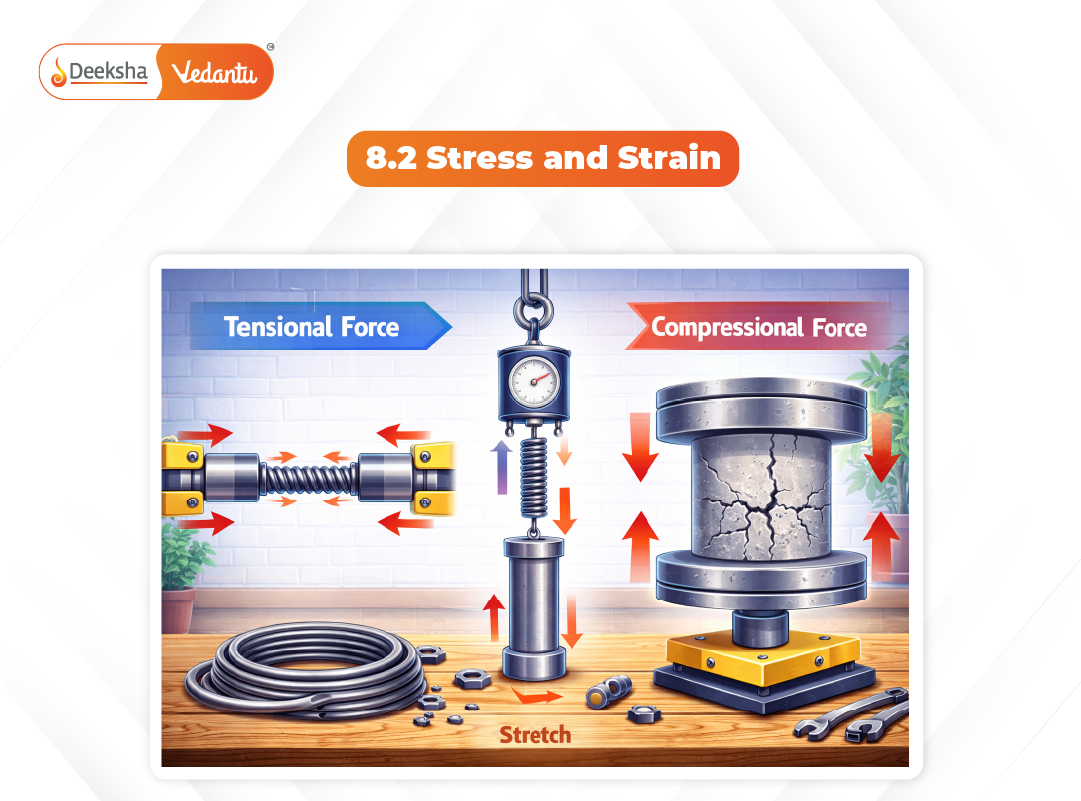


The study of stress and strain forms the foundation of the mechanical properties of solids. Whenever a force acts on a solid body, it produces deformation. This deformation gives rise to internal restoring forces inside the material. The analysis of these internal forces and the resulting deformation allows us to quantify the strength and elastic behaviour of materials.
In engineering structures, bridges, cables, rods, beams and machine parts are constantly subjected to forces. Understanding stress and strain ensures that these structures remain safe and operate within elastic limits.
In competitive examinations such as JEE Main and JEE Advanced, this topic is important because it connects force analysis with material response and dimensional reasoning.
1. Concept of Deforming Force
When an external force is applied to a solid body, it can cause:
- Change in length
- Change in shape
- Change in volume
If a rod is pulled from both ends, its length increases. If compressed, its length decreases. If subjected to tangential forces, its shape changes. If placed under uniform pressure, its volume changes.
The deformation may be elastic or plastic depending on whether the body regains its original shape after removal of force.
2. Stress – Internal Restoring Force per Unit Area
When a deforming force acts on a body, internal restoring forces develop inside it. The internal restoring force per unit area is called stress.
Mathematically,

Where:
 = Magnitude of applied force
 = Cross-sectional area on which force acts
SI unit of stress is Pascal (Pa), where:

Dimensional Formula of Stress
Force has dimension  and area has dimension
  .
.
Therefore,

Stress has the same dimensions as pressure.
However, conceptually:
- Pressure is external force per unit area.
- Stress is internal restoring force per unit area.
3. Types of Stress
Depending on the nature of force and deformation, stress is classified into three types.
3.1 Longitudinal Stress
When force is applied perpendicular to the cross-sectional area along the length of a body, it produces longitudinal stress.
There are two types:
- Tensile stress (pulling)
- Compressive stress (pushing)
If a wire of area  is pulled by force
  :
:
This type of stress changes length of the object.
3.2 Shearing Stress
When equal and opposite forces act tangentially on opposite faces of a body, it produces shearing stress.

This stress changes the shape of the body without significantly changing its volume.
Example: Sliding of one face of a cube relative to the opposite face.
3.3 Hydraulic or Volumetric Stress
When a body is subjected to uniform pressure from all sides, it experiences volumetric stress.
In this case:

Where  is applied pressure.
This stress produces change in volume only.
4. Strain – Measure of Deformation
Strain is defined as the fractional change in dimension.
It is a measure of deformation produced by stress.
Since it is a ratio of two similar quantities, strain is dimensionless.
4.1 Longitudinal Strain
If original length is  and change in length is
  :
:

If  → tensile strain.
If  → compressive strain.
4.2 Shear Strain
Consider a cube of side . If the top face is displaced by  while bottom remains fixed:

For small angles,

Thus shear strain equals angular deformation in radians.
4.3 Volumetric Strain
If original volume is  and change in volume is
  :
:

This strain measures compressibility of materials.
5. Microscopic Explanation of Stress and Strain
At the microscopic level, solids consist of atoms arranged in lattice structures. When a force is applied:
- Interatomic distances change slightly.
- Interatomic forces increase.
- Restoring forces develop due to electromagnetic interactions.
For small deformations, restoring force is approximately proportional to displacement. This leads to Hooke's law.
Thus elasticity originates from atomic bonding forces.
6. Relationship Between Stress and Strain
Within elastic limit, stress is directly proportional to strain.


Where  is modulus of elasticity (constant for given material).
This proportionality is known as Hooke's law.
The ratio:

remains constant within elastic limit.
7. Important Observations for JEE
- Stress depends on area, not on length.
- Strain depends on length, not on area.
- Thicker wire experiences less stress for same force.
- Longer wire experiences more extension for same stress.
- Strain is dimensionless.
If two wires of same material but different areas are subjected to same force:

If two wires have same area but different lengths:

These proportional relations are frequently tested in numerical problems.
8. Energy Stored Due to Stress
When a wire is stretched, work done is stored as elastic potential energy.
Energy density (energy per unit volume) is:

This expression is important in advanced problems involving strain energy.
9. Comparison Table – Stress vs Strain
| Property | Stress | Strain |
| Definition | Force per unit area | Fractional deformation |
| Formula |  |  |
| Unit | Pascal | No unit |
| Dimension |  | Dimensionless |
| Nature | Cause | Effect |
10. Advanced Conceptual Insight
In real materials:
- Stress distribution may not be uniform.
- Cross-sectional area may change during stretching.
- True stress differs from engineering stress.
True stress is defined using instantaneous area:

This concept is used in advanced material science.
FAQs
Q1. Why does stress have same unit as pressure?
Because both are defined as force per unit area.
Q2. Is strain a vector or scalar quantity?
Strain is a scalar quantity for simple deformation, though in advanced mechanics it is treated as a tensor.
Q3. Why is strain dimensionless?
Because it is a ratio of two similar physical quantities.
Q4. Can stress exist without strain?
In perfectly rigid bodies (ideal case), stress may exist without measurable strain.
Q5. Does larger area reduce stress?
Yes. Since , increasing area reduces stress.
Conclusion
Stress and strain form the backbone of the theory of elasticity. Stress quantifies internal restoring force, while strain measures deformation. Their relationship determines how materials respond to external forces.
A clear understanding of stress types, strain types, dimensional analysis and proportional relations is essential for solving JEE-level numerical problems and for understanding real-world structural design.
In the next section, we will study Hooke's law and develop the concept of elastic moduli in greater depth.



Get Social