
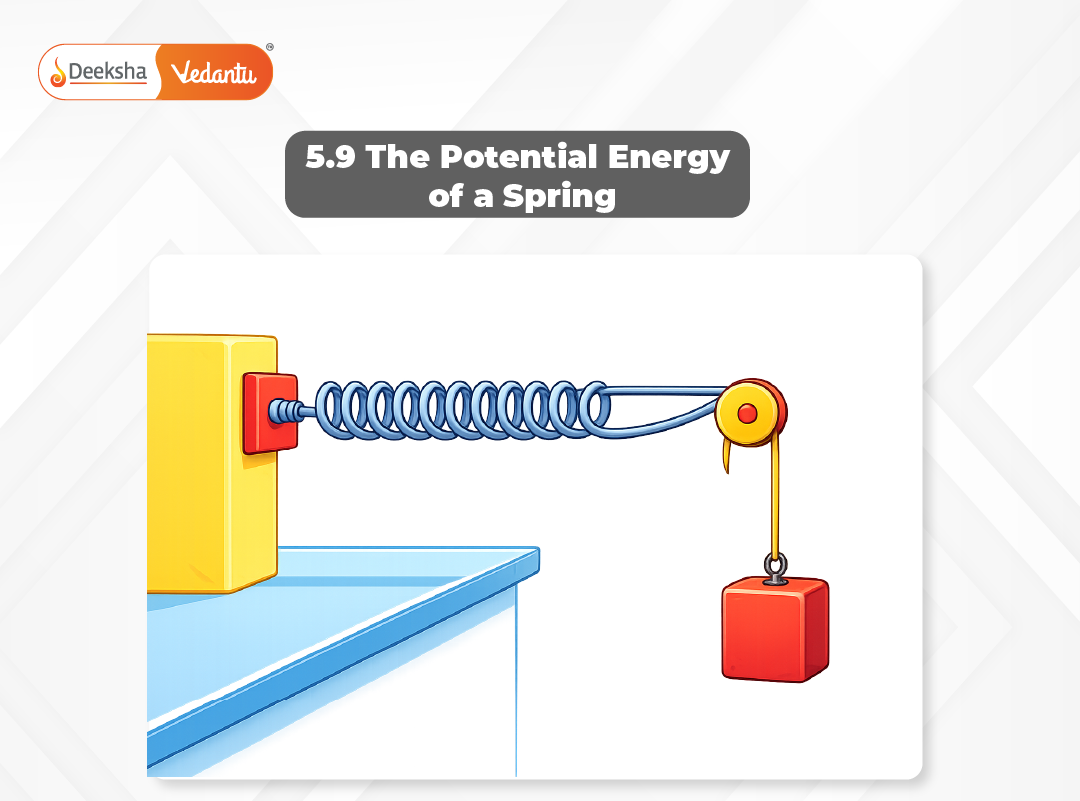


Section 5.9 explores in depth the elastic potential energy stored in a spring. While the formula  may appear simple, it forms the backbone of oscillations, collision problems, multi‑spring systems, vertical motion, and advanced JEE mechanics.
At Deeksha Vedantu, we emphasize that spring systems are conceptually rich. They connect force, work, energy conservation, equilibrium, and oscillatory motion into one unified framework. In JEE Advanced, spring problems are often multi‑stage and require deep conceptual clarity.
Hooke's Law – Mathematical Foundation
An ideal spring obeys Hooke's Law:

Where:
 = spring constant (measure of stiffness)
 = displacement from equilibrium
- Negative sign indicates restoring nature
 = displacement from equilibrium
The restoring force always acts toward equilibrium. Because work done by spring depends only on initial and final displacement, spring force is conservative.
Work Done by Variable Spring Force
Since spring force varies linearly with displacement, we must use integration.
For infinitesimal displacement  :
:

Substituting Hooke's Law:

Integrating from 0 to x:


Thus, work done by the spring is negative because it opposes displacement.
Elastic Potential Energy – Rigorous Derivation
From definition of potential energy:

Thus:

Therefore:
This expression is valid for both compression and extension.
Key Physical Interpretations
- Elastic potential energy is proportional to square of displacement.
- It is zero at equilibrium.
- It increases symmetrically for positive and negative displacement.
- Greater spring constant implies greater stored energy for same displacement.
These properties explain oscillatory motion behavior.
Force–Displacement Graph Interpretation
For a spring, the F–x graph is a straight line.
Work done equals area under the graph:

Since  :
:

Graphical interpretation is frequently used in JEE to calculate energy quickly.
Potential Energy Curve and Stability
Potential energy function:

This is an upward opening parabola.
Stability Analysis Using Derivatives
First derivative:

Setting equal to zero gives equilibrium:

Second derivative:

Since  , equilibrium is stable.
Thus, any small displacement produces restoring force.
Energy Exchange in SHM (Detailed Insight)
Total mechanical energy of spring-mass system:

At extreme position  :
:

At equilibrium :

Thus:


This connects energy method to angular frequency:

Energy perspective simplifies SHM analysis.
Multi-Spring Systems (Series and Parallel)
Springs in Series

For identical springs:

Energy stored:

Springs in Parallel

Parallel combination increases stiffness and stored energy.
These concepts are frequently tested in JEE Advanced.
Advanced JEE Problem 1 (Block Between Two Springs)
A block is attached between two identical springs of constant  .
.
Effective spring constant:

Potential energy:

Angular frequency:

Students must recognize effective stiffness correctly.
Advanced JEE Problem 2 (Spring + Gravity Vertical System)
A mass is attached to the vertical spring and released.
New equilibrium position shifts by:

Energy analysis must consider shifted equilibrium.
Total energy relative to new equilibrium:
This concept appears in JEE Advanced oscillation problems.
Advanced JEE Problem 3 (Two Blocks and Spring)
Two blocks connected by spring collide and compress spring.
Using momentum conservation first, then energy conservation:
Step 1: Find common velocity after collision.
Step 2: Use

Such multi-concept problems are common in advanced exams.
Advanced JEE Problem 4 (Energy Distribution in SHM)
At displacement  :
:
Potential energy:

Total energy:
Fraction of KE:

Understanding energy fractions helps solve objective questions quickly.
Spring with Friction (Energy Dissipation)
If kinetic friction acts:

Mechanical energy decreases each cycle.
This leads to damped oscillations in advanced topics.
Energy Density in Spring
Energy stored per unit length depends on extension.
If total extension is distributed across coils, energy distribution is uniform in ideal spring.
This idea sometimes appears conceptually in JEE Advanced.
Common Conceptual Traps
- Forgetting the equilibrium shift in vertical spring.
- Mixing up series and parallel formulas.
- Ignoring momentum conservation in collision-spring problems.
- Confusing amplitude with displacement.
Clarity prevents major exam mistakes.
Key Formula Summary
| Concept | Formula |
| Hooke's Law | |
| Elastic PE |  |
| SHM Energy |  |
| Angular Frequency | |
| Series Combination | |
| Parallel Combination | |
FAQs
Q1. Why does elastic energy depend on the square of displacement?
Because work is integral to linearly varying force.
Q2. Is the equilibrium of spring stable?
Yes, because the second derivative of potential energy is positive.
Q3. Why do springs oscillate?
Because restoring force produces periodic energy exchange between KE and PE.
Q4. How are multiple springs handled in JEE?
By calculating effective spring constant before applying energy formulas.
Q5. Why is this topic heavily tested in JEE Advanced?
Because it combines force laws, conservation principles, oscillations, and multi-step reasoning.
Conclusion
Section 5.9 develops elastic potential energy from calculus and connects it to oscillations, stability, and advanced mechanics. The formula becomes a central tool in solving multi-stage JEE Advanced problems.
At Deeksha Vedantu, we ensure students master both conceptual foundations and advanced applications so they can confidently handle spring systems in board exams and competitive examinations.



Get Social