
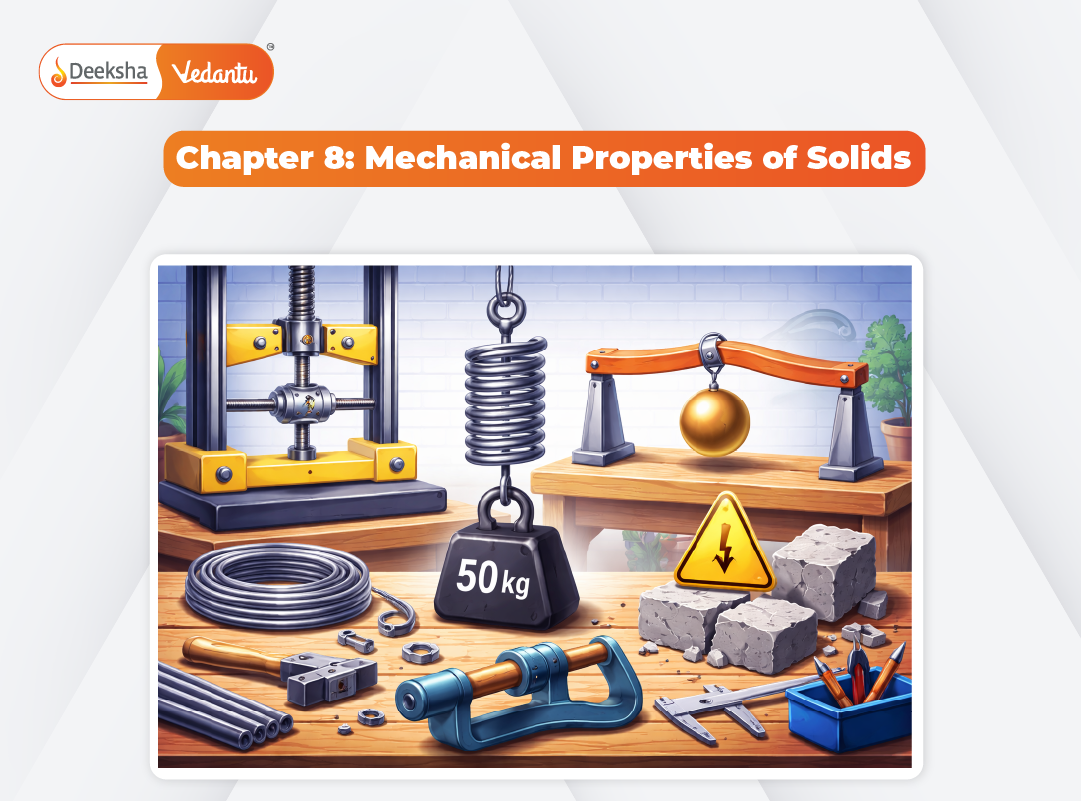


Mechanical properties of solids form the foundation of structural physics and engineering design. In this chapter, we study how solid bodies respond when external forces attempt to stretch, compress, bend, twist or deform them.
Although we often treat solids as rigid bodies in mechanics, in reality every solid undergoes deformation when subjected to external forces. Even a steel rod deforms slightly under load. The study of this deformation and the internal restoring forces developed inside solids leads us to the concepts of stress, strain, elasticity and elastic moduli.
This chapter is extremely important for:
- JEE Main and JEE Advanced conceptual clarity
- Structural engineering applications
- Understanding strength of materials
- Design of bridges, buildings and mechanical systems
In this overview, we will systematically understand all major sections of the chapter.
8.1 Introduction – Elastic and Plastic Behaviour
When an external force is applied to a solid body, its shape or size may change. If the body regains its original shape after removal of force, the deformation is called elastic deformation. The property responsible for this recovery is called elasticity.
If the body does not regain its original shape after removal of force, the deformation is called plastic deformation.
Examples:
- Steel spring → elastic behaviour
- Putty or mud → plastic behaviour
Elastic behaviour plays a central role in engineering design. Structures must operate within elastic limits to avoid permanent damage.
8.2 Stress and Strain
When a body is deformed, internal restoring forces develop. The restoring force per unit area is called stress.
Mathematically,

Where:
 = Applied force
 = Cross-sectional area
 = Applied force
 = Cross-sectional area
SI unit of stress = Pascal (Pa)
Types of Stress
- Longitudinal Stress (Tensile or Compressive)
- Shearing Stress
- Hydraulic (Volumetric) Stress
Longitudinal Strain
If original length is  and change in length is
  ,
,

Shearing Strain
If lateral displacement is  ,
,

Volume Strain

Strain is dimensionless.
8.3 Hooke's Law
For small deformations:


Where  is modulus of elasticity.
Hooke's law is valid only within the elastic limit.
This linear relationship forms the basis of elastic constant definitions.
8.4 Stress-Strain Curve
When stress is gradually increased and strain is measured, a stress-strain graph is obtained.
Important regions:
- Proportional limit
- Elastic limit
- Yield point
- Plastic region
- Ultimate tensile strength
- Fracture point
Key Observations
- Region OA → Hooke's law valid
- Point B → Yield point
- Beyond yield → Permanent deformation
- D → Ultimate strength
- E → Fracture point
Ductile materials have large plastic region.
Brittle materials fracture quickly after elastic limit.
This curve is extremely important in material science and competitive exams.
8.5 Elastic Moduli
Elastic modulus is the ratio of stress to strain within elastic limit.
There are three major elastic constants:
- Young's Modulus
- Shear Modulus
- Bulk Modulus
8.5.1 Young's Modulus
Defined as:

Using definitions:

Unit = Pascal
Higher  → material is more rigid.
Steel has larger Young's modulus than aluminium or copper.
8.5.2 Shear Modulus (Modulus of Rigidity)
Defined as:


Typically,

Shear modulus determines resistance to shape change.
8.5.3 Bulk Modulus
Defined as:

Negative sign indicates decrease in volume when pressure increases.
Bulk modulus measures resistance to volume change.
Solids → highest bulk modulus
Liquids → moderate
Gases → very low
8.5.4 Poisson's Ratio
When a wire is stretched longitudinally, its diameter decreases.
Poisson's ratio is:

It is dimensionless.
For most materials:

8.5.5 Elastic Potential Energy
When a wire is stretched, work done is stored as elastic potential energy.
Total elastic energy stored:

Energy density:

This concept is important for spring systems and energy storage problems.
8.6 Applications of Elastic Behaviour
Elastic theory has enormous practical importance.
Engineering Structures
For a beam supported at ends and loaded at centre:

Where:
 = length
 = breadth
 = depth
 = length
 = breadth
 = depth
Increasing depth reduces bending significantly.
Mountain Height Estimation
Maximum height of mountains is limited by shear strength of rocks.
Equating stress at base:

Gives approximate maximum height ~10 km.
Design of Cables
For safe load condition:

Where  is yield strength.
Safety factors are always included in engineering design.
Conceptual Summary of the Chapter
This chapter connects microscopic interatomic forces with macroscopic deformation behaviour.
Key ideas include:
- Stress measures internal force per unit area.
- Strain measures fractional deformation.
- Hooke's law defines linear elasticity.
- Stress-strain curve distinguishes elastic and plastic behaviour.
- Young's modulus measures stiffness.
- Shear modulus measures rigidity.
- Bulk modulus measures incompressibility.
- Elastic potential energy represents stored mechanical energy.
Understanding these principles allows prediction of how materials behave under load.
FAQs
Q1. What is the difference between stress and pressure?
Stress is restoring force per unit area inside a material, whereas pressure is external force per unit area applied on a surface.
Q2. Why is strain dimensionless?
Because it is the ratio of change in dimension to original dimension.
Q3. Why are solids less compressible than gases?
Because intermolecular forces are much stronger in solids.
Q4. What does the yield point represent?
It marks the beginning of permanent plastic deformation.
Q5. Which modulus is relevant for liquids?
Bulk modulus is relevant for solids, liquids and gases.
Conclusion
Chapter 8 builds a complete understanding of how solids respond to external forces. Through stress, strain, Hooke's law and elastic moduli, we quantify deformation and material strength.
These concepts are foundational not only for JEE examinations but also for real-world engineering applications. Mastery of this chapter enables students to analyze structural stability, design safe mechanical systems and understand the physical limits of materials.
In the next sections, we will study each subtopic in greater depth with detailed derivations and advanced problem-solving approaches.



Get Social