
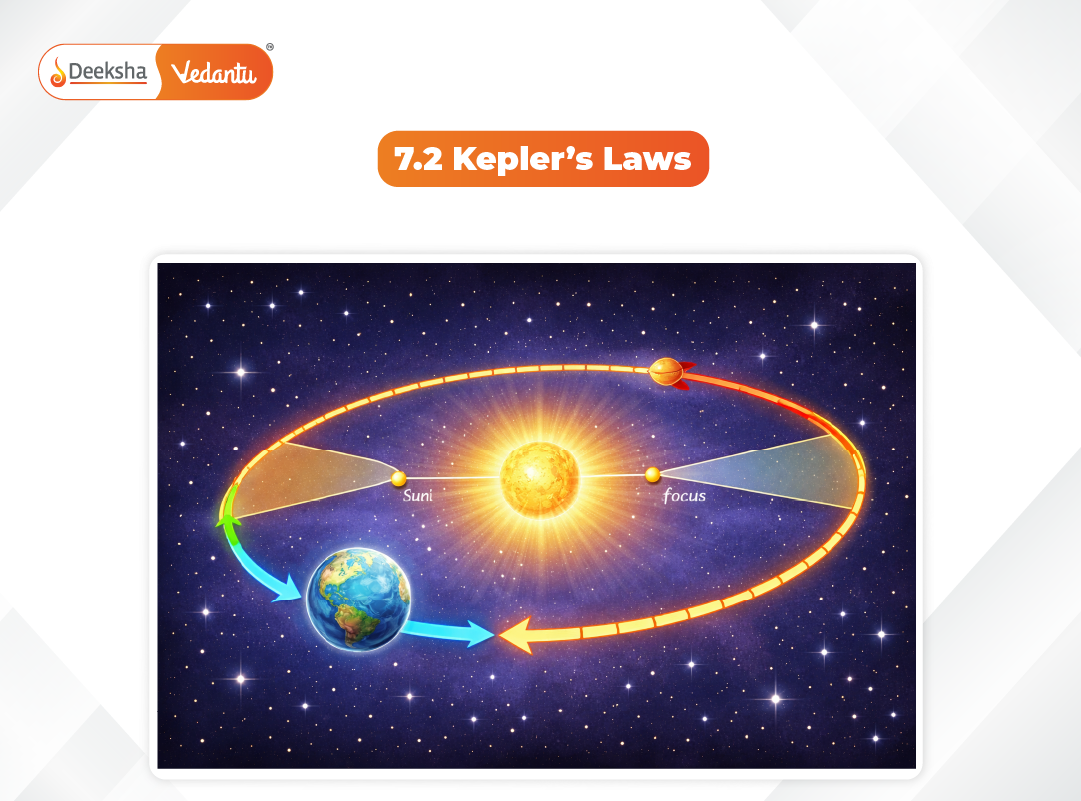


Kepler's Laws of Planetary Motion form the foundation of celestial mechanics. Long before Newton proposed the Universal Law of Gravitation, Johannes Kepler analyzed extremely precise astronomical observations recorded by Tycho Brahe and discovered three mathematical laws that describe how planets move around the Sun.
These laws were revolutionary because they replaced the ancient assumption that planets move in perfect circles. Kepler showed that planetary motion follows strict geometrical and mathematical rules. Later, Newton demonstrated that all three of Kepler's laws naturally emerge from the inverse‑square law of gravitation and the laws of motion.
For JEE Main and JEE Advanced, Kepler's laws are not merely historical statements — they are powerful tools that connect gravitation, circular motion, angular momentum, central forces, and energy conservation.
In this section, we will study in depth:
- Geometry of elliptical motion
- Kepler's First Law (Law of Orbits)
- Kepler's Second Law (Law of Areas)
- Kepler's Third Law (Law of Periods)
- Mathematical derivation of Third Law from Newton's law
- Speed variation in elliptical orbit
- Energy interpretation of planetary motion
- Advanced proportional reasoning used in JEE problems
1. Geometry of an Ellipse
An ellipse is the path followed by a planet around the Sun according to Kepler's First Law.
An ellipse is defined as the locus of a point such that the sum of distances from two fixed points (foci) is constant.
Important geometric quantities:
- Semi‑major axis: a
- Semi‑minor axis: b
- Distance from center to focus: c
- Eccentricity:


Relationship between a and b:

Special cases:
 → Circle
 → Ellipse
 → Circle
 → Ellipse
For most planets in our solar system, eccentricity is small. For example, Earth's orbit has very small eccentricity, making it nearly circular.
Key orbital points:
- Perihelion: Minimum distance from Sun (
 )
) - Aphelion: Maximum distance from Sun (
 )
)
 )
) )
)For an ellipse:


These relations are frequently useful in advanced problems.
2. Kepler's First Law – Law of Orbits
Statement:
Planets move in elliptical orbits with the Sun at one focus.
This implies:
- The Sun is not at the geometric center.
- The distance between planet and Sun continuously changes.
- Orbital speed is not constant.
This law corrected the Copernican circular‑orbit model.
Physical meaning:
Elliptical motion is a natural result of an attractive inverse‑square central force. Under such forces, bound orbits are ellipses.
Thus Kepler's First Law is a consequence of Newton's gravitational force.
3. Kepler's Second Law – Law of Areas
Statement:
The line joining the planet and the Sun sweeps equal areas in equal intervals of time.
Mathematically:

For a small angular displacement  in time
  :
:

Hence:

Since  ,
,

Using linear velocity  ,
,

Now angular momentum of planet:

Thus:

Because gravitational force is central, torque about the Sun is zero:

Hence:

Therefore areal velocity is constant.
This proves that Kepler's Second Law is a direct consequence of conservation of angular momentum.
Important Consequences

- Speed is maximum at perihelion.
- Speed is minimum at aphelion.

Thus:

This proportional relation is frequently used in JEE problems.
4. Kepler's Third Law – Law of Periods
Statement:
The square of the orbital period is proportional to the cube of the semi‑major axis.

Derivation for Circular Orbit
For circular orbit of radius r:
Gravitational force provides centripetal force:

Hence:

Time period:

Substituting:

Squaring both sides:

For elliptical orbit, r is replaced by semi‑major axis a:

Thus the Third Law is derived from Newton's law of gravitation.
5. Energy Interpretation of Planetary Motion
Total mechanical energy of planet in orbit:

For circular orbit:

For elliptical orbit:

Thus total energy depends only on the semi‑major axis, not on instantaneous position.
This explains why Third Law depends on a.
6. Speed at Any Point – Conceptual Insight
Although detailed derivation is beyond Class 11 scope, orbital speed in elliptical orbit depends on distance from the Sun.
From energy conservation:

Rearranging gives speed relation (vis‑viva form):

This equation explains:
- Speed increases as r decreases.
- Speed equals circular speed when r = a.
Advanced JEE problems often rely on this relation conceptually.
7. Comparison Between Two Planets
For two planets orbiting same star:

If the ratio of distances is known, the time period ratio can be immediately calculated.
Example proportional reasoning:
If orbital radius doubles:

Thus:

Such reasoning saves time in competitive exams.
8. Applications in Satellite Motion
Kepler's Third Law also applies to satellites orbiting Earth:

Thus:
- Geostationary satellite has fixed T = 24 hours.
- Orbital radius can be calculated from Third Law.
This law is universal for all central inverse‑square forces.
9. Conceptual Summary for JEE
- First Law defines orbit shape.
- Second Law represents angular momentum conservation.
- Third Law arises from inverse‑square force.
- Orbital speed decreases with increasing radius.
- Period depends only on central mass and orbital size.
Understanding the connection between geometry, force, and energy is essential for solving advanced orbital problems.
FAQs
Q1. Why are planetary orbits elliptical and not circular?
Because inverse‑square central forces naturally produce elliptical bound orbits.
Q2. What principle explains Kepler's Second Law?
Conservation of angular momentum due to zero external torque.
Q3. Does the orbital period depend on the mass of the planet?
No. It depends only on the central mass and semi‑major axis.
Q4. Why is speed maximum at perihelion?
Because angular momentum must remain constant while radius decreases.
Q5. How is Third Law derived from Newton's law?
By equating gravitational force to centripetal force and solving for time period.
Conclusion
Kepler's Laws provide a precise mathematical description of planetary motion. The First Law establishes elliptical orbits, the Second Law reveals angular momentum conservation, and the Third Law connects orbital size to time period.
Newton later showed that these empirical observations arise naturally from the inverse‑square gravitational force. Thus Kepler's Laws serve as the bridge between observation and theory in celestial mechanics.
Mastering these laws is essential for advanced problemsolving in JEE Main and JEE Advanced, particularly in questions involving proportional reasoning, conservation principles, and orbital dynamics.



Get Social