
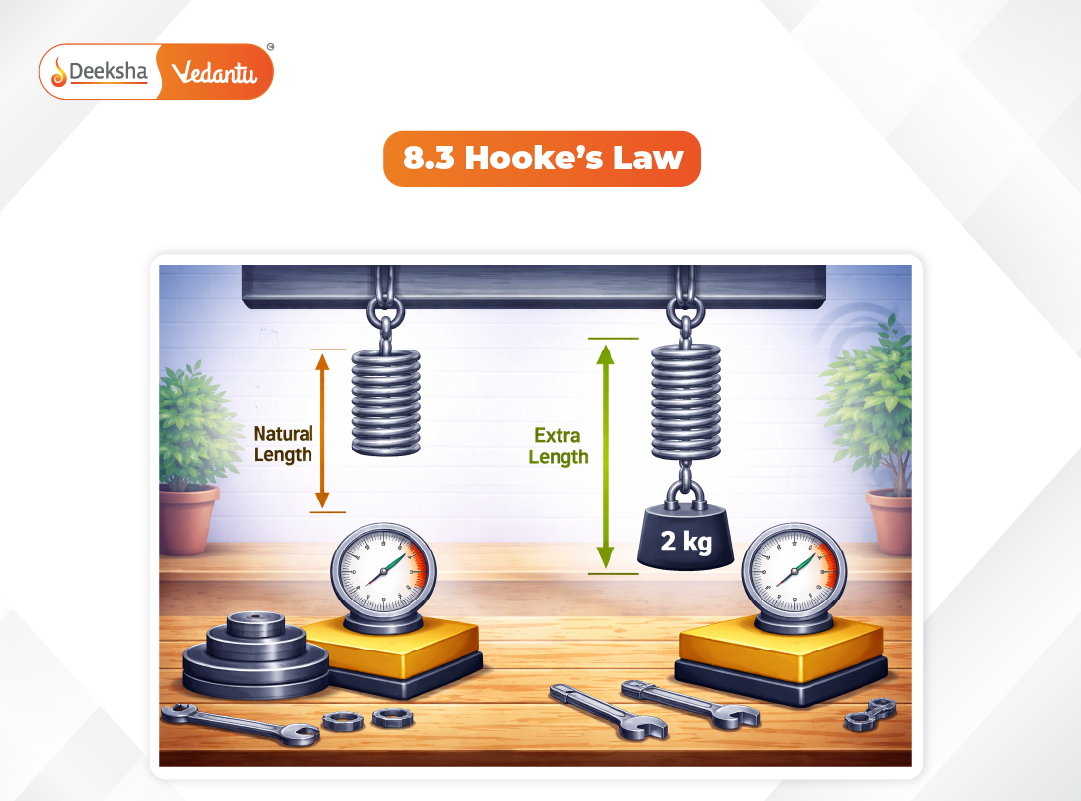


Hooke's Law is one of the most fundamental principles in the theory of elasticity. It establishes a linear relationship between stress and strain within the elastic limit of a material. This proportionality provides the mathematical foundation for defining elastic constants such as Young's modulus, shear modulus and bulk modulus.
In structural engineering, architecture, machine design and materials science, Hooke's Law allows us to predict deformation under load. In competitive examinations like JEE Main and JEE Advanced, this topic is extremely important because it connects force analysis, deformation behaviour, dimensional reasoning, graphical interpretation and energy storage in a single framework.
Understanding Hooke's Law deeply also prepares students for later topics such as simple harmonic motion, oscillations, and wave mechanics, where restoring forces proportional to displacement play a central role.
1. Statement of Hooke's Law
Hooke's Law states:
Within the elastic limit, stress is directly proportional to strain.
Mathematically,

Introducing proportionality constant,

Where:
 = Stress
 = Strain
 = Modulus of elasticity (material constant)
 = Stress
 = Strain
This proportionality holds only for small deformations, i.e., within the proportional limit of the material.
2. Physical Meaning of Proportionality
The statement implies:
- If strain doubles, stress doubles.
- If strain becomes zero, stress becomes zero.
- The ratio
 remains constant.
 remains constant.
The constant  measures stiffness of material.
Higher → material is more rigid.
Lower → material deforms more easily.
For example:
- Steel has very high Young's modulus.
- Rubber has very low Young's modulus.
Thus the slope of the stress-strain graph represents stiffness.
3. Hooke's Law for a Stretched Wire – Detailed Derivation
Consider a wire of:
- Length =

- Cross-sectional area =
- Applied force =

- Extension =


Stress:

Strain:

Applying Hooke's law:

Rearranging:

This equation shows that applied force is directly proportional to extension.
We may write:

Where the effective spring constant of the wire is:

This result is extremely important in JEE problems involving deformation of rods and wires.
4. Interpretation of Spring Constant Expression
From:
We observe:
 → Stiffer material gives larger spring constant.
- → Thicker wire is harder to stretch.
 → Longer wire is easier to stretch.
 → Stiffer material gives larger spring constant.
 → Thicker wire is harder to stretch.
 → Longer wire is easier to stretch.
These proportional relations help solve comparison-type objective questions quickly.
5. Graphical Representation of Hooke's Law
5.1 Stress-Strain Graph
Within the elastic limit, the stress-strain graph is a straight line passing through the origin.
Slope of graph gives:

Thus Young's modulus equals the slope of the linear region.
Beyond the proportional limit, the graph becomes nonlinear.
5.2 Force-Extension Graph
If force is plotted against extension:
Slope equals spring constant:

The area under the force-extension graph gives work done.
This graphical interpretation directly leads to energy expression.
6. Elastic Limit and Proportional Limit – Clear Distinction
Proportional limit:
- Stress proportional to strain.
- The graph is linear.
Elastic limit:
- The body returns to original shape after removal of load.
The proportional limit is slightly below the elastic limit.
Hooke's Law is valid only up to proportional limit.
Beyond the elastic limit, plastic deformation begins.
7. Energy Stored According to Hooke's Law
Work done in stretching wire from 0 to  :
:

Since  ,
,


Thus elastic potential energy stored is:

In terms of stress and strain:

Where  is energy density.
This quadratic dependence is important in oscillation problems.
8. Microscopic Explanation of Hooke's Law
At atomic level, atoms in solids are arranged in lattice structures and interact via interatomic potentials.
For small displacement from equilibrium:
- Potential energy curve is approximately parabolic.
- Force equals negative gradient of potential energy.
If potential energy is approximated as:

Then restoring force becomes:

This linear restoring force leads to Hooke's law.
For large displacement, potential becomes nonlinear, and Hooke's law fails.
9. Dimensional Analysis of Young's Modulus
Since:
And strain is dimensionless:

Thus modulus has the same dimension as stress and pressure.
10. Advanced JEE Applications
10.1 Two Wires in Series
If two wires of same material are joined end-to-end:

Total extension equals sum of individual extensions.
10.2 Two Wires in Parallel

Both wires experience the same extension.
10.3 Variable Cross-Section Wire
If area varies along length, extension must be calculated by integration:

Such problems appear in JEE Advanced.
10.4 Temperature Effects
If temperature changes simultaneously, total strain becomes the sum of mechanical and thermal strain.

Where  is the coefficient of linear expansion.
11. Limitations of Hooke's Law
Hooke's law fails when:
- Stress exceeds elastic limit
- Large deformations occur
- Material exhibits nonlinear behaviour
- Temperature effects dominate
Thus it is an approximation valid only for small elastic deformations.
12. Practical Importance
Hooke's law is applied in:
- Spring balances
- Suspension bridges
- Elevator cables
- Machine shafts
- Structural beams
- Shock absorbers
Engineering safety depends on operating within the Hookean region.
FAQs
Q1. Is Hooke's law valid for all materials?
No. It is valid only within the elastic (proportional) limit.
Q2. What does Young's modulus physically represent?
It represents stiffness or resistance to deformation.
Q3. Why is the stress-strain graph linear initially?
Because restoring force is proportional to displacement for small deformations.
Q4. Can Hooke's law apply to springs only?
No. It applies to any elastic body within small deformation limits.
Q5. Why is energy proportional to the square of extension?
Because force increases linearly with extension.
Conclusion
Hooke's Law provides a linear and predictable relation between stress and strain within an elastic limit. The derived relation:
connects material property, geometry and deformation in a single expression.
By understanding Hooke's Law thoroughly, students can solve complex deformation problems, interpret stress-strain graphs, and analyse energy storage in elastic systems.
This concept forms the mathematical and conceptual backbone of elasticity theory and is indispensable for mastering JEE-level mechanics.



Get Social