
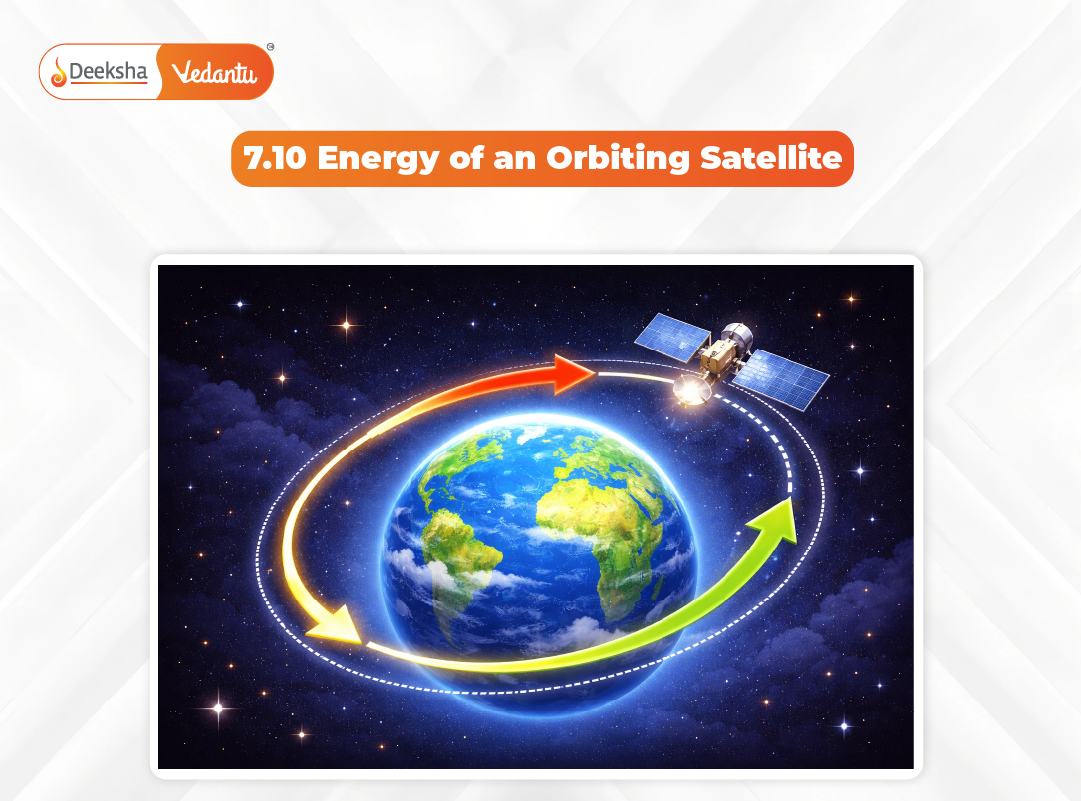


The motion of an orbiting satellite is one of the most powerful demonstrations of gravitational physics. While force-based derivations explain orbital velocity and centripetal motion, energy analysis provides a deeper and more elegant understanding of satellite dynamics.
In competitive examinations like JEE Main and JEE Advanced, energy-based approaches are extremely important because they simplify multi-step gravitational problems. By understanding kinetic energy, gravitational potential energy, and total mechanical energy together, students can quickly analyze orbital transitions, escape conditions, and binding strength.
In this chapter, we will explore:
- Orbital velocity derivation
- Kinetic energy of a satellite
- Gravitational potential energy in orbit
- Total mechanical energy and its interpretation
- Important energy relations
- Energy in elliptical orbits
- Binding energy concept
- Orbital transition energy analysis
- Advanced JEE conceptual applications
1. Satellite in Circular Orbit – Recap of Orbital Velocity
Consider a satellite of mass  moving in a circular orbit of radius
  around Earth of mass
  .
.
Gravitational force acts as the centripetal force required for circular motion:

Cancelling and simplifying:

Thus orbital velocity is:

Important conclusions:
- Orbital velocity is independent of satellite mass.
- It decreases as orbital radius increases.
- It depends only on the gravitational parameter
 .
.
 .
.This velocity expression is the foundation for deriving all energy relations.
2. Kinetic Energy of an Orbiting Satellite
Kinetic energy of the satellite is:

Substituting :

Thus:

Key insights:
- Kinetic energy is inversely proportional to orbital radius.
- As
 increases, kinetic energy decreases.
 - Higher satellites move slower and therefore possess less kinetic energy.
3. Gravitational Potential Energy in Orbit
Gravitational potential energy at distance from Earth's center is:

Important observations:
- Potential energy is negative because gravitational systems are bound.
- As increases, potential energy increases (becomes less negative).
- At infinity,
 .
.
 .
.The negative sign indicates that work must be done against gravity to separate the satellite from Earth.
4. Total Mechanical Energy of a Satellite
Total mechanical energy is the sum of kinetic and potential energy:

Substituting the derived expressions:

Simplifying:

This compact expression is one of the most important formulas in gravitational mechanics.
Fundamental Energy Relations
From the above derivation:


Thus:
- Potential energy magnitude is twice the kinetic energy.
- Total energy is negative.
- Total energy equals negative of kinetic energy.
These relations are frequently tested in JEE problems.
5. Interpretation of Negative Total Energy
The sign of total mechanical energy determines the nature of motion:
If  :
:
- The satellite is gravitationally bound.
- It remains in orbit.
If  :
:
- The satellite reaches escape condition.
If  :
:
- The satellite escapes with finite speed at infinity.
Thus energy classification provides a complete physical interpretation of orbital motion.
6. Connection with Escape Speed
Escape condition corresponds to total energy equal to zero.
For circular orbit:

Thus energy required to escape equals magnitude of total energy.
Escape velocity is:

Orbital velocity is:

Therefore:

This elegant proportional relation is a key conceptual result in JEE Advanced.
7. Energy in Elliptical Orbit
If the satellite does not move in a perfect circular orbit, its motion becomes elliptical.
For an elliptical orbit, total mechanical energy depends only on semi-major axis  :
:

Important conclusions:
- Total energy does not depend on instantaneous distance.
- It depends only on the size of the orbit.
- At periapsis, kinetic energy is maximum.
- At apoapsis, kinetic energy is minimum.
This result is extremely important in advanced gravitational problems.
8. Binding Energy of a Satellite
Binding energy is the energy required to remove a satellite from its orbit to infinity.
For circular orbit:
Thus binding energy equals magnitude of total mechanical energy.
More negative energy implies stronger gravitational binding.
This idea extends beyond satellites to stars and galaxies.
9. Energy Change During Orbital Transition
If a satellite shifts from orbit of radius  to
to  :
:
Initial energy:

Final energy:

Energy change:

If  :
:
- Energy must be supplied.
- Total energy becomes less negative.
- Satellites move slower in higher orbit.
If  :
:
- Energy must be removed.
- Satellite speeds up in lower orbit.
This principle is fundamental in satellite maneuvering.
10. Variation of Energies with Orbital Radius
As increases:
 decreases
 increases (less negative)
- increases (less negative)
 decreases
 increases (less negative)
 increases (less negative)
Thus higher satellites are less tightly bound and possess lower kinetic energy.
Graphically:
 follows an inverse curve.
 follows a similar inverse pattern.
- lies midway between and zero.
 follows an inverse curve.
 follows a similar inverse pattern.
 lies midway between
 11. Virial Theorem Insight (Advanced Concept)
For gravitational systems in stable orbit, the virial theorem states:

Which directly gives:

This matches our earlier result and confirms internal consistency of gravitational mechanics.
12. Important JEE-Level Conceptual Insights
- Total energy inversely proportional to orbital radius.
- Energy depends on semi-major axis in elliptical orbit.
- Escape corresponds to total energy zero.
- Binding energy equals magnitude of total energy.
- Increasing orbit requires energy supply.
- Lowering orbit requires energy removal.
Energy-based methods reduce complex orbital problems to simple algebraic manipulations.
FAQs
Q1. Why is total energy negative for an orbiting satellite?
Because the satellite is gravitationally bound to Earth.
Q2. Why is potential energy twice the kinetic energy in magnitude?
Because gravitational force provides centripetal force, leading to  .
.
Q3. What happens when total energy becomes zero?
The satellite reaches escape condition.
Q4. Does total energy depend on satellite mass?
Yes. Total energy is directly proportional to satellite mass.
Q5. On what orbital energy depends?
It depends only on orbital radius (or semi-major axis in elliptical orbit).
Conclusion
The energy of an orbiting satellite provides a complete and elegant framework for understanding gravitational motion. The relations:


form the backbone of orbital mechanics.
By mastering these energy relations, students can confidently solve problems involving escape speed, orbital transitions, elliptical motion, and gravitational binding.
A strong conceptual command over orbital energy is essential for excelling in JEE Main and JEE Advanced and for developing a deeper appreciation of celestial mechanics.



Get Social