
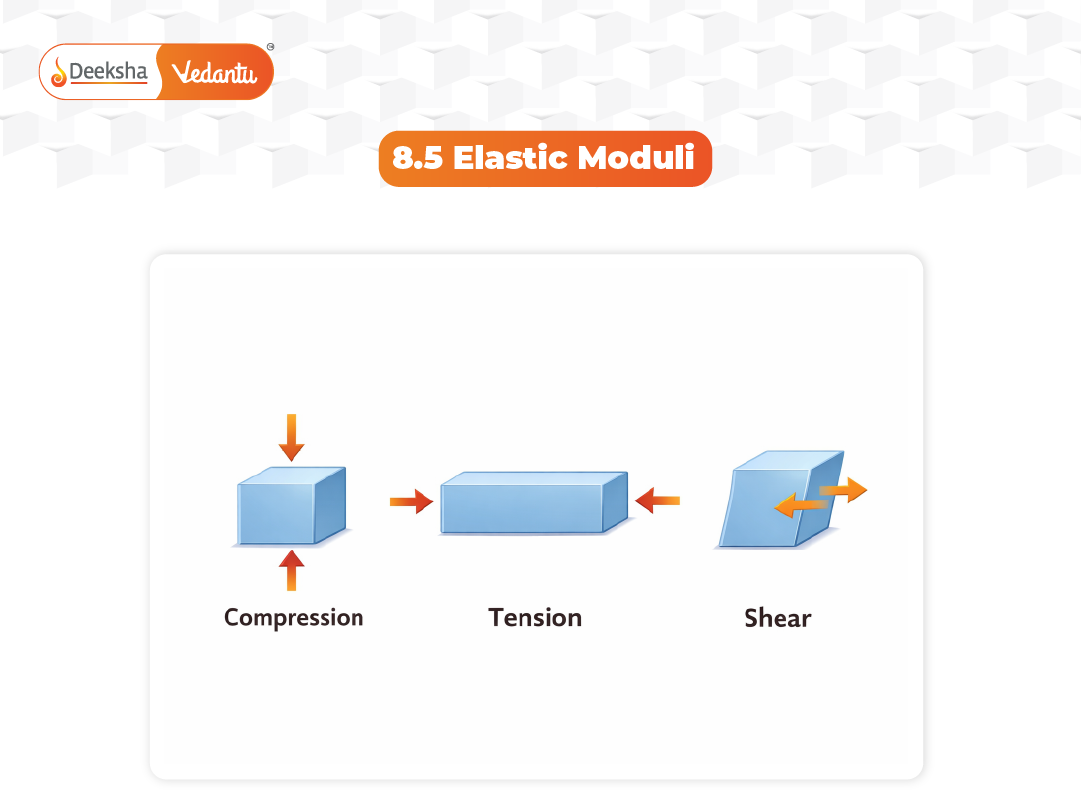


Elastic moduli are fundamental parameters that quantify how strongly a material resists deformation when subjected to external forces. In earlier sections, stress was defined as internal restoring force per unit area and strain as fractional deformation. Hooke's Law established that, within the elastic limit, stress is proportional to strain. The proportionality constant in this relation is called modulus of elasticity.
Different types of deformation – longitudinal, shear and volumetric – lead to different elastic constants. These constants are intrinsic material properties and do not depend on the size or shape of the body, provided deformation remains within the elastic limit.
For JEE Main and JEE Advanced, elastic moduli are extremely important because they combine conceptual understanding with numerical applications, dimensional analysis, and structural reasoning.
1. Young's Modulus
Young's modulus applies to longitudinal deformation produced by tensile or compressive stress.
It is defined as the ratio of longitudinal stress to longitudinal strain.

Using definitions of stress and strain:


Where:
 = Applied force
 = Cross-sectional area
 = Original length
 = Extension
 = Extension
Unit of Young's modulus is Pascal (Pa).
Dimensional formula:

Thus Young's modulus has the same dimensions as stress and pressure.
Higher value of  indicates greater stiffness.
Examples:
- Steel → Very high (rigid)
- Aluminium → Moderate
- Rubber → Very low (flexible)
1.1 Extension of a Wire – Detailed Derivation
From:
Rearranging:

This formula is fundamental in numerical problems.
Observations:


Thus:
- Longer wire stretches more.
- Thicker wire stretches less.
- Stiffer material stretches less.
1.2 Series and Parallel Combination of Wires
If two wires of same material are connected in series:

If connected in parallel:

Where spring constant of a wire is:

These relations frequently appear in JEE problems.
2. Shear Modulus (Modulus of Rigidity)
Shear modulus measures resistance to change in shape at constant volume.
It is defined as the ratio of shear stress to shear strain.

If tangential force  acts on area
  and angular deformation is
  (in radians):

Since shear strain equals angular displacement in radians for small angles.
Unit of shear modulus is Pascal.
High  indicates high rigidity.
Shear modulus is important in torsion of cylinders and twisting of shafts.
For a cylindrical rod of length  subjected to torque
  :
:

Where  is polar moment of inertia.
This connects elasticity with rotational mechanics.
3. Bulk Modulus
Bulk modulus measures resistance to uniform compression.
Defined as ratio of volumetric stress to volumetric strain:

Since volumetric stress equals pressure  :
:

Negative sign indicates volume decreases when pressure increases.
Large  → Material is incompressible.
Small → Easily compressible.
Comparison:
- Solids → High bulk modulus
- Liquids → Moderate bulk modulus
- Gases → Very low bulk modulus
Bulk modulus plays a key role in sound propagation in fluids.
Speed of sound in fluid:

Thus elasticity connects with wave mechanics.
4. Poisson's Ratio
When a material is stretched in one direction, it contracts in perpendicular directions.
Poisson's ratio is defined as:

If original diameter is  and change is
  :
:

Negative sign ensures  is positive.
Range for most materials:

Special cases:
 → Perfect incompressibility
 → No lateral contraction
 → Perfect incompressibility
 → No lateral contraction
Rubber has Poisson's ratio close to 0.5.
5. Relation Between Elastic Constants
For isotropic materials, the three elastic constants are interrelated.


These relations are derived from three-dimensional stress analysis.
Important conclusions:
- If
 increases, bulk modulus increases.
 - For incompressible material (), bulk modulus becomes very large.
Such interrelations are common in advanced objective questions.
6. Elastic Potential Energy Density
When a body is deformed elastically, work done is stored as elastic potential energy.
Energy per unit volume is:

Using  :
:

For a stretched wire:

This quadratic dependence explains why large deformation requires rapidly increasing energy.
7. Comparison Table of Elastic Moduli
| Modulus | Mathematical Form | Type of Deformation | Physical Meaning |
| Young's Modulus |  | Longitudinal | Stiffness |
| Shear Modulus |  | Shape | Rigidity |
| Bulk Modulus |  | Volume | Incompressibility |
8. Advanced JEE-Oriented Applications
- Calculating extension in non-uniform rods using integration.
- Determining compression of a sphere under pressure.
- Finding change in volume using Poisson's ratio.
- Comparing stiffness using slope of stress-strain graph.
- Relating sound speed to bulk modulus.
Example Concept:
If radius of wire is doubled:

Area becomes four times.
Thus extension becomes one-fourth for the same force.
Such proportional reasoning helps solve MCQs quickly.
FAQs
Q1. Why do elastic moduli have the same unit as stress?
Because they are ratios of stress to strain and strain is dimensionless.
Q2. Which modulus determines stiffness in tension?
Young's modulus.
Q3. Why is bulk modulus very large for solids?
Because solids strongly resist volume change.
Q4. What does Poisson's ratio indicate?
It indicates degree of lateral contraction relative to longitudinal extension.
Q5. Can one elastic constant determine the others?
Yes, for isotropic materials if Poisson's ratio is known.
Conclusion
Elastic moduli quantify the resistance of materials to different types of deformation. Young's modulus measures stiffness in tension, shear modulus measures rigidity against shape change, and bulk modulus measures resistance to volume change.
Poisson's ratio links longitudinal and lateral strains, while mathematical relations between elastic constants allow conversion between moduli.
A deep understanding of elastic moduli is essential for solving advanced JEE problems and for analysing real-world structural and material b



Get Social