
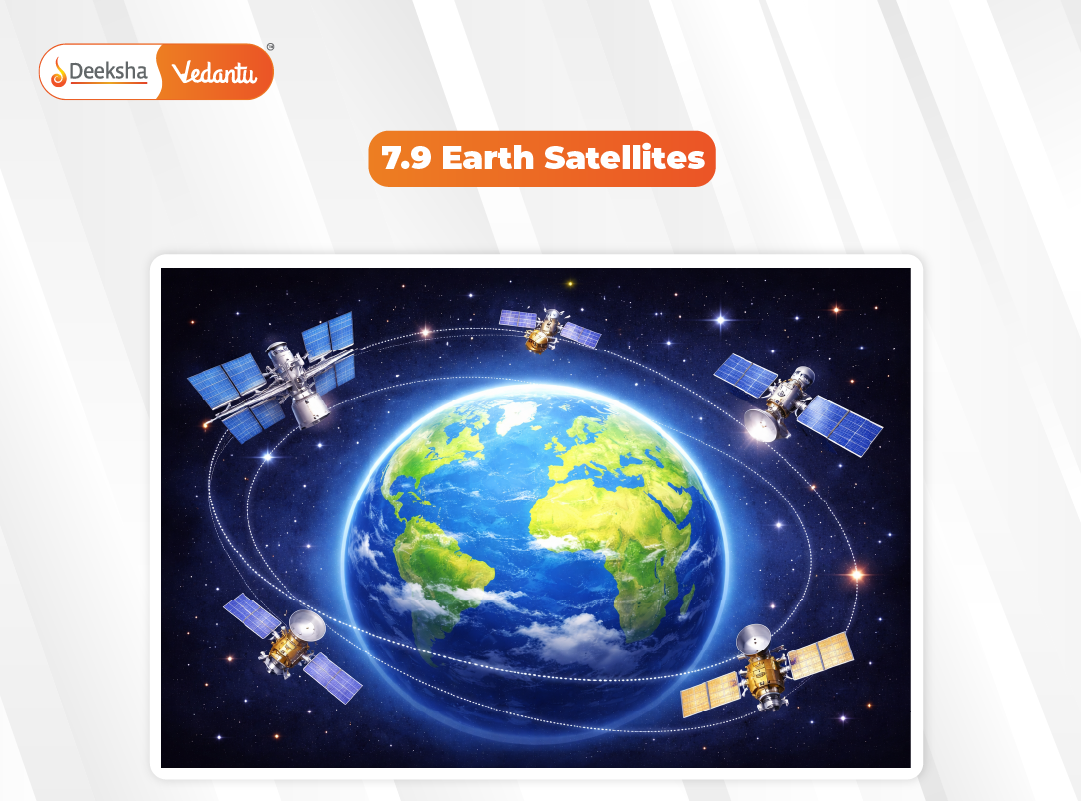


Earth satellites represent one of the most elegant applications of Newton's Universal Law of Gravitation and circular motion. The motion of satellites beautifully connects gravitational force, centripetal acceleration, conservation of mechanical energy, escape speed, and Kepler's laws.
From communication satellites to GPS systems and space missions, orbital mechanics plays a central role in modern technology. In JEE Main and JEE Advanced, Earth satellite problems are frequently asked because they integrate multiple concepts such as:
- Orbital velocity
- Time period of revolution
- Gravitational potential energy
- Total mechanical energy
- Escape speed comparison
- Geostationary satellite conditions
- Multi-step orbital transitions
In this section, we will develop a deep and structured understanding of Earth satellites from fundamental derivations to advanced conceptual insights.
1. What is an Earth Satellite?
A satellite is a body that revolves around the Earth under the influence of gravitational attraction.
There are two broad types:
- Natural satellites (e.g., Moon)
- Artificial satellites (man-made, launched by rockets)
A satellite does not fall to Earth because it has sufficient tangential velocity such that Earth's gravitational force continuously bends its path into a circular (or elliptical) orbit.
Thus, gravitational force provides the necessary centripetal force required for orbital motion.
2. Orbital Velocity of a Satellite
Consider a satellite of mass  moving in a circular orbit of radius
  around Earth.
Gravitational force acting on the satellite is:

For circular motion, centripetal force required is:

Since gravitational force provides centripetal force:

Cancelling and simplifying:

Thus orbital velocity:

Important conclusions:
- Orbital velocity depends only on orbital radius.
- It is independent of satellite mass.
- As
 increases, orbital velocity decreases.
For a satellite very close to Earth's surface ( ):
):

Using  :
:

Numerically for Earth:

This is called the first cosmic speed.
3. Time Period of Revolution
Time period  is the time taken to complete one revolution.
Distance covered in one revolution:

Time period:

Substituting orbital velocity:

Thus:

Squaring both sides:

This confirms Kepler's third law:

Key implications:
- Higher satellites take longer time to revolve.
- Low Earth satellites have a small time period.
4. Acceleration of Satellite
Centripetal acceleration of satellite:

Substituting  :
:

This equals gravitational acceleration at that radius.
Thus a satellite is in continuous free fall under gravity.
5. Total Mechanical Energy of a Satellite
Total mechanical energy:

Kinetic energy:

Substituting :

Potential energy:

Total energy:

Important relations:


- Total energy is negative → satellite is gravitationally bound.


Energy becomes less negative as increases.
6. Energy Required to Raise Orbit
If satellite is shifted from orbit of radius  to
to  :
:
Total energy changes from:

To:

Energy supplied equals:

Since  ,
,  is less negative.
Thus energy must be supplied to move the satellite to higher orbit.
This concept is frequently used in JEE Advanced multi-step problems.
7. Relation Between Escape Speed and Orbital Speed
Orbital speed:
Escape speed:

Thus:

If a satellite already moves with orbital speed, additional speed required to escape is:

This additional speed is much smaller than escape speed from rest.
8. Geostationary Satellite
A geostationary satellite has the following properties:
- Circular orbit
- Lies in equatorial plane
- Time period equals Earth's rotation (24 hours)
- Appears stationary relative to Earth
Using:
Setting  hours and solving gives:

Height above surface ≈ 36,000 km.
Geostationary satellites are widely used in communication, weather forecasting, and broadcasting.
9. Weightlessness in Orbit
Astronauts experience apparent weightlessness inside satellites.
Reason:
Satellites and astronauts both accelerate toward Earth with the same acceleration.
Normal reaction becomes zero.
Gravity is still present – weightlessness arises because there is no supporting force.
This concept is often tested in conceptual JEE problems.
10. Elliptical Orbits (Advanced Insight)
If speed is slightly greater or smaller than circular orbital speed, orbit becomes elliptical.
Total energy in elliptical orbit:

Where  is semi-major axis.
Thus total energy depends only on semi-major axis, not instantaneous distance.
This result is important in advanced gravitational mechanics.
11. Launching a Satellite
To launch a satellite, two main energy requirements exist:
- Gain gravitational potential energy to reach required height
- Gain kinetic energy equal to orbital kinetic energy
Total launch energy ≈ change in total mechanical energy.
Rockets must also overcome atmospheric drag and rotational considerations.
12. Important JEE-Level Insights
- Orbital velocity decreases with increasing orbital radius.
- Time period increases with radius.
- Total energy is inversely proportional to orbital radius.
- Escape speed is
 times orbital speed.
 - Geostationary satellites must lie in equatorial plane.
- Energy methods simplify orbital transition problems.
 times orbital speed.
These ideas frequently appear in integer-type and multi-step questions.
FAQs
Q1. Why does a satellite not fall to Earth?
Because its tangential velocity ensures gravitational force acts as centripetal force, maintaining orbit.
Q2. Does orbital velocity depend on satellite mass?
No. It depends only on distance from Earth's center.
Q3. Why is total energy negative for a satellite?
Because it is gravitationally bound to Earth.
Q4. Why do astronauts feel weightless?
Because they are in continuous free fall along with the satellite.
Q5. What is the condition for geostationary orbit?
Time period must equal Earth's rotation and orbit must lie in equatorial plane.
Conclusion
Earth satellites provide a powerful demonstration of gravitational force acting as centripetal force. Orbital velocity, time period, and total mechanical energy relations form the core of satellite mechanics.
The connections between orbital motion, escape speed, and energy conservation make this topic conceptually rich and highly important for JEE Main and JEE Advanced.
A deep understanding of orbital mechanics allows students to solve complex gravitational problems efficiently while appreciating the physics behind real-world space missions.



Get Social