
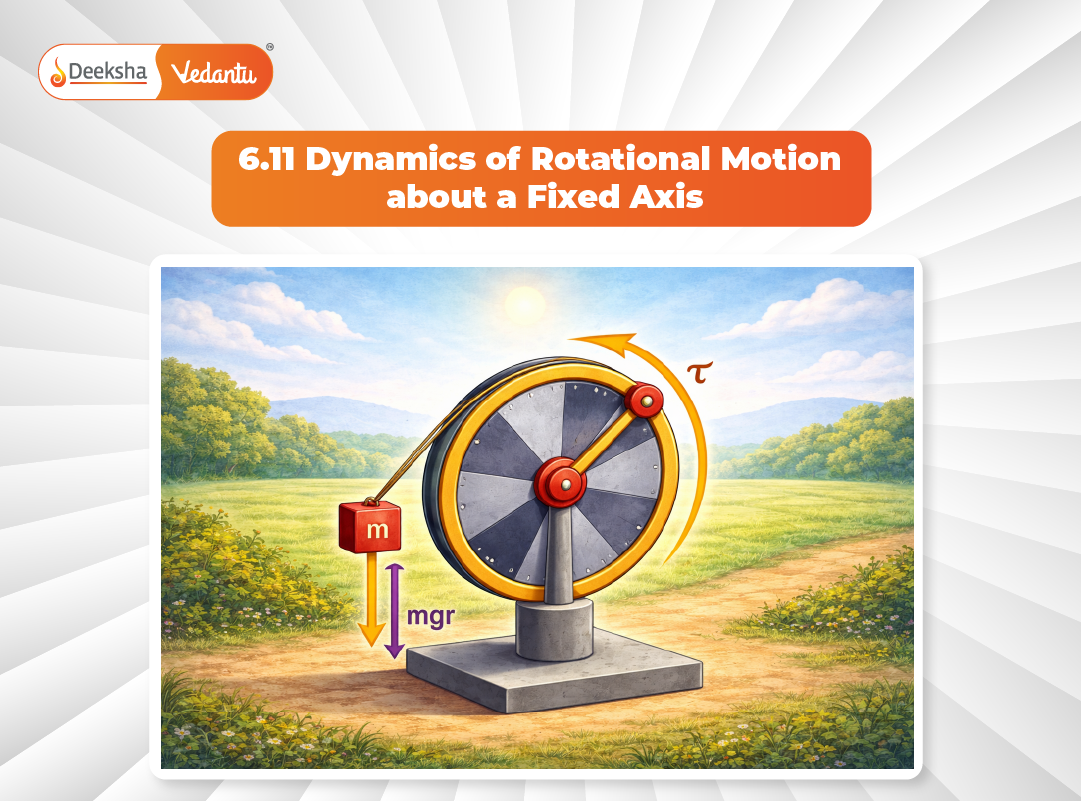


After developing the kinematics of rotational motion, we now enter the most powerful and conceptually rich part of rotational mechanics – dynamics of rotational motion about a fixed axis. While kinematics describes how angular displacement, velocity, and acceleration change with time, dynamics explains why these changes occur.
Rotational dynamics is the angular analogue of Newton's laws of motion. Just as force produces linear acceleration, torque produces angular acceleration. The mathematical structure built here forms the foundation for solving complex JEE Main and JEE Advanced problems involving pulleys, rolling bodies, rotating rods, discs, composite bodies, and constraint systems.
A strong command over this section is essential because most advanced rotational problems combine translational motion, rotational motion, torque balance, and energy conservation simultaneously.
1. Newton's Second Law for Rotation
In translational motion:

In rotational motion about a fixed axis:

Where:
 is the net external torque about the axis
 is moment of inertia about that axis
 is angular acceleration
 is the net external torque about the axis
 is angular acceleration
This equation is the fundamental law of rotational dynamics.
It immediately tells us:
- For a given torque, angular acceleration is inversely proportional to moment of inertia.
- For a given body, larger applied torque produces larger angular acceleration.
Thus moment of inertia plays exactly the same role in rotational motion that mass plays in translational motion.
2. Detailed Derivation of 
Consider a rigid body composed of many particles rotating about a fixed axis.
For the  particle located at perpendicular distance
  from the axis:
Tangential acceleration is:

Applying Newton's second law to that particle:

Torque on that particle:

Substituting:


Total torque on the rigid body:


But by definition:

Therefore:
This derivation shows that the rotational equation is a natural extension of Newton's second law applied to each particle of the rigid body.
3. Angular Momentum in Rotational Dynamics
For a rigid body rotating about a fixed axis:

Differentiating with respect to time:

If  is constant:
This shows that torque is the time rate of change of angular momentum.
If net external torque is zero:

Thus angular momentum remains conserved.
This conservation principle is heavily used in advanced problems involving variable moment of inertia.
4. Work–Energy Theorem for Rotation
Small angular displacement  produces small work:

Total work:

If torque is constant:

Using rotational kinematics and , we derive rotational kinetic energy:

This is the rotational analogue of:

Thus torque does work to increase rotational kinetic energy.
5. Power in Rotational Motion
Instantaneous power is given by:

This relation is extremely important in practical applications such as motors and engines.
If torque is constant and angular velocity increases, power increases proportionally.
For steady rotation with constant angular velocity, power equals rate of energy dissipation due to friction.
6. Rolling Motion as a Major Application
Consider a solid cylinder rolling down an incline without slipping.
For translation:

For rotation about centre:

Using rolling constraint:

Substituting  :
:


Substitute into translational equation:


This demonstrates how translational and rotational equations must be solved simultaneously.
7. Multi-Step JEE Advanced Example
A disc of mass  and radius
  is pulled by a horizontal force applied at its centre while it rolls without slipping.
Steps:
- Apply
 .
. - Apply
 about the centre.
 - Use rolling constraint
 .
.
Such systems require careful identification of torque-producing forces.
8. Rotational Dynamics About Arbitrary Axis
Equation is valid only when the axis is fixed and is constant.
If axis shifts or changes with time, full angular momentum relation must be used:
This distinction is important in advanced rigid body motion.
9. Composite Body Rotation
For composite bodies:

Apply torque equation using total moment of inertia.
Such problems appear frequently in JEE Advanced.
10. Rotational Equilibrium
If net external torque is zero:

Then:

Thus angular velocity remains constant.
This condition is crucial in pulley and balancing problems.
11. Advanced Conceptual Insights
- Torque depends on the chosen axis.
- Moment of inertia depends on mass distribution.
- Friction may provide torque even if it does no work.
- Angular momentum conservation is often simpler than force analysis.
- Energy methods can simplify rotational problems.
Many JEE Advanced problems require switching between force-torque and energy methods strategically.
12. Common Mistakes to Avoid
- Ignoring direction of torque.
- Applying about the incorrect axis.
- Forgetting rolling constraints.
- Confusing centripetal force with torque-producing force.
- Ignoring internal torque cancellation.
FAQs
Q1. What is the rotational form of Newton's second law?
It is .
Q2. How is rotational kinetic energy expressed?
.
Q3. What is the relation between torque and angular momentum?
.
Q4. Why is rolling motion a combined problem?
Because both  and
and  must be applied.
Q5. When is angular momentum conserved?
When net external torque is zero.
Conclusion
Dynamics of rotational motion about a fixed axis completes the structure of rigid body mechanics. The central equation
connects torque with angular acceleration, while
and
connect energy and power with rotational motion.
Mastering these relations, along with angular momentum conservation, allows students to confidently solve advanced multi-step JEE problems involving rigid body systems, rolling motion, pulleys, and composite structures.



Get Social