
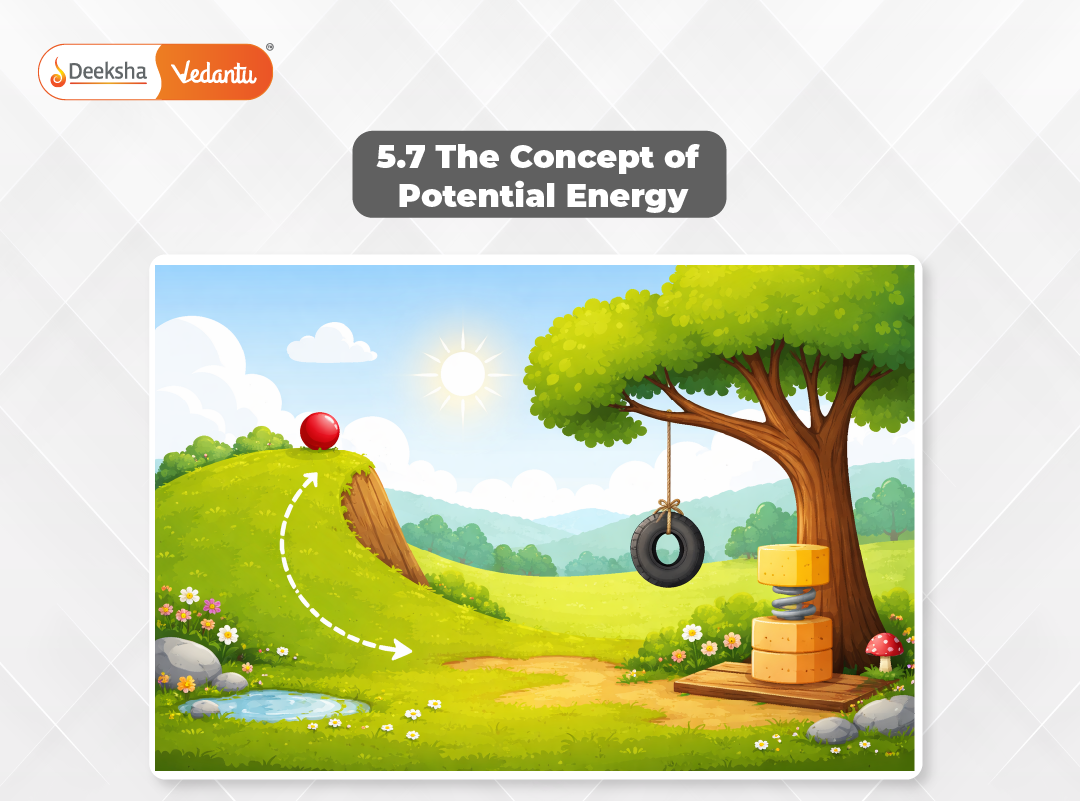


Section 5.7 introduces one of the most profound ideas in mechanics — Potential Energy. While kinetic energy is associated with motion, potential energy is associated with position, configuration, or arrangement within a force field. This concept allows us to analyze motion without always solving force equations directly.
At Deeksha Vedantu, we emphasize that potential energy is not merely a formula like  or
or  , but a deeper concept that connects force, work, equilibrium, stability, and conservation laws. Mastery of this topic is essential for excelling in JEE Main, JEE Advanced, and NEET.
What Is Potential Energy?
Potential energy is defined as the energy possessed by a body due to its position or configuration in a conservative force field.
Mathematically, potential energy is defined through work done by conservative forces:

This means that when a conservative force does positive work, potential energy decreases. When work is done against the conservative force, potential energy increases.
This negative sign ensures correct energy accounting and is fundamental in all advanced derivations.
Conservative Forces and Their Role
A force is conservative if:
- Work done depends only on initial and final positions.
- Work done over a closed path is zero.
Mathematically:

Only conservative forces have associated potential energy.
Examples:
- Gravitational force
- Spring force
- Electrostatic force
Non-conservative forces like friction do not have potential energy functions.
Gravitational Potential Energy Near Earth's Surface
Near Earth's surface, gravitational force is approximately constant:

Work done in lifting a mass  through height
  :
:

Thus gravitational potential energy is:
Important: Potential energy depends on the reference level chosen.
Only differences in potential energy are physically meaningful.
Reference Level Concept (Advanced Insight)
Potential energy is relative, not absolute.
We define a reference level where:

If reference is ground level, then above ground  .
.
If reference is infinity (as in gravitational fields), then:

Negative gravitational potential energy indicates a bound system.
This idea is crucial in orbital mechanics and escape velocity derivations.
General Gravitational Potential Energy (Variable Force Case)
For distances far from Earth, gravitational force varies with distance:

Potential energy at distance  is:
is:

Evaluating:
This expression forms the basis for:
- Escape velocity
- Orbital energy
- Satellite motion
Elastic Potential Energy (Spring Energy)
For a spring obeying Hooke's law:

Work done in stretching from 0 to x:

Thus potential energy stored:
Elastic potential energy is always positive because it represents stored energy relative to equilibrium.
Force as Gradient of Potential Energy
A powerful relation connects force and potential energy:

In three dimensions:

This means force always acts in the direction of decreasing potential energy.
This concept is fundamental in advanced mechanics and quantum physics.
Potential Energy Curves and Stability Analysis
Potential energy as a function of position gives deep insight into motion.
Stable Equilibrium
If potential energy has a minimum at  :
:

Small displacement results in restoring force.
Example: Spring at equilibrium.
Unstable Equilibrium
If potential energy has a maximum:

Small displacement causes object to move away.
Example: Ball balanced on top of hill.
Neutral Equilibrium
If potential energy remains constant:

Example: Particle on flat surface.
These second derivative conditions are frequently tested in JEE Advanced.
Advanced JEE-Level Problem 1 (Stability)
Given:

Find equilibrium points and nature.
Step 1:

Set equal to zero:

Equilibrium points:

Step 2: Second derivative

At  :
:
 → Unstable
At  :
:
 → Stable
Thus, stability can be determined purely from potential energy function.
Advanced JEE-Level Problem 2 (Energy-Based Motion)
A particle of mass 1 kg moves in potential:

Total energy = 12 J.
Maximum displacement occurs when KE = 0.
Thus:


This method avoids solving differential equations.
Turning Points and Motion Limits
In one-dimensional motion:

Since KE cannot be negative:

Turning points occur where:


This graphical method is widely used in advanced physics.
Potential Wells and Bound States
If potential energy curve forms a well:
- Particles oscillate between turning points.
- Motion is bounded.
If total energy exceeds barrier height:
- Particle escapes.
These ideas form the conceptual foundation for advanced topics like quantum mechanics.
Advanced JEE-Level Problem 3 (Combined Spring & Gravity)
A block attached to the vertical spring is displaced and released.
Total mechanical energy:

At equilibrium, effective potential becomes minimum.
Students must account for both gravitational and elastic contributions.
Such combined energy systems are common in competitive exams.
Important Properties of Potential Energy
- Scalar quantity.
- Defined only for conservative forces.
- Depends on reference level.
- Force equals negative gradient of potential.
- Governs equilibrium and stability.
Understanding these properties ensures conceptual clarity.
Common Mistakes to Avoid
- Forgetting negative sign in gravitational potential.
- Ignoring reference level dependence.
- Confusing stability conditions.
- Applying potential energy concept to friction.
- Mixing up
 and
and  .
.
 .
.Precision prevents conceptual errors.
Key Formula Summary
| Concept | Formula |
| Gravitational PE (near Earth) | |
| Gravitational PE (general) | |
| Elastic PE | |
| Work–Potential Relation | |
| Force from PE | |
| Stability Condition |  |
FAQs
Q1. Why is potential energy defined with a negative sign in  ?
?
Because conservative forces reduce potential energy when doing positive work.
Q2. Can potential energy be negative?
Yes, depending on reference level (e.g., gravitational field).
Q3. How is stability determined using potential energy curves?
By checking second derivative: positive → stable, negative → unstable.
Q4. Why is gravitational potential energy negative in space?
Because zero reference is taken at infinity.
Q5. Why is this topic important for JEE Advanced?
Because many problems use potential energy curves to determine equilibrium, turning points, and motion limits.
Conclusion
Section 5.7 elevates our understanding of energy by introducing potential energy as a stored form of energy associated with conservative forces. Through gravitational and elastic systems, we see how position determines energy and how force can be derived from potential.
With advanced tools like stability analysis, turning points, and potential wells, students gain powerful problem-solving techniques used extensively in JEE Advanced and higher physics.
At Deeksha Vedantu, we ensure students master both conceptual foundations and advanced applications so they can confidently solve board-level and competitive-level problems from this crucial topic.



Get Social