
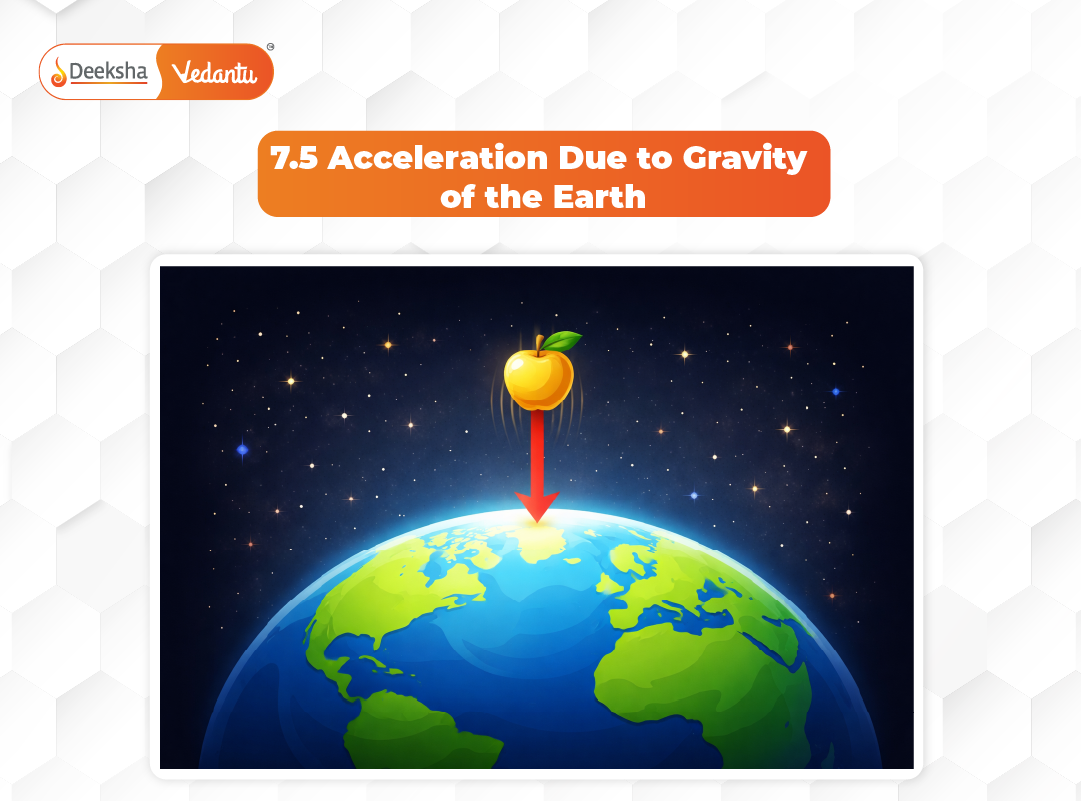


Acceleration due to gravity is one of the most fundamental and frequently used quantities in mechanics. It represents the acceleration experienced by a body when it falls freely under the gravitational attraction of Earth. This acceleration is denoted by  .
.
From falling apples to satellite motion, the concept of gravitational acceleration connects terrestrial physics with celestial mechanics. In competitive examinations like JEE Main and JEE Advanced, a deep understanding of – its derivation, variation, and applications – is essential.
In this section, we will:
- Derive acceleration due to gravity using Newton's law
- Evaluate its numerical value
- Study variation with altitude, depth, and latitude
- Distinguish between mass and weight
- Connect
 with escape velocity and orbital motion
 - Develop advanced conceptual insights useful for JEE
1. Derivation of Acceleration Due to Gravity at Earth's Surface
Consider a body of mass  placed on the surface of Earth.
Let:
 = Mass of Earth
 = Radius of Earth
 = Mass of the body
 = Mass of Earth
 = Radius of Earth
According to Newton's Universal Law of Gravitation, the gravitational force acting on the body is:

This force acts toward the center of Earth.
From Newton's Second Law of Motion:

Equating both expressions:

Cancelling :

This is the fundamental expression for acceleration due to gravity at Earth's surface.
Important conclusion:
Acceleration due to gravity depends only on Earth's mass and radius – not on the mass of the falling object.
2. Numerical Value of g
Using standard values:


Substituting into the formula:

We obtain approximately:

This means that in absence of air resistance, every freely falling object near Earth's surface accelerates downward at nearly 9.8 m/s².
3. Why g is Independent of Mass
From the derivation:
The mass of the falling body does not appear in the final expression.
Although gravitational force is proportional to mass:

Acceleration is given by:

Thus mass cancels out.
This explains why heavy and light objects fall with the same acceleration in vacuum.
This concept is frequently tested in JEE conceptual questions.
4. Relationship Between G and g
The expression:
shows the direct connection between universal gravitational constant  and acceleration due to gravity .
Important distinction:
 is universal and constant everywhere.
- depends on the planet's mass and radius.
For any planet of mass  and radius
  :
:

This formula allows comparison of gravity on different planets.
5. Variation of g with Altitude
If a body is at height  above Earth's surface, its distance from Earth's center becomes:

Thus acceleration due to gravity becomes:

Dividing by surface value :

For small heights where  , using binomial approximation:

Important conclusions:
- decreases as height increases.
- At very large heights, approaches zero.
- Satellites orbit Earth under reduced gravitational acceleration.
6. Variation of g with Depth
Consider a body at depth  below Earth's surface.
Let Earth be assumed to have uniform density.
Mass enclosed within radius  is proportional to
  :
:

Force at radius becomes:

Substituting  :
:

Thus acceleration at depth becomes:

Important conclusions:
- decreases linearly with depth.
- At Earth's center,
 .
.
 .
.Graphically:
- Outside Earth: inverse square decrease
- Inside Earth: linear decrease
These graphical interpretations are important for JEE Advanced.
7. Variation of g with Latitude (Effect of Earth's Rotation)
Earth rotates about its axis with angular velocity  .
.
Due to rotation, a body at latitude experiences centrifugal acceleration:

Where  is latitude.
Effective acceleration due to gravity becomes:

Important cases:
At equator ( ):
):

At poles ( ):
):

Thus:
- is minimum at equator.
- is maximum at poles.
Though small, this difference is measurable.
8. Weight of a Body
Weight is defined as gravitational force acting on a body.

Since varies:
- Weight varies with altitude.
- Weight varies with depth.
- Weight varies with latitude.
- Mass remains constant everywhere.
Thus mass and weight are fundamentally different physical quantities.
9. Free Fall Motion Under Constant g
Near Earth's surface, can be assumed constant.
Equations of motion:

For drop from rest:


These equations are frequently used in vertical motion and projectile problems.
10. Connection with Escape Velocity
Escape velocity from Earth is given by:

This relation directly connects acceleration due to gravity with escape speed.
If gravity were stronger, escape velocity would be higher.
11. Advanced JEE Insights
- varies inversely as a square of distance outside Earth.
- varies linearly inside Earth.
- Effective gravity includes centrifugal correction.
- is zero at Earth's center.
- Satellite motion occurs under reduced but not zero gravity.
Understanding proportional reasoning helps solve multi-step problems quickly.
FAQs
Q1. Why do all objects fall with the same acceleration in vacuum?
Because gravitational force is proportional to mass and acceleration equals force divided by mass, causing mass to cancel.
Q2. Why does g decrease with altitude?
Because gravitational force decreases with increase in distance from Earth's center following inverse square law.
Q3. Why is g zero at Earth's center?
Because gravitational forces from all directions cancel out and enclosed mass effectively becomes zero at the center.
Q4. Why is g less at the equator than at the poles?
Because Earth's rotation produces centrifugal acceleration that reduces effective gravity at the equator.
Q5. What is the relation between G and g?
Conclusion
Acceleration due to gravity is a direct consequence of Newton's Universal Law of Gravitation. It determines the motion of falling bodies, defines weight, influences projectile motion, and connects terrestrial physics with planetary science.
Its variation with altitude, depth, and latitude reveals the deeper structure of gravitational interaction. A strong conceptual understanding of – including its derivation, variation, and applications – is essential for mastering gravitation in Class 11 Physics and excelling in JEE Main and JEE Advanced.



Get Social