
Most students who lose marks in Maths do not lose them because they cannot solve the questions. They lose them because they spend fifteen minutes on one question early in the paper, rush the rest, and leave easy marks on the table. The paper is three hours long, and the real contest is how you spend those three hours.
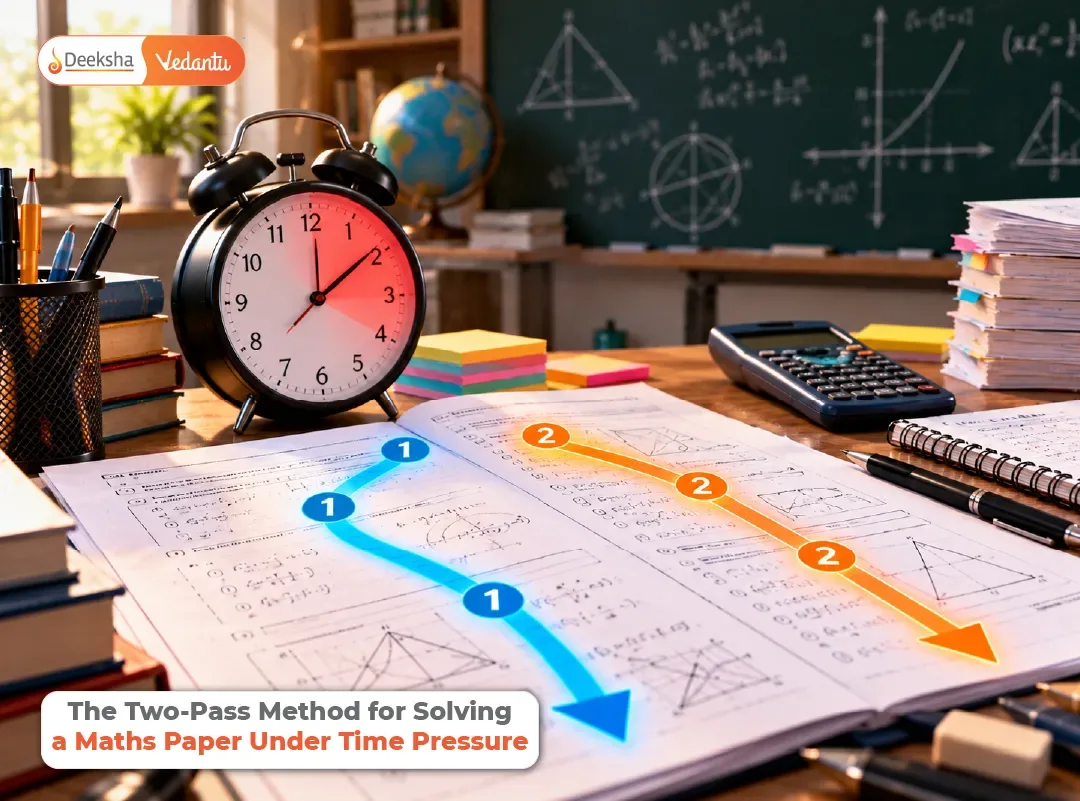
This guide explains the two-pass method, a simple way to approach how to solve cbse maths paper fast without cutting corners. The idea is to pass through the paper twice, taking the easy marks first and returning to the harder ones with the time you saved. We will cover how to set it up, how to decide in a few seconds what is “easy”, what to do in the second pass, and how to practise it. The time splits below are a starting point to practise with and adjust on past papers.
Why One Straight Run Through the Paper Fails
Many students solve in order, from question one to the last. It feels natural and organised, but it has three weaknesses.
- Time is spent unevenly. A single stubborn question can use up the time of three easy ones.
- Panic builds. Getting stuck early creates anxiety that spills over to later questions.
- Easy marks wait at the end. A short question at the back can be worth as many marks as a long one at the front, and you may not reach it.
The two-pass method fixes these by separating two jobs: collecting marks you are sure of, and then spending your remaining time on the questions that need thinking.
How the Two-Pass Method Works
In the first pass, you go through the paper in order, but with a strict rule. If you can see the method within about 20 to 30 seconds, you solve the question fully. If you cannot, you mark it with a small flag in the margin and move on. You do not stay with it.
In the second pass, you return to the flagged questions, choose the most promising first, and give them your remaining time.
The first pass is for certainty. The second is for effort. Together they make sure that the marks available through straightforward work are never lost to a hard question.
Setting Up Your Time
A rough plan for a three-hour paper, which you should adjust after practice, looks like this:
- First 5 minutes: Read the paper. Note the sections, the marks of each section and the questions with internal choice.
- Next 100 to 110 minutes: First pass, solving everything you can.
- Next 45 to 50 minutes: Second pass, on the flagged questions.
- Last 15 to 20 minutes: Check the numbers, units and signs.
These timings are only a starting point. Time yourself on a sample paper once and see where you are actually slow. If you finish the first pass much earlier or later than planned, shift the split.
How to Decide “Easy” in a Few Seconds
The skill that makes the method work is a fast decision. Use three quick checks.
- Do I recognise the type? For example, a quadratic equation to solve, an arithmetic progression sum or a trigonometric identity. If yes, it is likely a first-pass question.
- Can I write the first line? If you know the formula or the first step, you can usually finish.
- Is the question long but simple? Case-based and word problems can look long, but they often reduce to one equation. Do not skip them just for length.
If you hesitate for more than half a minute, flag it. You will return to it with a clearer head.
The First Pass: Rules to Follow
- Start with what you know best. Many students do well starting with the multiple-choice section, because the questions are short and each gives a mark.
- Write the full steps for longer questions. Method marks are given for steps, and you will not have time to rewrite later.
- Flag, don’t erase. Put a small mark next to a skipped question, and leave space in your answer sheet if you plan to write the answer in order. Alternatively, write the answer later in the space that remains, with the question number clearly marked.
- Do not check as you go. Save checking for the end, unless it takes five seconds.
The Second Pass: How to Pick Which Flagged Question to Attempt
When you return, do not go in order. Rank the flagged questions by how close you were.
- Questions where you had a start but got stuck: These go first. A fresh look often reveals the missing step.
- Questions with high marks: Give these the next block of time.
- Questions you had no idea about: These come last. Write what you can, since partial marks may be available for relevant steps, formulae or a correct diagram.
If a question does not move after a few minutes, stop and switch. The same discipline applies in the second pass.
What to Do in the Last 15 to 20 Minutes
Use this time to protect marks you already earned.
- Recheck the calculations in the longer questions, especially signs and unit conversions.
- Check that each answer is written clearly, with the final result underlined or boxed.
- Confirm that you have answered every question, including those on the last page.
- Make sure the question numbers match the order in the answer sheet.
A quick way to check without an answer key is to substitute your result back into the original equation or condition wherever possible. If it satisfies the question, you can move on with confidence.
Practising the Method
Reading about it is not enough. Build the habit with practice over a few weeks.
- Week 1: Take one previous-year paper and solve it normally. Note where you lost time.
- Week 2: Solve a second paper using the two-pass method, with a timer.
- Week 3: Do two more papers, and compare the marks and the time spent on each section.
- Week 4: Repeat on sample papers and adjust your timing split.
After each paper, write down which questions you flagged, whether the flag was the right call, and how you used the second pass. You will notice patterns, such as spending too long on geometry or flagging simple algebra out of nervousness. Practise with the Class 10 Maths MCQs to build speed in the short-answer section, and the syllabus for Class 10 Maths to check what is in scope.
A short note on nerves: the first five minutes of reading are not wasted time. Students who begin writing at once often discover later that a high-mark question was waiting at the end. A calm scan also tells you where your first pass will be heaviest, so you can set mental checkpoints, for example, ‘I should be at the halfway mark of the paper by the ninety-minute point.’ If you are behind a checkpoint, speed up by flagging faster rather than writing less on each answer.
Common Mistakes With the Method
- Flagging too much. If you flag half the paper, you are being too cautious. Give yourself a chance on each question.
- Flagging too little. If you never flag, you are back to one straight run.
- Spending the second pass on one question. The same time rule applies.
- Forgetting to return. Mark flags clearly so you can find them quickly.
- Skipping the final check. A small slip in the last step can undo a whole solution.
For a broader look at managing time and nerves in the exam hall, our article on time management for CBSE exams has more ideas, although the exam format has changed since it was written.
Frequently Asked Questions
Q1. What Is the Two-Pass Method in Maths?
It means solving the questions you can do quickly in the first pass, flagging the rest, and then using the remaining time on the flagged questions in a second pass.
Q2. How Long Should I Spend on the First Pass?
A common starting point is around 100 to 110 minutes of a three-hour paper, but this is a suggestion. Adjust it after timing yourself on a sample paper.
Q3. How Do I Decide Whether to Skip a Question?
If you cannot see the method or write the first line within 20 to 30 seconds, flag it and move on.
Q4. Should I Attempt the Questions in Order?
In the first pass, yes, with a skip rule. In the second pass, choose by how close you were and how many marks are involved.
Q5. How Do I Practise the Method?
Solve previous-year and sample papers with a timer, and review each time which questions you flagged and whether it was the right decision.
Conclusion
The two-pass method does not make you faster at algebra. It makes your three hours work harder by separating the marks you can collect now from the marks that need thinking. Set a quick rule for what counts as easy, flag the rest, use the second pass on the questions where you were closest, and keep the last 15 minutes for checking. Practise it on real papers until it becomes a habit, and adjust the timings to your own pace.










Get Social