
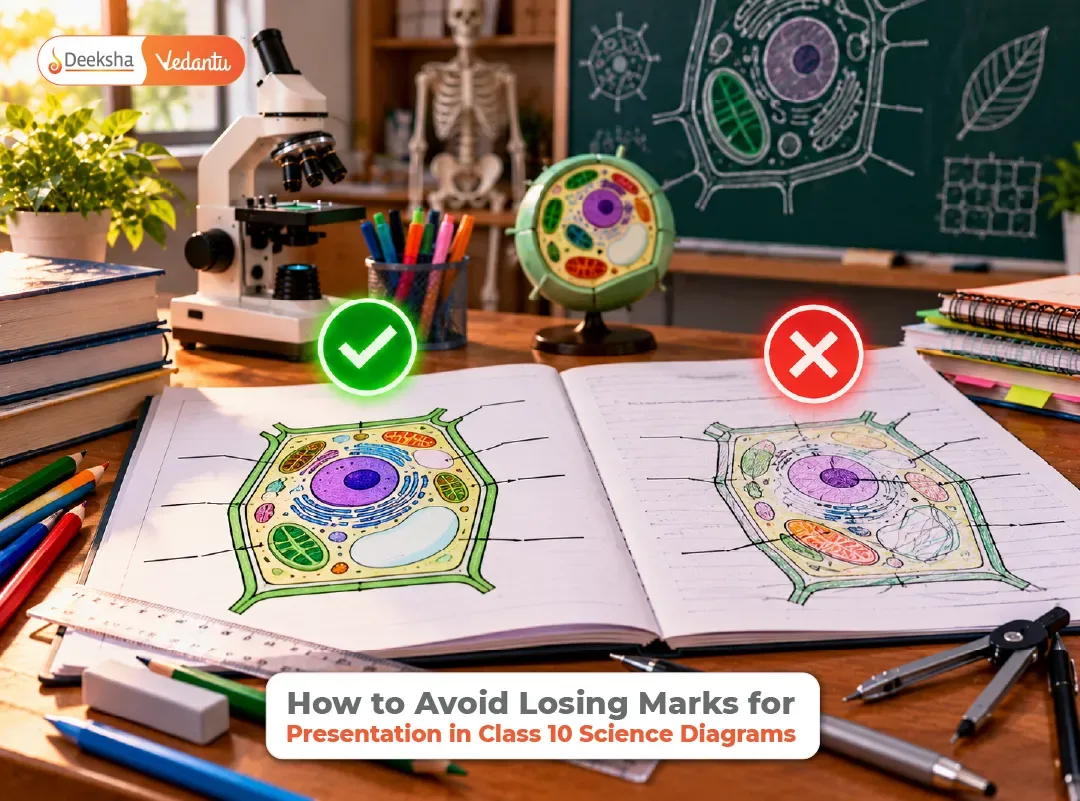
Every year, some students who know the content perfectly still lose two or three marks in Science for something that has nothing to do with knowledge: how the diagram looks. A label that points to the wrong place, a line drawn freehand, a heading missing, or a drawing so small that the parts cannot be told apart. These are presentation errors, and they are among the easiest marks to protect.
This guide is about how to score full marks in science diagrams by fixing presentation. It does not teach you the content of each diagram, since your textbook does that. It teaches you how to draw and label so that an examiner reading a hundred scripts in a day can award every mark quickly. Follow any instruction printed on your own paper.
Why Presentation Costs Marks
An examiner marks against a scheme that lists what must be present. For a diagram question this usually means a correct figure, correct labels and, in some cases, a title or a short note. If a part is unclear, the examiner cannot tell whether you know it, and the benefit of the doubt is not guaranteed. Our article on how examiners actually grade Science diagrams explains how the marking scheme thinks about this.
Presentation problems fall into four groups:
- Drawing errors: Wrong shape, missing part, wrong proportion.
- Labelling errors: Label missing, label placed on the wrong part, label too far from the pointer line.
- Layout errors: A diagram too small, too crowded, or squeezed into a corner.
- Tool errors: Freehand lines where a ruler is expected, smudged pencil, overwriting.
Each of these is fixable with a routine.
Before You Draw: Plan the Space
Spend ten seconds deciding where the diagram will sit. Many students start drawing at the left margin and run out of space for labels on the right.
- Leave room on both sides for labels, since you will usually label on the right and sometimes on the left.
- Draw the diagram large enough that each part is clearly visible, but not so large that it forces the answer onto another page.
- If a question has a written part and a diagram, write the short answer first or leave a clear gap, so the diagram does not push the text off the page.
A useful guide is to give a labelled diagram about a third of a page, unless the question needs more. Adjust this to the marks, and do not overspend time on a one-mark figure.
Use the Right Tools
Pencil for the figure and pen for the labels is common practice. Follow the instruction printed on your paper.
- Sharpen the pencil. A blunt pencil makes thick lines that blur small parts.
- Use a ruler for straight lines, such as the principal axis, the normal, mirror surfaces drawn as straight lines and the arms of a circuit.
- Draw curves smoothly. In ray diagrams, a bent ray should be a straight line with a clear bend at the surface, not a wobbly curve.
- Keep an eraser handy and rub out fully, not by smudging.
Light and Electricity diagrams reward a ruler more than others. For ray diagrams, your rays must be straight, arrows must be on the rays, and the image must be drawn at the point where rays meet. For circuits, use standard symbols and straight lines for wires.
Labelling: The Part That Earns the Marks
Labels are where most presentation marks are lost. A few habits fix most of the problems.
- Draw label lines with a ruler, and make sure each line touches the part it names. A line that stops short of the part, or ends between two parts, can be read either way.
- Do not cross label lines. If two lines cross, an examiner may suspect you have swapped the labels.
- Write labels horizontally, in a clear column, with the writing aligned and not slanted in all directions.
- Label every part the question asks for. Count the parts, then count your labels.
- Use the names from your textbook, not nicknames. For a human heart, a vein and an artery need the exact names, and “tube” is not a label.
- Do not write long sentences as labels. One or two words per label is enough.
A Closer Look: Three Typical Diagram Families
Biology diagrams. These often have many parts close together, such as the human heart, the nephron, the neuron or a flower’s reproductive parts. The risk is crowding. Draw the diagram large, keep proportions reasonable, and use label lines that fan out without crossing. For flow diagrams such as the path of blood through the heart, arrows should show direction clearly.
Physics diagrams. Ray diagrams and circuit diagrams are about accuracy and symbols. Mark the principal focus and centre of curvature on a mirror or lens ray diagram, draw the arrows, and label the object and image. In a circuit diagram, the ammeter goes in series and the voltmeter in parallel, and the symbols must be the standard ones.
Chemistry diagrams. Experimental set-ups, such as testing for a gas, show apparatus. The apparatus should look like apparatus, with sealed joints, the delivery tube dipping in the right place and the reagents named. Label the chemicals and the gas collected, and note any observation if the question asks for it.
For revision notes on the chapters involved, see the Class 10 Science notes, and for the Light chapter in particular, the chapter notes on Light.
Titles, Headings and Short Notes
Some diagram questions ask for a heading, such as “Diagram of the human excretory system”, while others do not. If the question does not ask, a short title below the diagram is still a harmless habit that costs five seconds. If the question asks you to “draw and label”, do both. If it asks you to “draw a neat diagram”, the word “neat” is a signal that clarity counts.
A Five-Step Routine You Can Practise
Practise this sequence until it becomes automatic.
- Plan the space and leave room on both sides.
- Draw the figure lightly in pencil, then darken the final lines.
- Add the arrows and special points, such as direction of flow or the focus.
- Draw label lines with a ruler, touching the correct parts.
- Write the labels, then count them against the parts in the question.
At the end, spend five seconds scanning for missing labels. This final scan is where most of the lost marks are recovered.
How to Practise
Presentation improves with repetition, and drawing is a skill that needs hands, not eyes.
- Take a diagram from your textbook, close the book, draw it from memory and then compare. This tests both content and presentation.
- Do this once for each major diagram before the exam, with a timer. A typical labelled diagram should take only a few minutes.
- Use previous-year Science papers and sample papers to see which diagrams are asked often, and practise those first.
- Ask a friend or teacher to look at your diagram for ten seconds and say which part was unclear. That feedback is more useful than another hour of drawing.
If you are short of time in the last days, our guide to what to study and what to skip in the last 30 days can help you decide how much drawing practice to fit in.
Common Mistakes to Avoid
- Copying the textbook figure too exactly, including decorations, which wastes time. A clear, simple version is enough.
- Shading everything. Shading wastes time and can hide labels, unless the diagram specifically needs it.
- Writing labels on the diagram itself, where they mix with lines. Keep them outside the figure.
- Forgetting the arrow on a ray. A ray without an arrow is an incomplete ray.
- Rushing the diagram at the end. If the diagram is worth marks, give it time.
For other habits that look harmless but cost marks, see our article on board exam mistakes that look like good habits.
Frequently Asked Questions
Q1. Do I Lose Marks for a Messy Diagram?
Marking schemes focus on the correct figure and labels, but a diagram that is unclear can make parts unreadable and so cost marks.
Q2. Should I Use a Pencil or a Pen for Diagrams?
Many students draw in pencil and label in pen. Follow the instruction printed on your paper.
Q3. How Large Should a Diagram Be?
Large enough that each part is clearly visible, usually about a third of a page for a multi-part figure. Adjust to the marks.
Q4. How Many Labels Should I Add?
Label every part the question asks for, and the parts your textbook usually labels in that diagram. Count them against the figure.
Q5. How Can I Practise Diagrams Quickly?
Draw from memory with a timer, compare with the textbook, and repeat for the diagrams that appear most in past papers.
Conclusion
Presentation marks in Science diagrams are among the most protectable marks in the paper. Plan the space, use a sharp pencil and a ruler, draw label lines that touch the right parts, count your labels and give each figure a quick final scan. Practise the five-step routine on the diagrams that appear most often, and you will find that the habit saves marks without costing extra time.












Get Social