
Every Class 10 student has felt it: you solve a long Maths problem, get a final answer that does not match the key, and assume the whole question is lost. In fact, board marking does not work that way. In the longer questions, marks are attached to the steps of the solution, so a clear method with one slip near the end can still earn most of the marks.
This guide explains how the cbse maths marking scheme steps system works in practice and how to write solutions so that every correct step is visible to the examiner. You will learn what earns marks, how to lay out a solution, a worked example, the habits that cost marks and a short practice routine. If you want to protect your time as well as your marks, read it together with our guide to the two-pass method for solving the Maths paper under time pressure.
How Step Marking Works
The Class 10 Maths paper has 80 marks for theory, and the questions grow in length with their marks. In the current pattern, Section A has 20 one-mark questions, Section B has five two-mark questions, Section C has six three-mark questions, Section D has four five-mark questions and Section E has three case-based questions of four marks each.
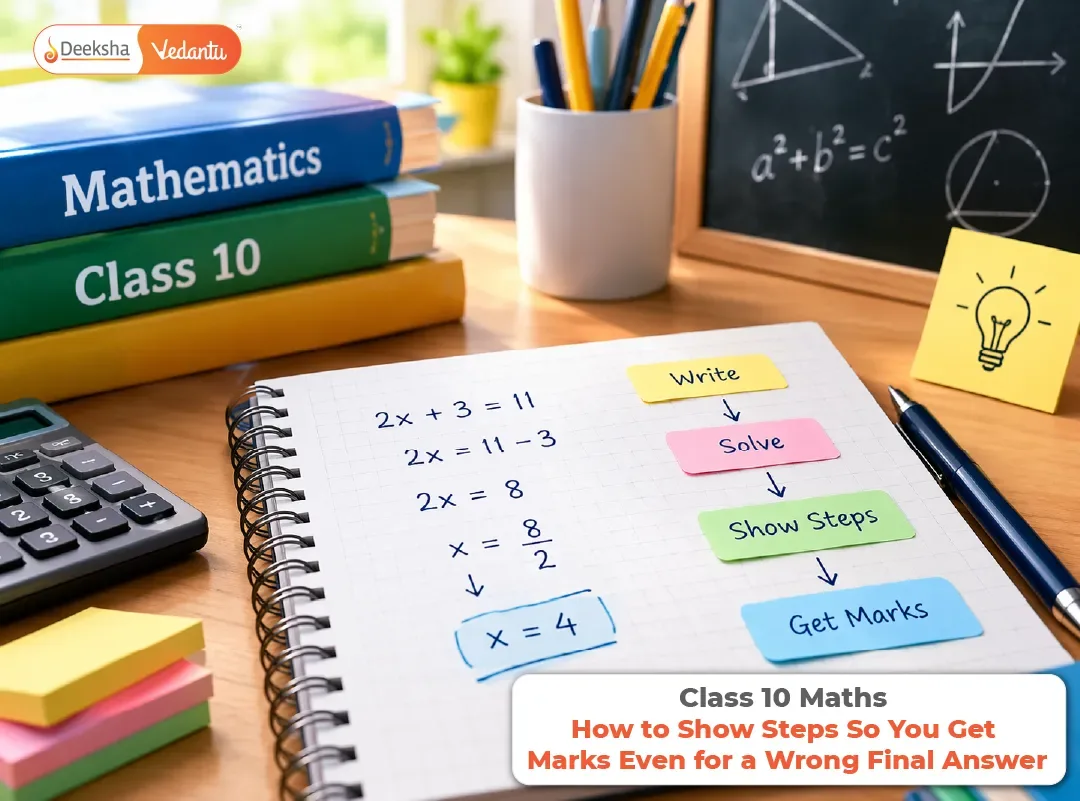
For a one-mark question, only the final answer counts. From two marks upward, the marking scheme breaks the solution into parts. A three-mark question is typically split into steps such as writing the correct formula, substituting the values, simplifying and stating the answer. An examiner follows the scheme and gives a mark for every step that you have written correctly.
This is why a wrong final answer does not always mean zero. If the method is right and the slip comes late, the early marks are already yours. The reverse is also true: a bare answer with no working is a poor bet in a question that carries several marks.
What Earns Marks in a Solution
Think of each long question as a set of small, separate tasks. These are the things examiners look for.
- The correct formula or theorem. Writing it before you use it is itself a step.
- Correct substitution. Showing the values placed into the formula.
- A correct method. Even if the arithmetic goes wrong, the right approach is credited.
- Intermediate results. Each correct result on the way is a step.
- The final answer with units. For word problems, write the unit and a closing sentence.
- A diagram where needed. In geometry, trigonometry and mensuration, a neat labelled figure usually carries a mark.
A Layout That Makes Steps Visible
Use the same layout for every long answer. A clean page lets the examiner find each step quickly.
- Given: Write the data in symbols, with units.
- To find or prove: State the goal in one line.
- Formula or theorem: Write it in general form.
- Substitution: Put the values in.
- Simplification: Work in short lines, one operation at a time.
- Answer: Box the result and add the unit.
Keep each step on its own line. Do not squeeze three operations into one line, because a mistake in a crowded line hides the correct work around it.
Worked Example: Quadratic Equation
Question (3 marks): The sum of two numbers is 27 and their product is 182. Find the numbers.
Given: Sum of the numbers = 27 and product = 182.
Let the numbers be x and (27 − x).
Step 1, form the equation: x(27 − x) = 182, so 27x − x² = 182, which gives x² − 27x + 182 = 0.
Step 2, factorise: x² − 13x − 14x + 182 = 0, so x(x − 13) − 14(x − 13) = 0, which gives (x − 13)(x − 14) = 0.
Step 3, solve: x = 13 or x = 14.
Answer: The numbers are 13 and 14. Check: 13 + 14 = 27 and 13 × 14 = 182.
Now suppose a student writes the equation correctly in Step 1 and the factorisation correctly in Step 2, but makes a sign slip in Step 3. Because the first two steps are visible and correct, those marks are protected. If the same student had jumped straight to a wrong pair of numbers with no working, nothing could be credited.
What to Do When You Get a Wrong or Odd Answer
Sometimes you reach an answer that looks impossible, such as a negative length or a fraction of a person. Do not scratch out your work in panic.
- Check the last two steps first. Most slips are in the final simplification.
- If you cannot find the error quickly, leave your working as it is and write the answer you reached. Method marks do not depend on a correct final line.
- Do not overwrite or cut the correct earlier steps while hunting for the slip.
- If time allows, redo the problem on the rough page and compare.
Scoring well is partly about avoiding the panic that destroys correct work.
Step-Writing for Different Question Types
Proofs
State what is given and what is to be proved. Name each theorem you use, such as the Basic Proportionality Theorem or the Pythagoras theorem. Write a reason for every statement. The final line should restate what was to be proved.
Constructions
Write the steps of construction in order, even when the figure is clean. Keep the arcs visible. A good figure with no steps may lose marks for the steps.
Word Problems
Define the variable in a line, form the equation, solve it and answer in a sentence with the unit. The definition of the variable and the closing sentence are small marks that students often drop.
Mensuration and Trigonometry
Draw the figure, mark the given values and write the formula before you substitute. Show the value of the trigonometric ratio you use.
Habits That Cost Marks
- Skipping the formula. Writing only numbers hides the method.
- Mental calculation. An error done in the head leaves no trace to credit.
- Messy working. Crossing and re-writing on top of earlier lines makes the correct steps hard to find.
- Changing the question. Copying a number wrongly at the start spoils every later step, so recheck the data once.
- No final statement. Always close with the answer in words.
- Using the answer to guess backwards. If a step does not follow, the examiner cannot credit it.
Practise the Writing, Not Just the Sums
Many students practise getting the answer and nothing else. Practise writing the whole solution in the layout above instead. Our guide on how to self-check Maths numericals without an answer key shows how to verify your own steps by substituting back and by estimating.
A simple routine takes twenty minutes a day.
- Pick two questions from a three-mark or five-mark group.
- Write full solutions in the layout, with a diagram where it applies.
- Compare with the marking scheme in a previous-year Maths paper and tick each step you earned.
- Note any step you skipped, and rewrite that step.
- Add repeated slips to your wrong-answer log.
After a week of marking your own steps, you will begin to write them without being asked.
Time and Neatness
Writing steps does not mean writing more. A three-mark answer should fit in a short block, and a five-mark answer in about half a page. Keep a margin on the left for rough work and mark it clearly as rough. Write numbers carefully, since a 1 that looks like a 7 can turn a correct step into an error.
Give yourself about two to three minutes for a three-mark question and about five to six for a five-mark question. If a question is taking much longer, move on and return to it. The time you save on a long sum is better spent on steps in the next one, as the guide on time management tips for board exams explains.
Frequently Asked Questions
Q1. Do I get marks in Class 10 Maths if my final answer is wrong?
In questions of two marks and above, the marking scheme gives marks for the correct steps. A correct method with a late slip can still earn most of the marks, while a one-mark question depends on the final answer.
Q2. Should I write the formula before substituting?
Yes. Writing the formula is a step in its own right, and it also shows the examiner that your method is right even if the arithmetic goes wrong.
Q3. How many steps should I write for a three-mark question?
Write every distinct step: the formula or equation, the working, the intermediate result and the answer. Do not skip lines for the sake of speed.
Q4. Is rough work counted by the examiner?
Keep rough work separate and clearly marked. The answer that you want checked should be in the main working, written in order.
Q5. What if I realise a mistake after writing the answer?
If there is time, correct it with a single neat line through the wrong step and write the right one beside it. Do not overwrite the entire solution.
Conclusion
A wrong final answer does not have to cost you the whole question. Write the formula, show the substitution, work one operation per line and close with the answer and its unit. Use the same layout every time, keep your working neat and practise by marking your own steps against the scheme. With this habit, small slips cost you a mark instead of the full question.












Get Social