
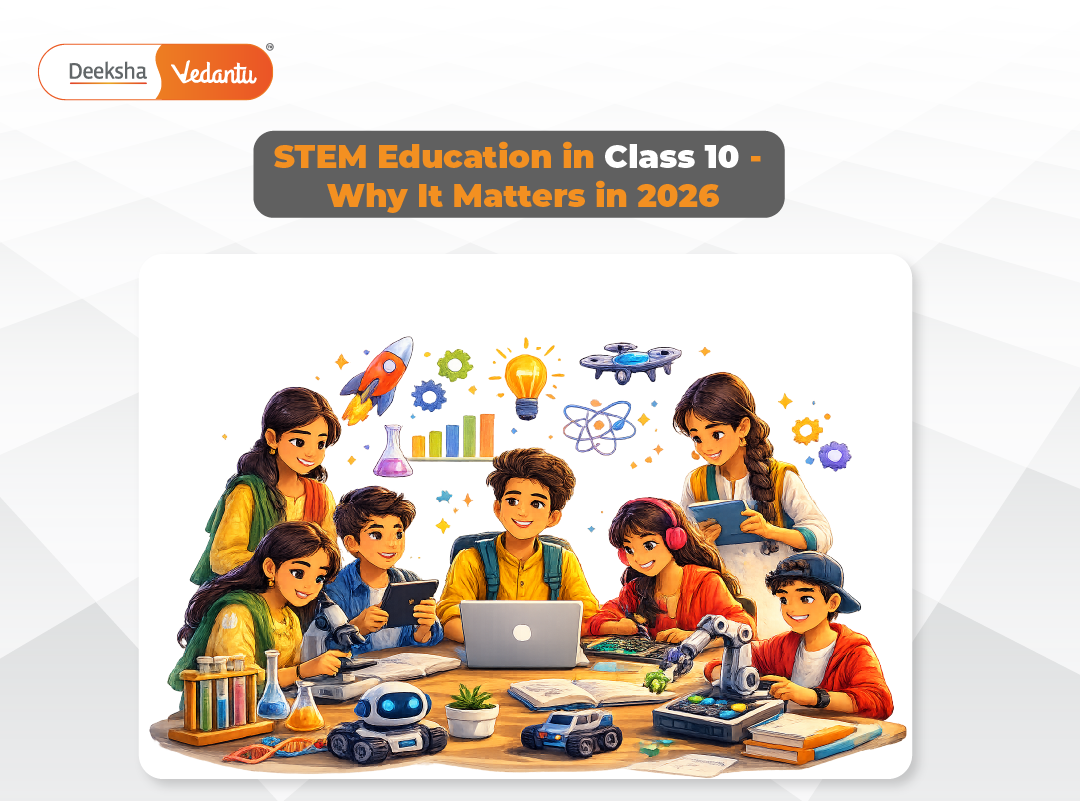
In 2026, education is no longer limited to textbook knowledge. The world is increasingly driven by technology, data, automation, scientific research, and rapid innovation cycles. STEM education – Science, Technology, Engineering, and Mathematics – plays a central role in preparing students for this evolving global landscape.
For Class 10 students, STEM is not merely about scoring high marks in Science and Mathematics. It is about developing a structured way of thinking, strengthening analytical depth, building experimentation confidence, and preparing for careers that demand logical clarity and technological comfort.
The 2026–2036 decade will reward students who can solve problems, interpret data, understand systems, and adapt to new tools quickly. STEM education in Class 10 lays the foundation for this adaptability.
This expanded article explores why STEM education matters more than ever in 2026, how it influences long-term career trajectories, and how students can manage its academic intensity effectively.
What STEM Education Really Means in Class 10
STEM is often misunderstood as preparation only for engineering or medical careers. In reality, STEM education builds a cognitive framework.
It encourages students to:
- Ask deeper “why” and “how” questions
- Connect theory with real-world application
- Apply mathematical reasoning logically
- Use technology responsibly and strategically
- Design structured solutions to practical problems
- Interpret evidence instead of memorizing conclusions
In Class 10, subjects such as Mathematics, Physics, Chemistry, and introductory Computer Science create this foundation.
STEM education strengthens reasoning patterns that extend far beyond classroom exams.
Why STEM Matters More in 2026
Several global and economic trends amplify the importance of STEM exposure:
- Artificial Intelligence is automating repetitive tasks
- Data-driven decision-making is influencing governance and business
- Renewable energy innovation is reshaping infrastructure
- Healthcare technology is accelerating diagnostic capabilities
- Cybersecurity threats require technical awareness
- Climate science and sustainability demand scientific literacy
Even professions traditionally viewed as non-technical now require technological understanding and quantitative comfort.
A lawyer analyzing digital evidence, a marketer interpreting analytics dashboards, or a policymaker evaluating climate data all rely on STEM-influenced thinking.
Early STEM exposure at the Class 10 level increases readiness for these realities.
Core Benefits of STEM Education in Class 10
1. Strong Analytical Foundation
Mathematics and Science train students to think in structured sequences.
They learn to:
- Identify variables
- Understand cause-and-effect relationships
- Test assumptions
- Validate conclusions logically
This strengthens board exam performance and builds reasoning required for competitive examinations.
Analytical thinking developed in Class 10 becomes the intellectual backbone for higher education.
2. Problem-Solving Orientation
STEM subjects require students to attempt unfamiliar problems instead of memorizing ready-made answers.
Students develop:
- Hypothesis testing habits
- Iterative correction approaches
- Patience during trial-and-error
- Confidence in handling complex tasks
This problem-solving orientation transfers directly into engineering, medicine, business analytics, entrepreneurship, and research careers.
3. Innovation and Structured Creativity
STEM does not suppress creativity. It refines it.
Designing experiments, building models, understanding simulations, and connecting theoretical formulas to practical application foster structured creativity.
Innovation requires imagination guided by logic – a skill strengthened by STEM education.
4. Technological Confidence and Digital Readiness
Students exposed to coding basics, simulations, calculators, scientific tools, and data platforms gain technological confidence.
This confidence reduces fear when encountering advanced software in higher classes or professional environments.
Technological fluency is no longer optional in 2026.
STEM and Career Opportunities (2026–2036 Outlook)
| STEM Area | Career Examples | Future Growth Potential |
| Science | Medical Research, Biotechnology, Climate Science | High |
| Technology | AI, Software Development, Cybersecurity, Automation | Very High |
| Engineering | Robotics, Renewable Energy, Aerospace | High |
| Mathematics | Data Science, Actuarial Science, Quantitative Finance | Very High |
STEM-based skills are highly transferable and remain resilient despite automation because they focus on high-level reasoning.
STEM vs Non-STEM Skill Overlap
While STEM strengthens analytical depth, it also enhances general competencies.
| Skill | Strengthened by STEM | Career Relevance |
| Logical Reasoning | Strongly | Competitive Exams & Technical Roles |
| Data Interpretation | Strongly | Business & Research |
| Structured Thinking | Strongly | Management & Strategy |
| Innovation | Moderately–Strongly | Entrepreneurship |
| Digital Fluency | Strongly | All Industries |
This demonstrates that STEM education supports both technical and non-technical career paths.
STEM vs Non-STEM Academic Intensity Comparison
Academic intensity is an important factor for Class 10 students.
| Criteria | STEM-Focused Academic Path | Non-STEM-Focused Academic Path |
| Conceptual Depth | High | Moderate |
| Practice Requirement | Daily problem-solving | Balanced theory & writing |
| Time Commitment | Higher structured hours | Moderate structured hours |
| Cognitive Load | Strong analytical load | Strong conceptual discussion load |
| Competitive Exam Alignment | High alignment | Depends on field |
| Burnout Risk (If Misaligned) | Higher | Moderate |
| Flexibility After Class 10 | Broad technical eligibility | Broad non-technical pathways |
STEM demands consistent effort and discipline, but when aligned with interest, it becomes sustainable and rewarding.
Students should evaluate intensity tolerance before committing to heavily STEM-oriented academic tracks.
Is STEM Only for Science Stream Students?
No. STEM thinking benefits students across all streams.
- Commerce students gain advantage through quantitative reasoning and data interpretation.
- Humanities students benefit from research methodology and logical argument structuring.
- Vocational students benefit from technical literacy and automation awareness.
STEM in Class 10 builds cognitive strength even for careers outside engineering or medicine.
Challenges Students May Face in STEM
STEM subjects require:
- Conceptual clarity rather than memorization
- Consistent problem-solving practice
- Comfort with abstract reasoning
- Patience during difficulty
Students who initially struggle often improve significantly with structured revision and guided practice.
The key is early doubt resolution and steady reinforcement.
Long-Term Impact of STEM in the Next 10 Years
| Years After Class 10 | STEM Advantage |
| 0–2 Years | Strong base for competitive exams |
| 3–6 Years | Comfort in technical specialization |
| 7–10 Years | High adaptability in digital economy |
Students exposed to STEM early often transition smoothly into data-driven and innovation-focused careers emerging between 2026 and 2036.
Balancing STEM Intensity with Well-Being
While STEM offers strong long-term advantages, students must:
- Maintain consistent revision schedules
- Protect sleep cycles
- Avoid comparison-driven pressure
- Seek conceptual clarity instead of memorizing shortcuts
Sustainable discipline ensures long-term growth without burnout.
FAQs
Q1. Is STEM education necessary for every student in Class 10?
While not mandatory for all careers, STEM exposure strengthens analytical and technological readiness, benefiting most professions.
Q2. Does STEM guarantee a high-paying career?
No stream guarantees income. However, STEM skills align with high-growth industries and innovation-driven sectors.
Q3. Can students who struggle in Mathematics still benefit from STEM?
Yes. Gradual concept clarity, structured practice, and doubt-solving significantly improve confidence over time.
Q4. Is STEM only about coding and engineering?
No. STEM includes scientific reasoning, engineering design thinking, mathematical logic, experimentation, and technological awareness.
Q5. How can Class 10 students strengthen STEM skills effectively?
By focusing on conceptual understanding, practicing application-based problems, experimenting with small projects, and developing digital fluency gradually.
Conclusion
In 2026, STEM education in Class 10 is not just preparation for engineering or medical pathways. It is preparation for analytical thinking, technological adaptation, structured creativity, and innovation-driven industries.
Students who build strong STEM foundations improve their flexibility, cognitive depth, and long-term career resilience.
STEM does not restrict career options – it strengthens core reasoning skills that remain valuable across the next decade and beyond.





Get Social