
For generations, academic marks have been treated as the ultimate measure of student success. High percentages meant better streams, stronger college options, and social validation. Parents celebrated rank holders. Schools showcased toppers. Students equated marks with intelligence.
But as we move into the 2026–2036 decade, the global landscape is shifting rapidly.
Artificial intelligence is automating repetitive work. Employers are valuing adaptability. Universities are emphasizing application-based learning. Industries are prioritizing problem-solving over memorization.
This raises an important question for Class 10 students and parents:
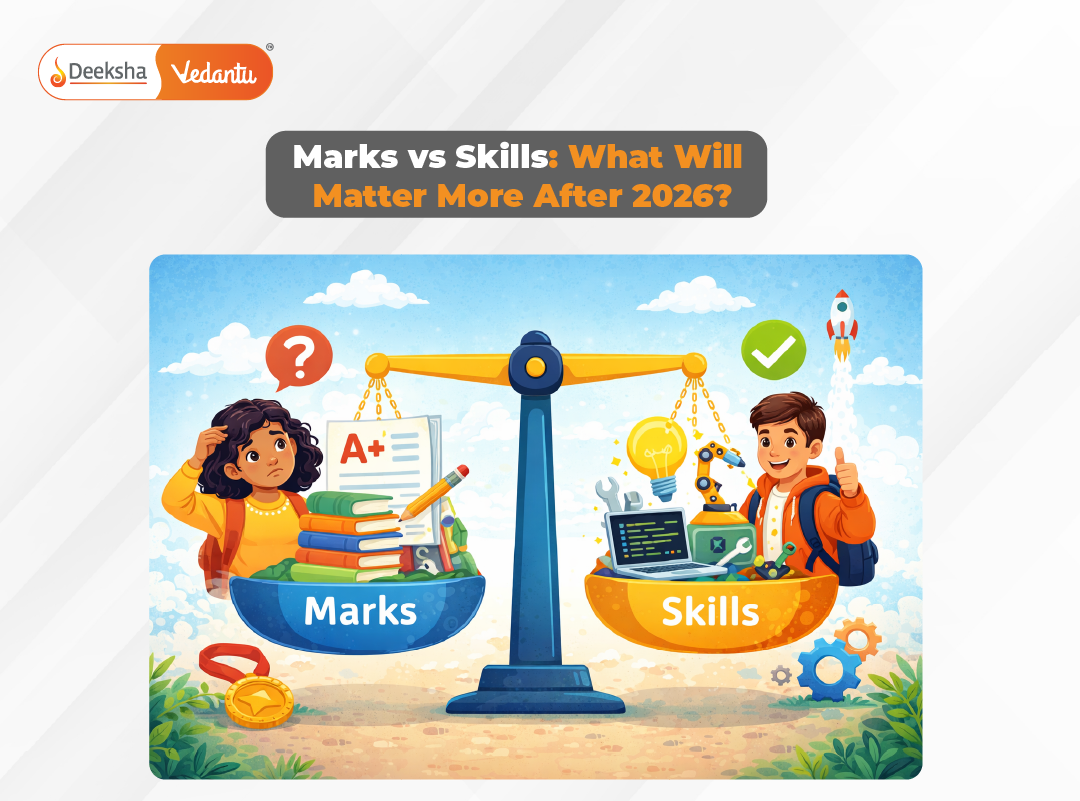
After 2026, what will matter more marks or skills?
The honest answer is nuanced. Marks and skills are no longer rivals. They are interconnected pillars of long-term success. However, their roles are changing.
Understanding that shift is crucial for making the right decisions in Class 10.
Why Marks Still Matter in 2026
Before dismissing academic scores, we must acknowledge their continued importance.
Marks continue to:
- Determine eligibility for Science, Commerce, or Humanities streams
- Influence admissions into reputed colleges
- Impact scholarship opportunities
- Reflect subject discipline and consistency
- Signal exam readiness and time management ability
Board examinations remain standardized evaluation systems. They test clarity, structured writing, conceptual understanding, and pressure handling.
For Class 10 students, marks are gateways. They open academic doors.
Without adequate marks, certain pathways may become temporarily restricted.
In short, marks create opportunities.
But they do not guarantee long-term success.
Why Skills Are Becoming Increasingly Powerful After 2026
Industries in the next decade are demanding more than academic scores.
Organizations now seek individuals who can:
- Solve unfamiliar problems independently
- Communicate ideas clearly and persuasively
- Collaborate across diverse teams
- Adapt to new tools and technologies quickly
- Analyze data and make informed decisions
- Demonstrate emotional intelligence under pressure
High marks without application skills may secure admission but may not sustain growth.
Skill-driven individuals often:
- Perform better in interviews
- Adapt faster during internships
- Earn leadership roles earlier
- Innovate more confidently
- Build stronger professional networks
After 2026, professional growth increasingly depends on how well students apply what they learn.
The Changing Definition of Merit
Earlier, merit meant scoring high in exams.
Today, merit includes:
- Conceptual clarity
- Application ability
- Communication strength
- Digital fluency
- Creativity
- Resilience
Exams measure performance in structured settings.
Real life tests performance in unpredictable situations.
Students who combine both forms of excellence build lasting competitive advantage.
Marks vs Skills: A Deeper Comparative Analysis
| Criteria | High Marks Focus | Strong Skills Focus |
| Short-Term Benefit | Higher board percentages | Confidence in real-world application |
| College Admissions | Strong academic eligibility | Interview & portfolio strength |
| Competitive Exams | Qualification support | Advanced problem-solving depth |
| Workplace Readiness | Limited without soft skills | High adaptability & leadership potential |
| Long-Term Career Growth | Stable but may plateau | Accelerated through innovation |
| Global Mobility | Based on credentials | Based on competence |
Marks demonstrate mastery of syllabus.
Skills demonstrate mastery of application.
The 2026 economy increasingly rewards application.
The 2026–2036 Career Reality
By 2036, automation and AI will handle repetitive calculations, data processing, and routine reporting. What will differentiate professionals is:
- Creativity in problem framing
- Strategic thinking in uncertain environments
- Emotional intelligence in team leadership
- Complex analytical reasoning
- Interdisciplinary integration of knowledge
These are skill-based differentiators.
A student with strong communication and analytical ability can pivot across industries. A student relying only on memorized knowledge may struggle when contexts change.
How Deeksha Vedantu Bridges Marks and Skills
At Deeksha Vedantu, academic preparation is not limited to textbook completion.
The integrated approach recognizes that:
- High board scores are essential foundations
- Concept clarity must go beyond rote memorization
- Application-based questioning strengthens reasoning
- Competitive exam alignment builds analytical depth
- Structured mentorship develops confidence
Students are trained to:
- Understand concepts deeply
- Solve higher-order thinking questions
- Present structured answers
- Build discipline without burnout
- Develop communication confidence
This ensures that students do not become exam machines but future-ready thinkers.
The philosophy is simple: score high, but also grow strong.
Skill Categories That Will Define Success After 2026
| Skill Category | Why It Matters | How Class 10 Students Can Develop It |
| Analytical Thinking | Required in AI, finance, research | Practice case-based & HOTS questions |
| Communication | Essential for interviews & leadership | Participate in debates & structured discussions |
| Digital Literacy | Needed across industries | Learn productivity tools & basic coding |
| Adaptability | Industries evolve rapidly | Explore new topics beyond syllabus |
| Collaboration | Workplace teamwork | Engage in group academic tasks |
| Emotional Resilience | Handles pressure & uncertainty | Maintain healthy routines |
| Decision-Making | Required for leadership | Evaluate pros and cons logically |
| Creativity | Drives innovation | Participate in projects & competitions |
Marks reflect academic strength.
Skills reflect professional readiness.
Can High Marks Compensate for Weak Skills?
In the short term, yes.
Strong marks can secure admissions and scholarships.
In the long term, weak skills create bottlenecks in:
- Group discussions
- Internship performance
- Corporate presentations
- Leadership opportunities
- Entrepreneurial ventures
Academic excellence without communication or adaptability can slow career momentum.
Can Strong Skills Compensate for Low Marks?
Partially but not entirely.
Moderate marks may restrict entry into certain competitive streams.
However, students with strong skill sets often:
- Perform exceptionally in entrance exams
- Build strong portfolios
- Excel in interviews
- Network effectively
- Accelerate growth once inside institutions
Ideally, students should avoid extremes.
The most powerful combination is academic strength plus skill depth.
Marks and Skills Across Academic Phases
| Stage | Role of Marks | Role of Skills |
| Class 10 | Stream eligibility | Basic communication & digital confidence |
| Class 11–12 | Competitive alignment | Advanced analytical ability |
| Undergraduate | Academic credibility | Internship & leadership exposure |
| Early Career | Entry qualification | Career acceleration |
| Mid Career | Less relevant | Strategic & leadership dominance |
Over time, the importance of marks gradually decreases, while skill relevance increases.
Psychological Impact of Over-Focusing on Marks
Excessive pressure on marks can lead to:
- Anxiety and burnout
- Fear of failure
- Reduced creativity
- Comparison-driven stress
Balanced academic ecosystems like those encouraged at Deeksha Vedantu aim to reduce pressure while maintaining performance standards.
Students perform better when confidence replaces fear.
What Will Truly Matter More After 2026?
Marks will continue to matter.
But skills will determine trajectory.
Marks help students enter systems.
Skills help them rise within those systems.
After 2026, the professionals who grow fastest will be those who:
- Apply knowledge creatively
- Adapt to emerging technologies
- Communicate effectively
- Solve new problems confidently
- Learn continuously
FAQs
Q1. Are marks becoming irrelevant after 2026?
No. Marks remain critical for academic progression, but skills increasingly shape long-term career outcomes.
Q2. Should Class 10 students prioritize skills over board preparation?
Board preparation must remain strong. Skill development should be integrated gradually alongside academics.
Q3. How can students build skills without affecting marks?
Through structured schedules, application-based practice, communication exercises, and guided mentorship.
Q4. Do employers value marks or skills more?
Entry-level eligibility often depends on academic background, but career growth depends largely on skill application.
Q5. How does Deeksha Vedantu ensure balanced growth?
By combining strong conceptual training, competitive alignment, structured doubt-solving, and emphasis on reasoning strength alongside board-focused preparation.
Conclusion
The debate between marks and skills is not about choosing one over the other.
It is about understanding how their importance shifts over time.
In Class 10, marks open doors.
In higher education and careers, skills determine how far students travel.
Students who combine disciplined academic preparation with structured skill development as encouraged at Deeksha Vedantu build both immediate academic success and long-term career resilience.
After 2026, the future will belong to students who do not just score well, but think well, communicate clearly, adapt quickly, and apply knowledge confidently.







Get Social