
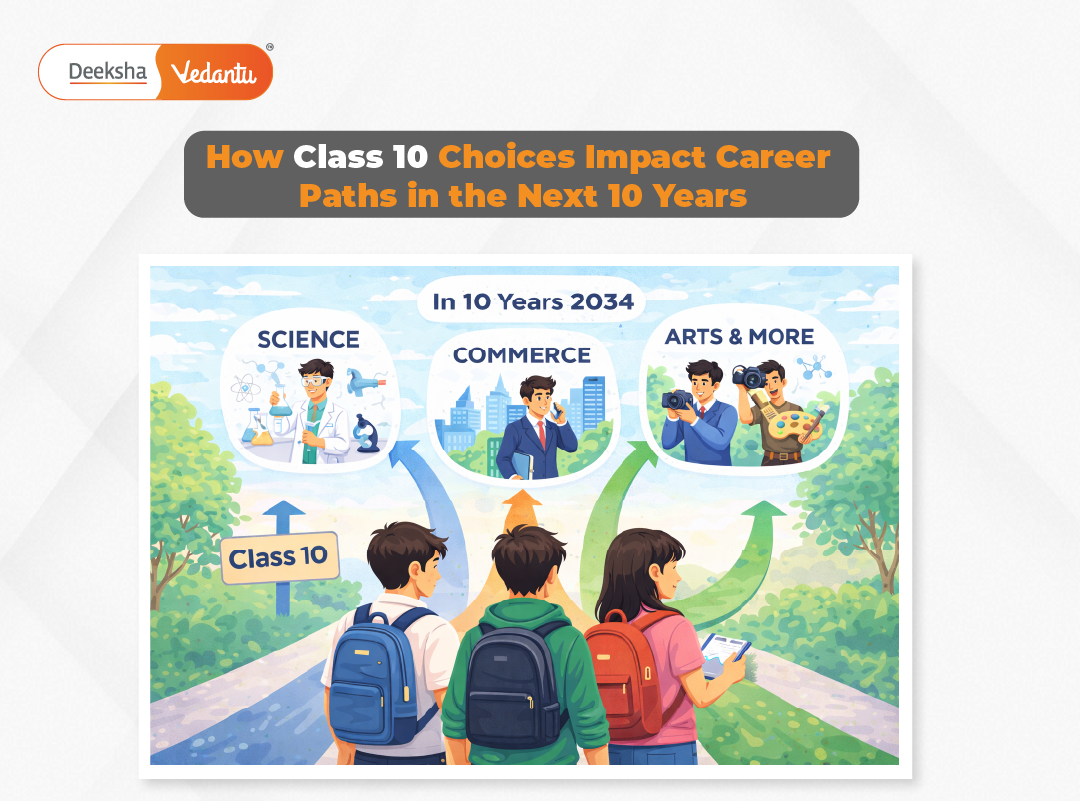
Class 10 is not just another academic year. It represents the first major strategic academic decision in a student’s life – selecting subjects and streams that influence the next decade of educational development and career direction.
In 2026, career ecosystems are evolving rapidly due to artificial intelligence, digital transformation, globalization, and interdisciplinary education models. While Class 10 choices do not permanently determine a student’s destiny, they strongly influence eligibility windows, academic preparedness, confidence levels, and long-term professional positioning over the next 10 years.
Understanding the long-term ripple effect of these decisions helps students and parents move from emotional selection to strategic planning.
The 10-Year Academic Timeline After Class 10
The next decade after Class 10 generally follows three structured phases.
| Phase | Years | Academic Stage | Core Focus |
| Phase 1 | 2026–2028 | Class 11 & 12 | Stream depth, entrance exam preparation |
| Phase 2 | 2028–2032 | Undergraduate Degree | Specialization and professional alignment |
| Phase 3 | 2032–2036 | Postgraduate / Early Career | Industry expertise and career positioning |
The stream selected after Class 10 directly shapes Phase 1. Phase 1 determines undergraduate eligibility. Undergraduate choices influence postgraduate specialization and industry access.
This compounding academic structure shows why early alignment matters.
Competitive Exam Eligibility: The Hidden 10-Year Impact
Many competitive examinations are subject-specific. Stream selection affects eligibility at the foundational level.
Examples include:
- Engineering pathways require Mathematics in Classes 11–12.
- Medical entrance examinations require Biology.
- Chartered Accountancy favors Commerce foundations.
- Law and Civil Services often align well with Humanities subjects.
- Data science careers strongly benefit from Mathematics and Computer Science exposure.
If Mathematics or Biology is excluded in Phase 1, certain high-demand careers become significantly harder to access later.
Therefore, Class 10 decisions shape opportunity access points for the next decade.
Academic Skill Development Over 10 Years
Each stream cultivates a distinct cognitive framework that compounds over time.
| Stream | Core Skill Development | 10-Year Advantage |
| Science | Analytical reasoning, quantitative depth | Technical problem-solving expertise |
| Commerce | Financial analysis, strategic thinking | Business and economic decision-making |
| Humanities | Critical thinking, communication | Policy, leadership, advisory roles |
Over 10 years, these foundational strengths influence specialization comfort, professional confidence, and career growth speed.
Students who align stream choice with natural strengths often experience smoother academic progression and lower burnout rates.
Flexibility vs Early Specialization
One common assumption is that Science offers maximum flexibility. While it does preserve multiple technical pathways, it also carries heavier academic intensity.
Commerce provides structured specialization with strong professional certification options.
Humanities has seen major expansion in global opportunities, particularly in law, governance, psychology, research, international relations, and digital media.
True flexibility comes not from selecting the most demanding stream, but from selecting one that ensures consistent performance for two years without emotional exhaustion.
Sustainability across 2 years creates stability across 10 years.
Career Growth Trajectory Projection (2026–2036)
| Stream | Years 0–2 | Years 3–6 | Years 7–10 |
| Science | Entrance exam preparation | Technical degree completion | Industry specialization / research |
| Commerce | Foundation subjects | Professional certification / degree | Corporate leadership / entrepreneurship |
| Humanities | Concept depth building | Specialization degree | Policy, law, academia, advisory roles |
The momentum created in Years 0–2 significantly influences Years 3–6. Strong undergraduate specialization influences Years 7–10 income growth and job stability.
Psychological Impact Across a Decade
Stream alignment affects more than academic eligibility.
When students choose streams aligned with interest:
- Academic confidence strengthens
- Self-identity becomes clearer
- Competitive preparation becomes purposeful
- Long-term motivation stabilizes
When stream selection is misaligned:
- Academic stress increases
- Performance inconsistency appears
- Self-doubt develops
- Stream switching becomes more likely
Over 10 years, psychological stability becomes as important as academic competence.
The Cost of Mismatched Stream Selection
Choosing a misaligned stream can create ripple effects.
Common consequences include:
- Decline in academic scores
- Increased tutoring dependency
- Delayed competitive preparation
- Reattempt of entrance exams
- Switching streams after 1–2 years
- Loss of academic confidence
Although correction is possible, it may involve additional time, financial investment, and emotional strain.
Stream Switching Cost Analysis (2026 Perspective)
Changing streams after Class 11 or 12 is possible but comes with practical challenges.
| Scenario | Academic Cost | Time Cost | Emotional Cost | Financial Cost |
| Science to Commerce | Moderate syllabus adjustment | 6–12 months adaptation | Identity shift stress | Coaching / bridge courses |
| Commerce to Science | High (Maths/Science gap) | 1–2 years catch-up | High academic pressure | Additional tuition |
| Humanities to Science | Very High (technical gap) | 1–2 years | Confidence impact | Structured re-training |
| Science to Humanities | Low–Moderate | Minimal | Manageable | Minimal |
Switching from technical to non-technical streams is generally easier than the reverse.
The earlier the correction, the lower the cost.
Long-Term Employability and Market Trends (2026–2036)
The next decade will emphasize:
- Interdisciplinary knowledge
- Digital literacy
- Problem-solving ability
- Communication skills
- Adaptability to automation
Stream choice should therefore not only consider present career titles but also skill transferability.
For example:
- Mathematics supports analytics, AI, finance, and data science.
- Economics supports policy, consulting, and business strategy.
- Psychology supports HR, mental health, marketing, and research.
Thinking 10 years ahead encourages a broader perspective.
Academic Intensity and Burnout Risk Over 10 Years
| Stream | Academic Intensity | Burnout Risk (If Misaligned) | Sustainability |
| Science | High | High | Strong if interest-driven |
| Commerce | Moderate | Moderate | Stable with consistency |
| Humanities | Moderate | Low–Moderate | High with engagement |
Long-term success depends not on initial intensity, but on sustained performance.
Strategic Questions Before Finalizing Stream
Instead of checklists, students should deeply reflect on three strategic dimensions:
- Can I study these core subjects consistently for two full years without resentment?
- Does this stream keep open at least two career pathways I genuinely like?
- Am I choosing this because of interest, or because of comparison pressure?
Honest answers reduce long-term regret.
FAQs
Q1. Does choosing Science guarantee better income after 10 years?
No. Income growth depends on specialization, skill quality, market demand, and continuous learning – not just stream selection.
Q2. Can students change career paths within 10 years?
Yes. Many professionals pivot careers. However, switching may require additional certifications, postgraduate degrees, or bridge training.
Q3. How important is Mathematics for long-term flexibility?
Mathematics significantly increases eligibility for technical and analytical careers, but many successful careers do not require advanced mathematics.
Q4. Is early competitive coaching essential?
It depends on the career goal. Structured preparation helps in technical fields but should be balanced with mental well-being.
Q5. What is the biggest mistake after Class 10?
Choosing a stream based on social prestige rather than personal aptitude and long-term sustainability.
Conclusion
Class 10 choices influence academic exposure, competitive exam pathways, cognitive skill development, psychological stability, and employability positioning across the next 10 years.
While no decision is irreversible, strategic alignment reduces switching costs, preserves flexibility, and builds stronger long-term foundations.
In the rapidly evolving 2026–2036 decade, the smartest decisions are interest-driven, research-backed, and future-focused rather than comparison-based.
Early clarity creates long-term momentum.




Get Social