
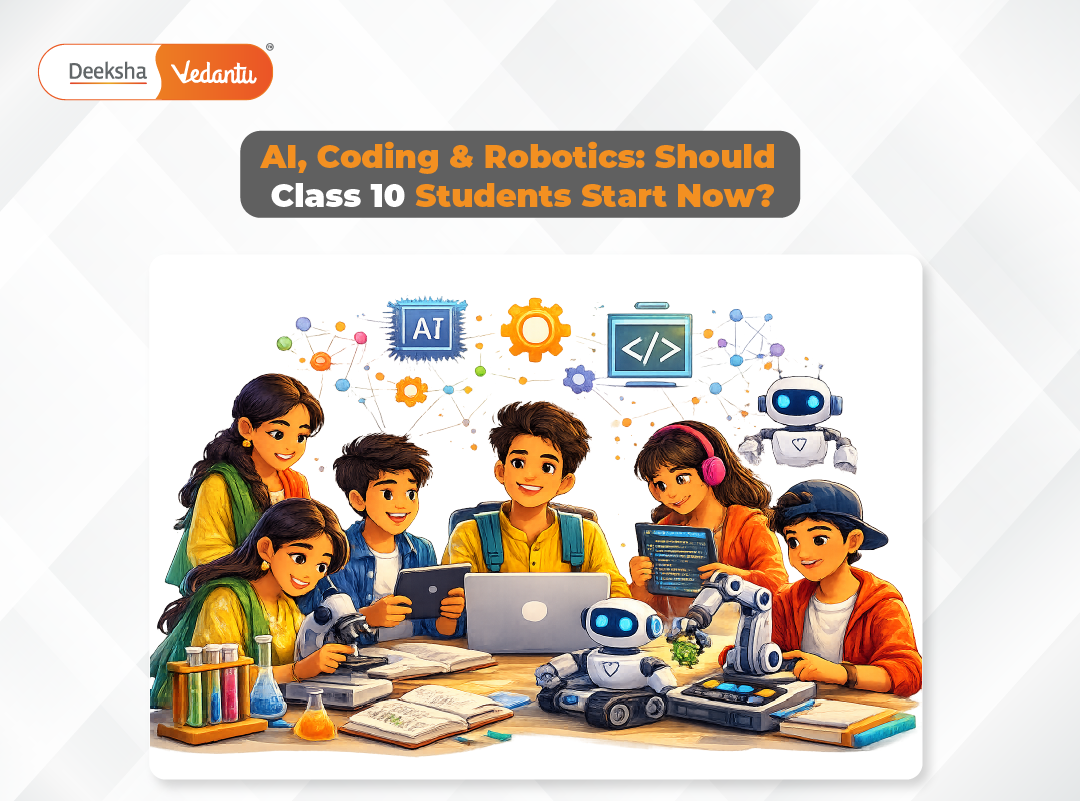
In 2026, Artificial Intelligence, coding, and robotics are no longer futuristic buzzwords. They are shaping industries, redefining job roles, automating decision-making systems, and transforming how businesses, healthcare institutions, governments, and research labs operate across the world.
For Class 10 students, the question is no longer whether these fields matter – it is whether they should begin learning them during a crucial board exam year.
The answer is not a simple yes or no. It depends on academic balance, interest level, cognitive readiness, long-term career goals, and sustainability. When approached correctly, early exposure to AI and coding can strengthen logical thinking and digital fluency. When approached incorrectly, it can create academic overload and unnecessary pressure.
This expanded guide explores whether Class 10 students should begin AI, coding, and robotics now, how early exposure influences future careers between 2026 and 2036, and how to approach learning responsibly without compromising board performance.
Why AI, Coding, and Robotics Are Highly Relevant in 2026
Global industries are increasingly driven by:
- Automation and machine learning systems
- Data-driven decision-making
- Smart manufacturing and robotics integration
- AI-powered healthcare diagnostics
- Cybersecurity and digital infrastructure protection
- Financial technology and algorithmic trading systems
Even non-technical professions now interact with AI-powered platforms. Marketing uses predictive analytics. Law firms use AI for document analysis. Agriculture uses smart sensors. Logistics uses automated routing systems.
Understanding coding logic and automation principles provides a cognitive advantage in this modern economy.
Students who are comfortable with algorithmic thinking early often adapt more quickly in higher education and professional training environments.
What Learning AI or Coding in Class 10 Actually Means
Starting early does not mean building complex neural networks or writing industrial-level software.
At the Class 10 level, it means foundational exposure such as:
- Understanding programming logic and syntax
- Learning beginner-friendly languages like Python
- Exploring block-based coding platforms
- Building small robotics kits
- Understanding how algorithms process input and produce output
- Learning how AI systems use data patterns to make predictions
The focus should remain conceptual and exploratory rather than professional specialization.
AI learning at this stage should support logical development, not replace academic fundamentals.
Benefits of Starting AI & Coding Early
1. Strong Logical Thinking Development
Coding strengthens:
- Step-by-step reasoning
- Pattern recognition
- Conditional thinking
- Debugging mindset
- Structured problem-solving
These skills directly improve Mathematics performance and analytical reasoning in Science.
Logical thinking developed through coding also supports competitive exam preparation in later years.
2. Technological Confidence
Students comfortable with programming concepts adapt faster to digital tools in Classes 11 and 12.
They feel less intimidated by:
- Data analysis software
- Simulation platforms
- Scientific calculators
- Spreadsheet modeling tools
Technological confidence reduces hesitation when encountering new systems in college or internships.
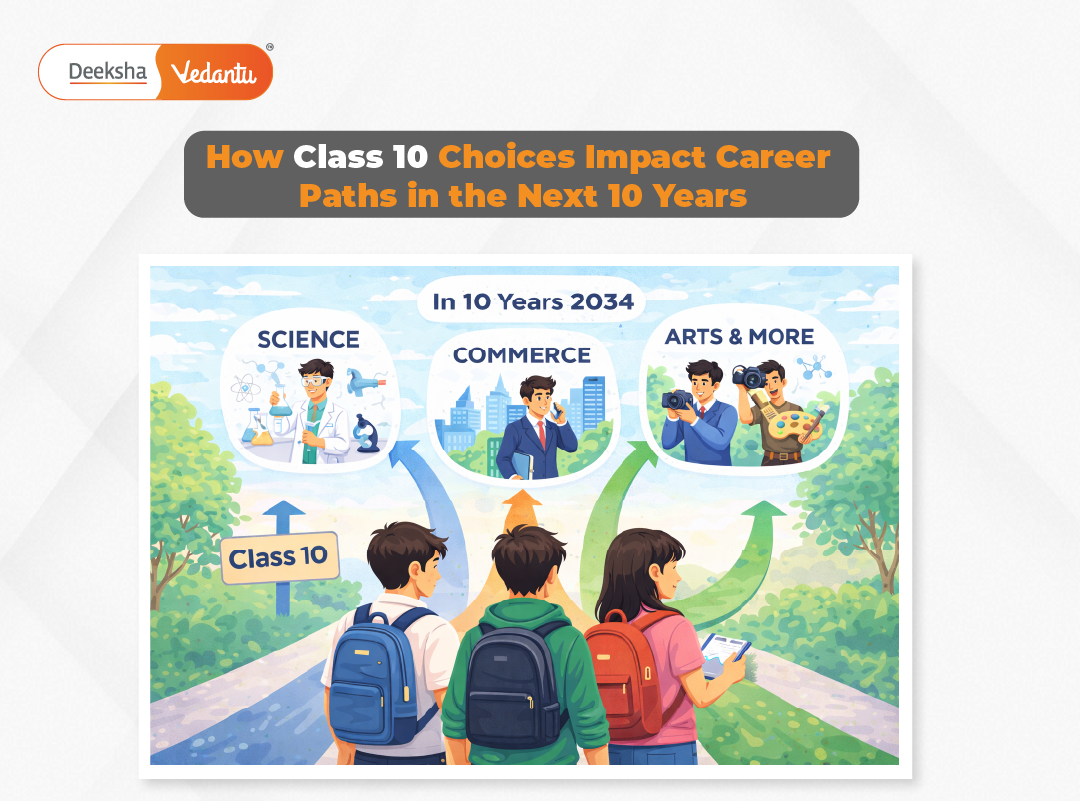
3. Career Flexibility and Future Proofing
AI and coding skills support multiple high-growth career paths:
- Engineering and Robotics
- Artificial Intelligence and Machine Learning
- Data Science and Analytics
- Game Development and App Design
- FinTech and Digital Finance
- Automation Systems
- Cybersecurity
Even Commerce and Humanities students benefit from understanding automation, analytics, and digital systems.
Coding knowledge does not lock students into technical careers – it expands options.
4. Innovation and Creative Engineering Exposure
Robotics and coding projects allow students to convert ideas into functioning systems.
Students learn how:
- Sensors detect signals
- Code controls mechanical movement
- Data influences machine behavior
This bridges imagination with execution – a skill valued across industries.
Potential Risks of Starting Too Early
While early exposure is beneficial, risks emerge when expectations are unrealistic.
Common mistakes include:
- Overloading daily schedules
- Neglecting core board subjects
- Chasing certificates instead of fundamentals
- Comparing progress with advanced peers
- Experiencing burnout due to excessive ambition
Class 10 remains a board-focused year. Academic stability must remain the primary goal.
AI learning should supplement, not dominate.
AI & Coding vs Board Preparation Balance
| Factor | Balanced Approach | Overloaded Approach |
| Weekly Time | 2–4 hours | Daily long sessions |
| Academic Priority | Board exams first | Coding prioritized |
| Learning Method | Concept exploration | Competitive pressure |
| Emotional State | Curious & calm | Stressed & rushed |
| Sustainability | High | Low |
Moderation ensures skill development without academic compromise.
AI vs Traditional STEM Learning Comparison
AI learning is often confused with full STEM mastery. They are related but not identical.
| Criteria | Traditional STEM Learning | AI-Focused Learning |
| Core Focus | Mathematics & Scientific fundamentals | Algorithm application & automation |
| Cognitive Base | Deep conceptual reasoning | Applied computational logic |
| Dependency | Independent analytical thinking | Tool-based execution |
| Best Starting Stage | Early foundational years | After STEM basics are stable |
| Risk if Rushed | Concept confusion | Superficial understanding |
| Long-Term Advantage | Strong intellectual framework | Industry-specific edge |
Traditional STEM builds thinking capacity. AI builds applied technical exposure on top of that capacity.
Students should strengthen Mathematics and Science fundamentals before pursuing advanced AI modules.
AI, Coding & Robotics Career Outlook (2026–2036)
| Field | Example Careers | Growth Outlook |
| Artificial Intelligence | Machine Learning Engineer, AI Researcher | Very High |
| Robotics | Automation Engineer, Robotics Designer | High |
| Coding & Software | Full-Stack Developer, App Developer | Very High |
| Data Science | Data Analyst, Quantitative Specialist | Very High |
| Cybersecurity | Security Analyst, Ethical Hacker | High |
The next decade will continue expanding digital and automation-driven careers globally.
Students who begin exposure early may reduce their future learning curve significantly.
Should All Class 10 Students Start Coding?
Not necessarily.
Students may consider starting if:
- They enjoy logical puzzles
- They are curious about how apps function
- They show sustained interest in STEM subjects
- They manage time responsibly
- They can balance academics and exploration
Students uncertain about interest should begin with light exposure rather than structured certification courses.
Interest-driven learning is more sustainable than pressure-driven enrollment.
Long-Term Skill Compounding (10-Year Projection)
| Years After Class 10 | Impact of Early AI & Coding Exposure |
| 0–2 Years | Stronger logical reasoning foundation |
| 3–6 Years | Faster technical specialization in Class 11–UG |
| 7–10 Years | Competitive edge in digital job markets |
Early familiarity reduces fear, increases curiosity, and builds professional confidence.
Practical Starting Strategy for Class 10 Students
A structured and sustainable approach includes:
- Learning beginner-level Python basics
- Exploring AI concepts through guided educational platforms
- Building entry-level robotics kits
- Participating in school STEM exhibitions
- Watching structured tutorials instead of random content
- Maintaining board exam priority
Consistency matters more than speed.
FAQs
Q1. Is coding mandatory for future careers?
No. However, digital literacy and structured problem-solving are increasingly valuable across industries.
Q2. Will learning AI in Class 10 guarantee a tech career?
No. Long-term career success depends on sustained interest, higher education choices, and consistent skill development.
Q3. Can Commerce or Humanities students learn coding?
Yes. Coding is a logical skill and not restricted to Science stream students.
Q4. How many hours per week are ideal for beginners?
Two to four hours per week is generally sufficient during a board preparation year.
Q5. Should AI learning replace extracurricular activities?
No. Balanced development, including sports, arts, and relaxation, supports sustainable performance.
Conclusion
AI, coding, and robotics are shaping the future global economy. Early exposure in Class 10 can strengthen logical reasoning, technological comfort, structured thinking, and long-term career flexibility.
However, the key is balance. Board exam preparation must remain stable while AI exploration remains structured, moderate, and curiosity-driven.
Starting early can provide an advantage – but only when aligned with discipline, foundational STEM strength, and sustainable academic planning.







Get Social