
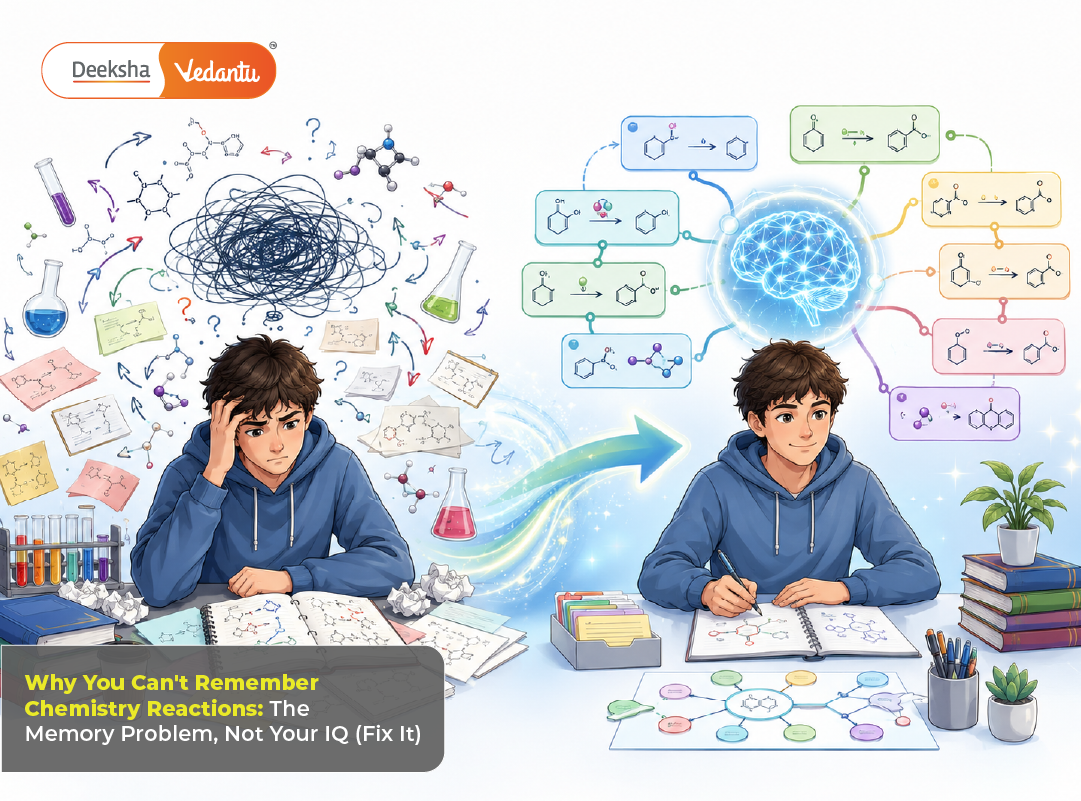

You’re not stupid. Your brain isn’t broken. You’re just using a memory encoding method that works for literally nobody.
Here’s what’s happening: When you read a chemistry reaction, your brain doesn’t automatically save it. It processes it briefly, then deletes it within hours. By the next day, 80% is gone. By the exam, it’s completely erased.
This isn’t an IQ problem. It’s an encoding problem.
How Your Memory Actually Works (The Science)
Your brain has three memory systems:
- Sensory Memory (1-2 seconds)
- When you READ “C₆H₁₂O₆ + O₂ → CO₂ + H₂O”
- Your eyes capture it
- Duration: 1-2 seconds max
- Then it disappears completely
- Working Memory (20-30 seconds)
- You hold the reaction in mind while reading it
- You might understand it briefly
- Duration: 20-30 seconds without repetition
- When you look away, it’s gone
- Long-Term Memory (Permanent, if encoded correctly)
- Information you can recall weeks later
- This is what you NEED for NEET
- But it requires specific encoding methods
The problem: You’re reading reactions and assuming they go straight to long-term memory. They don’t. They vanish from working memory in 30 seconds.
Why Rereading Doesn’t Work (The Forgetting Curve)
Hermann Ebbinghaus proved this in 1885. After learning something:
- After 1 hour: You forget 50%
- After 1 day: You forget 70%
- After 1 week: You forget 80%
- After 1 month: You forget 90%
This is the “forgetting curve.”
Your current method:
Day 1: Read reaction 5 times → Understand it → Feel good
Day 2: Can’t remember it → Read again (back to 50% forgotten)
Day 7: Try to recall → Blank → Panic → Read AGAIN Day 30: Start from scratch
You’re literally relearning the same reaction 4+ times. That’s not learning. That’s spinning wheels.
Why It Feels Like You’re “Bad at Chemistry”
You’re not. You’re experiencing memory decay that happens to everyone. The difference between “chemistry geniuses” and you isn’t IQ. It’s encoding frequency.
Chemistry toppers don’t memorize reactions better. They space out their repetitions so they review just before forgetting.
Example:
- Topper: Reviews reaction on Day 1, Day 3, Day 7, Day 21
- You: Review it once on Day 1, then try to recall it on Day 7 (surprise: you forgot)
Same brain. Different system.
The Fix: Spaced Repetition (The Science-Backed Method)
Instead of reading once and hoping, use this schedule:
Spaced Repetition Schedule:
- Review 1: Immediately after learning (same day, within 1 hour)
- Review 2: After 3 days
- Review 3: After 7 days
- Review 4: After 21 days
- Review 5: After 2 months
Each review takes 30 seconds to 1 minute (not the full learning time).
Why it works: You’re reviewing just BEFORE the forgetting curve drops below 50%. Each review resets the curve at a longer interval.
The math:
- Reaction A: Learned Day 1
- Review Day 1 (1 minute)
- Review Day 4 (30 seconds)
- Review Day 11 (30 seconds)
- Review Day 32 (30 seconds)
- Total time invested: 2.5 minutes
- Result: Permanent memory
Compare to your method:
- Day 1: Read 5 times (10 minutes)
- Day 7: Can’t recall, read 5 times again (10 minutes)
- Day 14: Read 3 times (6 minutes)
- Total: 26 minutes, still forget by exam
The Practical System for Chemistry Reactions
Step 1: Create Flashcards (or use Anki app)
- Front: Reactants + conditions
- Back: Products (mechanism if Organic)
- Example:
- Front: “Benzene + Br₂/FeBr₃”
- Back: “Bromobenzene (electrophilic aromatic substitution)”
Step 2: Schedule Reviews
- Week 1: Review daily (Day 0, 1, 2, 3)
- Week 2-3: Review every 3 days
- Week 4+: Review every 7-14 days
- Month 3+: Review weekly
Step 3: Use Spaced Repetition Apps
- Anki (free, best for this)
- Quizlet (easier interface)
- SuperMemo (advanced)
- These apps calculate review intervals automatically
Step 4: Active Recall (Critical)
- Don’t just read the answer
- Try to RECALL from memory first
- THEN check if you got it right
- Only repeated retrieval creates long-term memory
Why Active Recall Matters More Than You Think
Passive Review (doesn’t work): “Okay I’ll read this reaction 5 times” → You read passively → Information stays in working memory → Decays
Active Recall (works): “Hide the answer. Try to recall it from memory.” → You force your brain to retrieve → That retrieval strengthens the neural pathway → Information moves to long-term memory
Neurologically, retrieval is the encoding mechanism. Reading isn’t. This is why cramming feels productive (you’re reading a lot) but doesn’t stick (you’re not retrieving).
The 30-Day Test
Try this protocol for ONE WEEK on Organic Chemistry reactions:
Day 1-7:
- Learn 10 reactions (use flashcards)
- Review Day 1, Day 3, Day 7
- Active recall each time (hide answer, try to remember)
Day 8:
- Test yourself on those 10 reactions
- Compare to your current method
You’ll recall 80-90% using spaced repetition. Using your current method, you’d recall 20-30%.
That’s not your IQ difference. That’s the system difference.
Your memory isn’t broken. It’s just operating under a system designed to fail. The fix isn’t studying harder. It’s studying smarter-using spaced repetition, active recall, and distributed practice. Your brain is capable. It just needs the right encoding protocol.














Get Social