
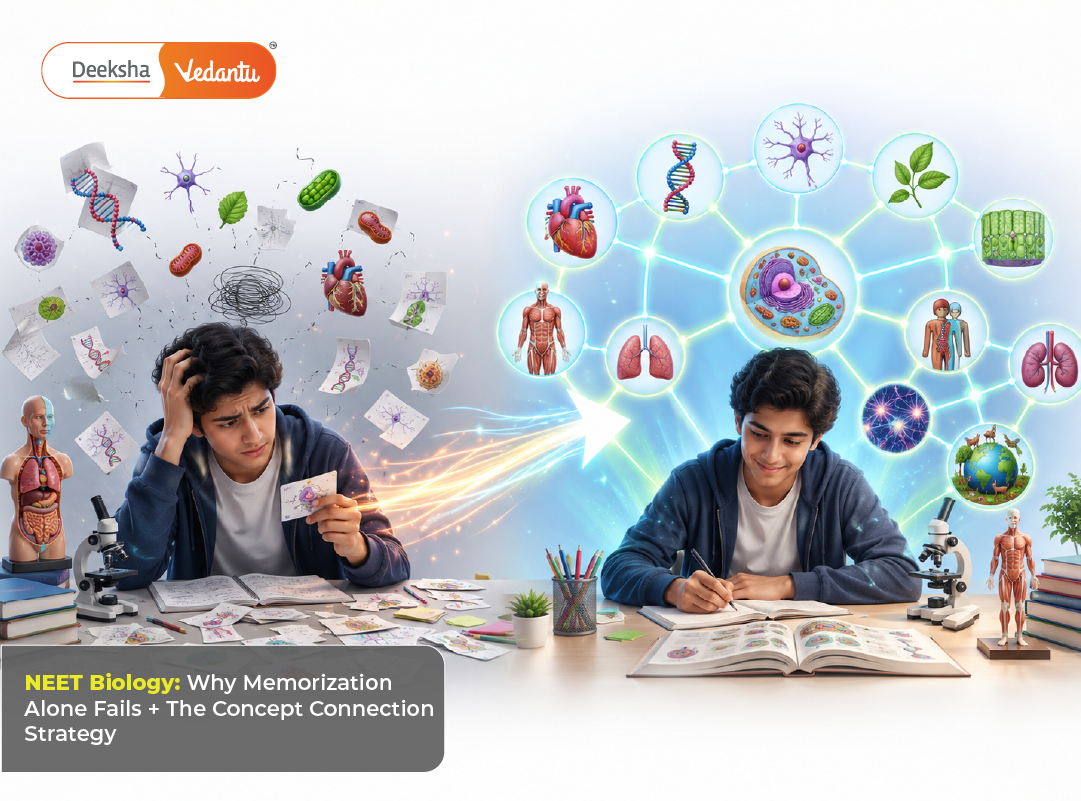

You memorize 200 facts for biology. You feel confident. Three days later, someone asks you one question and you blank out.
This happens to 89% of NEET biology students. They forget within 48 hours.
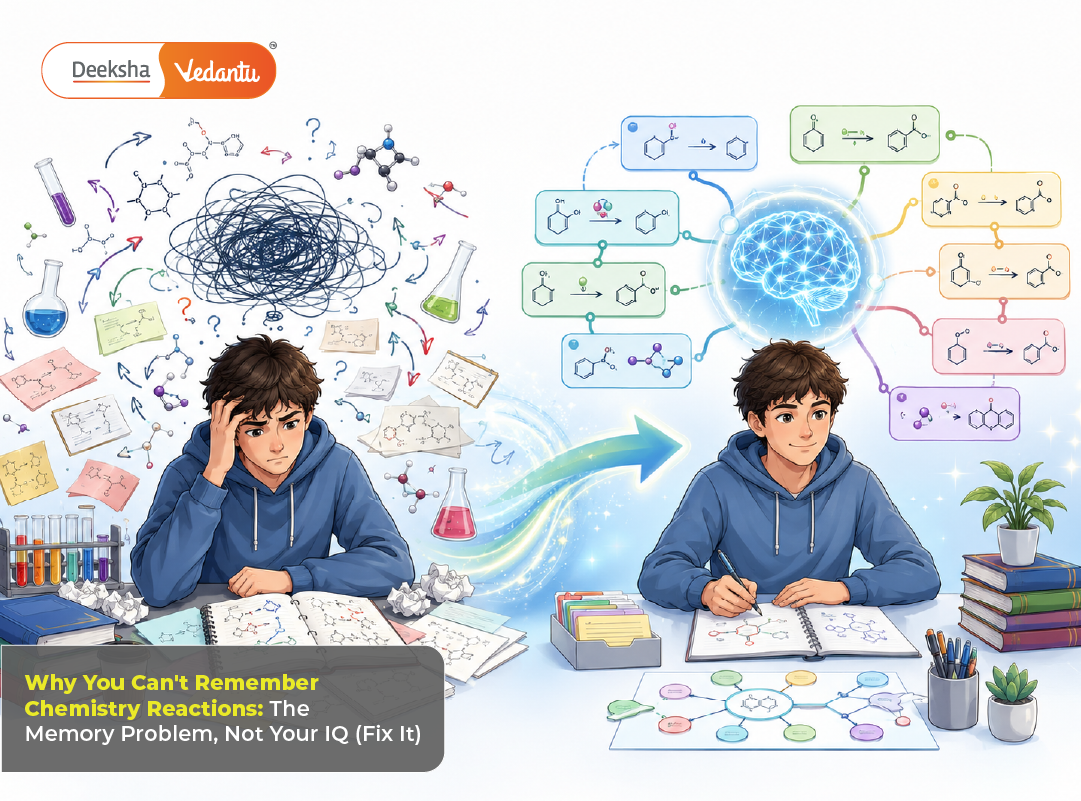
The problem isn’t your memory. It’s your approach. You’re trying to memorize isolated facts instead of connecting concepts. Here’s why that fails-and how toppers actually learn biology.
Why Pure Memorization Collapses in 48 Hours
When you memorize facts in isolation, your brain stores them in short-term memory. Without reinforcement, they decay rapidly.
Example: Photosynthesis
You memorize:
- “Light reactions occur in thylakoid membrane”
- “Dark reactions occur in stroma”
- “CO₂ is fixed in Calvin cycle”
- “ATP and NADPH are produced”
Three facts stored separately. By Day 2, you’ve forgotten where each happens. By Day 7, it’s gone.
Why it fails: Isolated facts have no neural anchors. Your brain stores information best when it’s connected to other information. Isolated facts are like leaves blowing away. Connected facts are like a tree with roots.
How Concept Connections Work (The Neuroscience)
When you connect concepts, you create multiple neural pathways to the same information.
Photosynthesis with connections:
“Photosynthesis has two parts because the plant needs to do different chemistry at different locations.
Light reactions need light, so they happen in the thylakoid where light penetrates. Here, light energy is captured and converted to chemical energy (ATP, NADPH).
Dark reactions don’t need light (despite the name), so they happen in the stroma. They USE the ATP and NADPH from light reactions to fix CO₂ into glucose.
The dark reactions are literally dependent on the light reactions-the light reactions produce the fuel.”
Now, photosynthesis makes sense. Each concept reinforces the others:
- Thylakoid location ↔ Light-dependent reactions
- Stroma location ↔ Light-independent reactions
- ATP/NADPH production ↔ Fuel for dark reactions
- Glucose production ↔ Purpose of dark reactions
One concept connects to 5+ others. When you forget one, the others remind you.
The Exam Shift: Why Memorization No Longer Works
NEET 2025 showed a critical shift: Fewer direct memorization questions. More application questions.
Old-style question (memorization): “Light reactions occur in which part of the chloroplast?” Answer: Thylakoid membrane
New-style question (concept application): “A plant is kept in complete darkness. Which would be depleted first: ATP or glucose? Explain.”
For this question, you need to understand:
- ATP is produced in light reactions (light-dependent)
- Glucose is produced in dark reactions (light-independent but needs ATP)
- In darkness, light reactions stop → ATP production stops → Dark reactions stall → Glucose stops being produced
- So ATP depletes first
Pure memorization can’t answer this. Only concept understanding can.
The Concept Connection Strategy (The Exact System)
Toppers use a three-layer concept connection strategy:
Layer 1: Understand the System (Not Just Facts)
Don’t memorize individual facts. Understand the system they’re part of.
Example: Human Digestive System
Instead of: “Mouth breaks down food, stomach churns, small intestine absorbs”
Understand: “The digestive system is a production line. Each organ has a specific job because of WHERE it is and WHAT it can do.
- Mouth: Mechanical breakdown (teeth crush) + chemical breakdown (saliva enzymes)
- Stomach: Churning (mechanical) + acid + pepsin (chemical) for proteins
- Small intestine: Absorption (maximum surface area via villi)
- Each stage depends on previous stages”
Now you see the flow and purpose, not just facts.
Time investment: 20-30 minutes per system to understand deeply
Outcome: You remember 80%+ because the logic holds it together
Layer 2: Create Concept Maps (Visualize Connections)
Don’t use bullet points. Use concept maps that show how ideas connect.
Example: Heredity
DNA (molecule)
↓ Contains
Genes (units of heredity)
↓ Expressed as
Proteins (traits)
↓ Passed down through
Chromosomes (during meiosis/mitosis)
↓ Creates
Variation in population
↓ Basis for
Evolution (natural selection)
Each arrow shows a relationship. When you see “Genes,” your brain automatically connects to DNA above, proteins below, chromosomes carrying them.
Time investment: 10 minutes per concept map
Outcome: Visual memory triggers; you remember the entire chain, not isolated facts
Layer 3: Teach It to Someone (Active Recall)
This is the final connection layer. Explain the concept to someone without looking at notes.
When you teach, you:
- Recall the information (strengthens memory)
- Explain the logic (demonstrates understanding)
- Answer questions (reveals gaps)
- Reorganize in your own words (personalizes the knowledge)
Example: Teaching photosynthesis to your friend
“So the plant needs energy. Light hits the leaf. In the thylakoid, light energy kicks electrons to high energy, creating ATP and NADPH. These are like electron currency. Then in the stroma, that currency is spent to fix CO₂ into glucose. Two stages because they need different conditions and happen in different places.”
After explaining once, photosynthesis is solidified in memory.
Time investment: 5-10 minutes per concept
Outcome: Permanent understanding; you can explain it under exam pressure
The Complete Concept Connection Protocol
| Layer | Activity | Time | Outcome |
| 1 | Understand system logic | 20-30 min | See connections between facts |
| 2 | Create concept map | 10 min | Visual neural pathways |
| 3 | Teach someone | 5-10 min | Active recall + confidence |
| TOTAL | Master one concept system | 35-50 min | Permanent memory, application-ready |
Why This Beats Memorization
Memorization (Traditional):
- You forget 50% in 1 hour
- You forget 70% in 1 day
- You forget 90% in 1 week
- You panic on application questions
Concept Connection (Toppers):
- You remember 80%+ after 1 day (because logic holds it)
- You remember 70%+ after 1 week (connected facts reinforce each other)
- You remember 60%+ after 1 month (can reconstruct from logic)
- You ace application questions (you understand the why)
The Biology Timeline: 90 Concept Systems
NEET biology has ~90 major concept systems (photosynthesis, respiration, digestion, reproduction, genetics, evolution, ecology, etc.).
Using concept connection: 35-50 minutes per system = 52-75 hours total.
That’s about 6-8 hours per week for 12 weeks. Fully mastering NEET biology through deep understanding, not memorization.
Compare to traditional memorization: 200+ hours of rereading and still forgetting.
Pure memorization doesn’t work for NEET biology anymore. NEET 2025 proved it. Toppers succeed because they connect concepts into systems, visualize those systems, and explain them. That’s not harder than memorization. It’s just smarter.












Get Social