
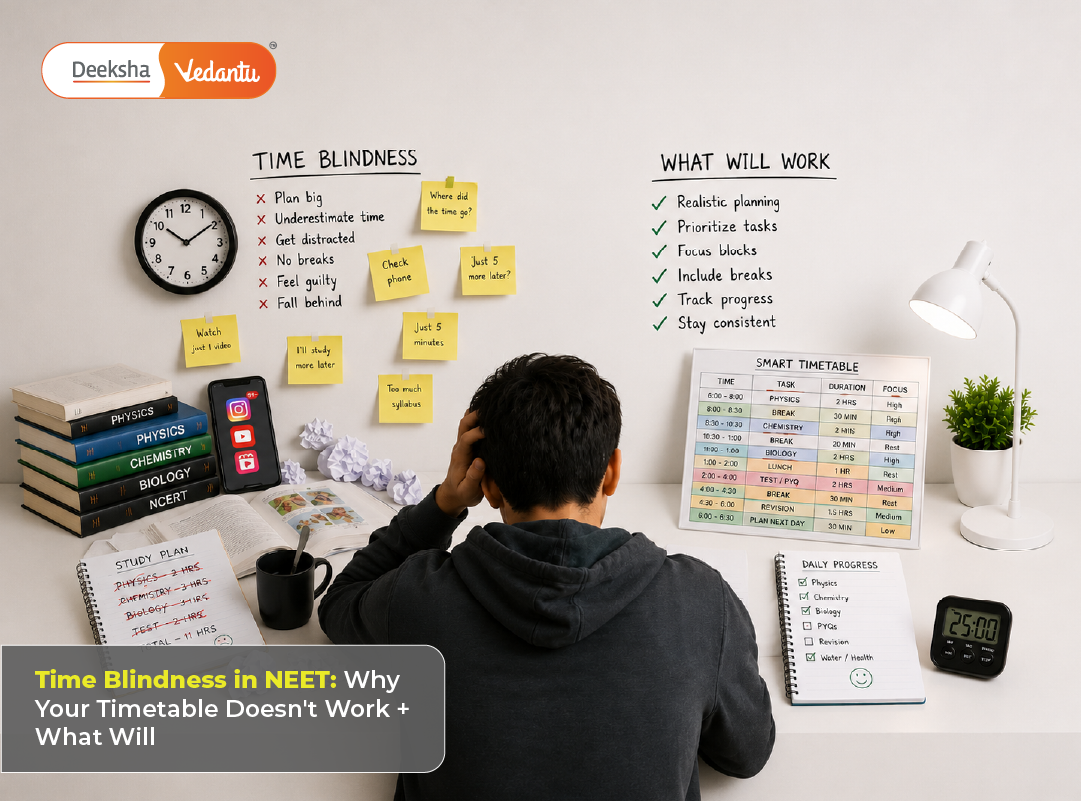

You create the perfect timetable. 6 AM wake up. 2 hours of physics. 1.5 hours break. 2 hours of chemistry. Everything scheduled.
By Day 3, you’re lost. You spent 3 hours on one chapter instead of 1.5. You skipped your break. You’re studying at 11 PM instead of 9 PM. The timetable is useless.
This isn’t laziness. This is time blindness-your brain’s inability to perceive time passing. It affects 80% of NEET students.
Here’s why your timetable fails and what actually works.
Why Timetables Fail (The Neuroscience)
Your brain has two time perception systems:
- Prospective Time (Planned Time)
- “I’ll study for 2 hours”
- Your brain sets a timer
- You intend to follow it
- Retrospective Time (Actual Time)
- What actually happened
- How long you ACTUALLY studied
- Usually doesn’t match prospective time
The gap between these two is time blindness.
When you’re deep in studying a difficult concept, your prospective timer turns OFF. Your brain enters a “flow state” where time disappears. You look up and 4 hours have passed, not 2.
The problem: A timetable assumes you can FEEL time passing. You can’t.
Result: Your timetable becomes a fantasy you follow for 3 days, then abandon.
The Five Time-Blind Student Archetypes (Which One Are You?)
Understanding your type is the first step to fixing time blindness.
Archetype 1: The Flow State Trap
You get interested in a concept and lose track of time completely.
Symptoms:
- You sit down for 2-hour physics session
- You emerge 4 hours later, wondering where the time went
- You’ve studied one chapter deeply instead of two chapters moderately
Why timetables fail for you: You can’t interrupt flow. The moment you try to “check the time,” you lose interest.
What works: Externally-enforced time breaks (not self-imposed). Set a phone alarm that interrupts you forcefully. Make it DIFFICULT to ignore.
Archetype 2: The Underestimator
You think tasks take less time than they actually do.
Symptoms:
- “I’ll do 10 physics problems in 30 minutes” (actually takes 90 minutes)
- “10-minute break” becomes 45 minutes
- By 10 AM, you’re already 2 hours behind schedule
Why timetables fail for you: You allocate unrealistic time. Your estimates are always optimistic.
What works: Track actual time spent on tasks for 1 week. Find your REAL pace. Then make timetables based on real data, not hopes.
Example: “Last week, 10 physics problems took 92 minutes on average. This week, I’ll allocate 100 minutes.”
Archetype 3: The Transition Loser
You lose 20-30 minutes between tasks without realizing it.
Symptoms:
- You finish physics at 9 AM
- You intend to start chemistry at 9 AM
- You check your phone, grab water, find notes, adjust desk
- You actually start at 9:35 AM
- Over 4 transitions per day, you lose 1.5-2 hours
Why timetables fail for you: They don’t account for transition time.
What works: Add 10-15 minute “transition buffers” between subjects. Use those minutes intentionally: get water, bathroom, organize materials. Then START on the dot.
Archetype 4: The Distraction Magnet
You have 6 “quick” distractions that destroy your time blocks.
Symptoms:
- “Quick Instagram check” = 15 minutes
- “Quick text to friend” = 20 minutes
- “Quick news check” = 10 minutes
- 6 distractions = 1 hour lost
- You’re actually studying 5 hours instead of 6
Why timetables fail for you: They assume you’ll have willpower. You won’t.
What works: Eliminate the choice. Put your phone in another room. Close your laptop. Make distractions physically inaccessible. You can’t be disciplined about something you can’t access.
Archetype 5: The Perfectionist Spiral
You get stuck on one concept because you want to master it completely before moving on.
Symptoms:
- Planned: 1 hour organic chemistry
- Actually: 3 hours on one reaction mechanism
- You’ve studied deeply but thrown off the entire day’s schedule
- By evening, you’re demoralized and behind
Why timetables fail for you: They don’t define “enough.” You keep going because perfection is never achieved.
What works: Set a “time ceiling” not just a “time block.” “I will study this reaction for a maximum 60 minutes. After 60 minutes, I move on, whether I’m perfect or not.”
What Actually Works: The Behavioral Design System
Forget traditional timetables. Use behavioral design instead.
Principle 1: Make Time Visible (Not Felt)
You can’t feel time. So SHOW it.
System:
- Use a visible timer (kitchen timer, not phone)
- Place it WHERE YOU CAN SEE IT
- Watch it tick down
- When it rings, you STOP (not negotiate, not finish this sentence)
Why it works: Visual + auditory signals bypass your broken time perception. You don’t feel time. You see and hear it.
Principle 2: Stack New Habits on Existing Ones
Don’t create new routines. Attach new tasks to things you already do.
Example:
- After breakfast > 2-hour physics block (not “at 7 AM”)
- After physics > 15-min break
- After break > 90-min chemistry block
- After lunch > 1-hour problem-solving
By anchoring to meals (things you DO notice), you create a structure you actually follow.
Principle 3: Track Actual Time (Not Planned Time)
For 1 week, track everything:
- How long did physics actually take?
- How long was your break actually?
- How much time did transitions actually consume?
Then build your timetable on REAL DATA, not hopes.
Example:
- My actual physics pace: 2.5 hours per chapter (not 2)
- My actual transitions: 12 minutes (not 5)
- My actual breaks: 30 minutes (not 15)
- Revised timetable: accounts for these REAL timings
Principle 4: Use Environment Design
Don’t rely on willpower. Change your environment.
For the Distraction Magnet:
- Phone in another room (not just silent)
- Study in a place with no WiFi if possible
- Tell others: “Don’t disturb me for 2 hours”
For the Perfectionist:
- Set a timer before starting (creates urgency)
- Pre-decide: “When timer rings, I move on”
- Remove the option to negotiate
Principle 5: Align with Your Chronotype
Are you a morning person or night person?
- Morning person: Hardest subjects 7-9 AM (peak focus)
- Night person: Hardest subjects 7-9 PM (peak focus)
Don’t fight your biology. Your time blindness is WORSE during your low-energy hours. Schedule important work during YOUR peak hours, not the “ideal” hours.
The Replace-Your-Timetable Protocol (30 Minutes)
Do this TODAY:
Step 1 (5 min): Identify your archetype. Which one are you?
Step 2 (10 min): List your three biggest time-blindness problems.
- Example: “I lose 2 hours to distraction. I underestimate task time. I spend 3 hours on one chapter.”
Step 3 (15 min): Implement ONE behavioral design fix.
- Archetype 1 > Set phone alarm every 2 hours
- Archetype 2 > Track actual time this week
- Archetype 3 > Add transition buffers
- Archetype 4 > Phone in another room
- Archetype 5 > Set time ceiling for each topic
Don’t implement all fixes. Just ONE. Master it in 1 week. Then add another.
Your time blindness is neurological. Your timetable is willpower-based. That’s why it fails. Instead, use behavioral design: make time visible, stack habits on routines, track actual data, design your environment, align with your biology. That’s what works.

















Get Social