
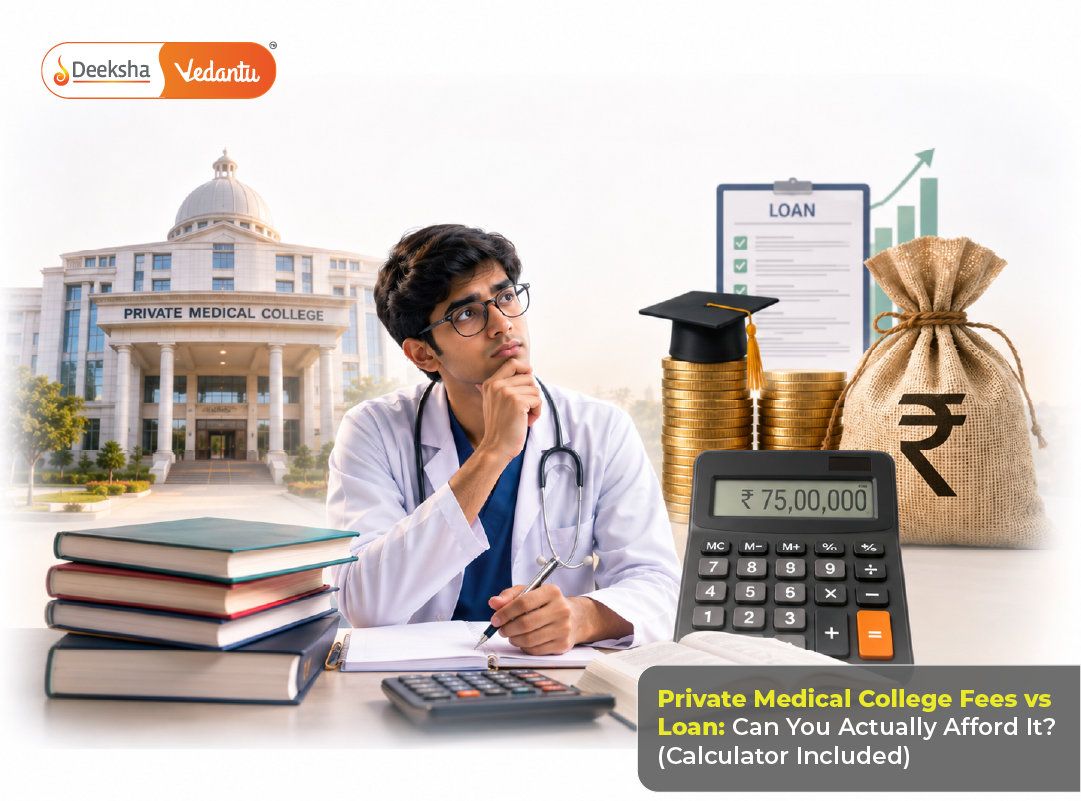

Private medical college costs ₹50-100 lakh. Education loans cover it.
But here’s what nobody tells you: The loan company approves you. Your family needs to survive the EMI.
Let me show you the real math-and which families can actually afford it.
The Real Cost: ₹60L Private College
Fees: ₹12-15 lakh/year × 5 years = ₹60-75 lakh Hostel + living: ₹3,000-₹5,000/month × 60 months = ₹18-30 lakh True total: ₹78-105 lakh
Loan taken: ₹80 lakh Loan interest rate: 9.5%-13% per annum (typical) Loan tenure: 10 years (standard)
The EMI Calculator Formula (Do the Math)
EMI = P × r × (1 + r)ⁿ / ((1 + r)ⁿ − 1)
Where:
- P = Principal (₹80 lakh = ₹80,00,000)
- r = Monthly interest rate (10% annual = 0.833% monthly = 0.00833)
- n = Number of months (10 years = 120 months)
For ₹80 lakh at 10% for 10 years:
EMI = ₹80,00,000 × 0.00833 × (1.00833)^120 / ((1.00833)^120 – 1) EMI ≈ ₹16,900/month
For ₹10 lakh at 9.5% for 10 years, EMI is approximately ₹13,331/month, so for ₹80 lakh, multiply by 8 = ₹106,648/month (more conservative estimate)
Let’s use ₹17,000/month as realistic EMI for ₹80 lakh.
Total amount paid over 10 years: ₹17,000 × 120 = ₹20.4 lakh in EMI Total interest paid: ₹20.4L – ₹8L = ₹12.4 lakh in pure interest
Three Financial Archetypes: Can You Afford This?
Archetype 1: “The Can-Afford Family”
Profile:
- Combined family income: ₹15-20 lakh/year
- Father/Mother: Government job or stable business
- Savings: ₹25-50 lakh liquid
- Living expenses: ₹50,000-₹80,000/month (excluding education)
The math:
- Monthly income: ₹125,000-₹167,000
- Monthly expenses (rent, food, utilities): ₹60,000
- Monthly loan EMI: ₹17,000
- Remaining per month: ₹48,000-₹90,000
Status: ✅ Can comfortably afford
- EMI is 10-14% of monthly income (safe threshold is 15-20%)
- Savings buffer exists for emergencies
- No stress on family budget
- Can still pursue other financial goals
Archetype 2: “The On-the-Edge Family”
Profile:
- Combined family income: ₹8-12 lakh/year
- Father/Mother: Private job or small business
- Savings: ₹5-15 lakh (tight)
- Living expenses: ₹40,000-₹60,000/month
The math:
- Monthly income: ₹67,000-₹100,000
- Monthly expenses: ₹50,000
- Monthly loan EMI: ₹17,000
- Remaining per month: 0-33,000
Status: ⚠️ Risky, but possible if:
- No job loss occurs for 10 years
- No major medical emergency
- Student earns slightly during college (₹5-10K/month through internships)
- Parents can suppress other spending
Reality: 6 out of 10 families in this category regret it by year 3.
Why? Because life happens:
- Medical emergency (₹2-5 lakh)
- Job loss (even 3 months = ₹51,000 EMI gap)
- Younger sibling education
- House repair
- Extended family support
One unexpected cost = bankruptcy risk
Archetype 3: “The Drowning Family”
Profile:
- Combined family income: ₹4-7 lakh/year
- Father or Mother single earner, unstable job
- Savings: ₹0-5 lakh
- Living expenses: ₹30,000-₹45,000/month
The math:
- Monthly income: ₹33,000-₹58,000
- Monthly expenses: ₹40,000
- Monthly loan EMI: ₹17,000
- Monthly deficit: -₹22,000 to -₹24,000 NEGATIVE
Status: ❌ Cannot afford. Do not take this loan.
- EMI alone is 29-52% of monthly income (catastrophic)
- Family is already spending more than earning
- Adding ₹17,000 EMI = impossible
- Will default on loan within 2-3 years
- Will face legal action from bank
- Parents’ property at risk (if mortgaged)
The Affordability Assessment: 5 Reality Checks
Before taking the loan, answer honestly:
Check 1: What’s Your Debt-to-Income Ratio?
EMI ÷ Monthly Income = ?
✅ If <15%: Affordable ⚠️ If 15-25%: Risky but manageable ❌ If >25%: Too expensive, don’t do it
For ₹80L loan (₹17K EMI):
- Monthly income must be >₹113,000 for safety
- That’s annual income >₹13.5 lakh
Check 2: Do You Have 6-Month Emergency Savings?
✅ If yes (6 months of living expenses saved): You can absorb a crisis ⚠️ If maybe (3-month savings): You’re at risk ❌ If no: Don’t take this loan
For a ₹17K/month EMI family, 6-month emergency fund = ₹1.2 lakh minimum
Check 3: Is Your Parent’s Job Stable?
✅ If government job or large stable company: Safe ⚠️ If private job or small business with decent history: Medium risk ❌ If job is unstable/contract-based: High risk
One parent job loss = EMI gap instantly
Check 4: What’s Your Backup Plan?
If your parent loses income:
- Can you study while earning? (Intern jobs pay ₹5-10K/month)
- Can extended family help temporarily?
- Can you take a personal loan to cover shortfall?
✅ If you have a credible backup: Somewhat safer ❌ If no backup: Too risky
Check 5: Is There Pressure or Support?
✅ If parents genuinely support AND you want medicine: Proceed if financially feasible ⚠️ If parents are hesitant but parents are doing it for you: Risky ❌ If parents are against it: Don’t do it (financial stress will destroy you)
The Hidden Costs Nobody Mentions
Loan processing fee: ₹20,000-₹50,000 Loan insurance (optional but recommended): ₹2,000-₹5,000/year Late EMI penalty: ₹500 per bounce + 2% penal interest/month Tax deduction benefit: You can claim interest paid on education loan under Section 80E, but only if you’re earning (so years 1-2 of internship don’t help)
The Real Talk
If you’re in Archetype 1: Private college is fine. EMI is manageable.
If you’re in Archetype 2: Only if you’re 100% certain about medicine and willing to be tight for 10 years.
If you’re in Archetype 3: Don’t take this loan. Seriously. The risk is real. Government college is better-you get free education + scholarship option.
₹80L private college loan = ₹17K/month EMI for 10 years. Safe only if monthly income >₹113,000. Check your debt-to-income ratio, emergency savings, parent job stability, and backup plan. If any is weak, the loan will break you.














Get Social