
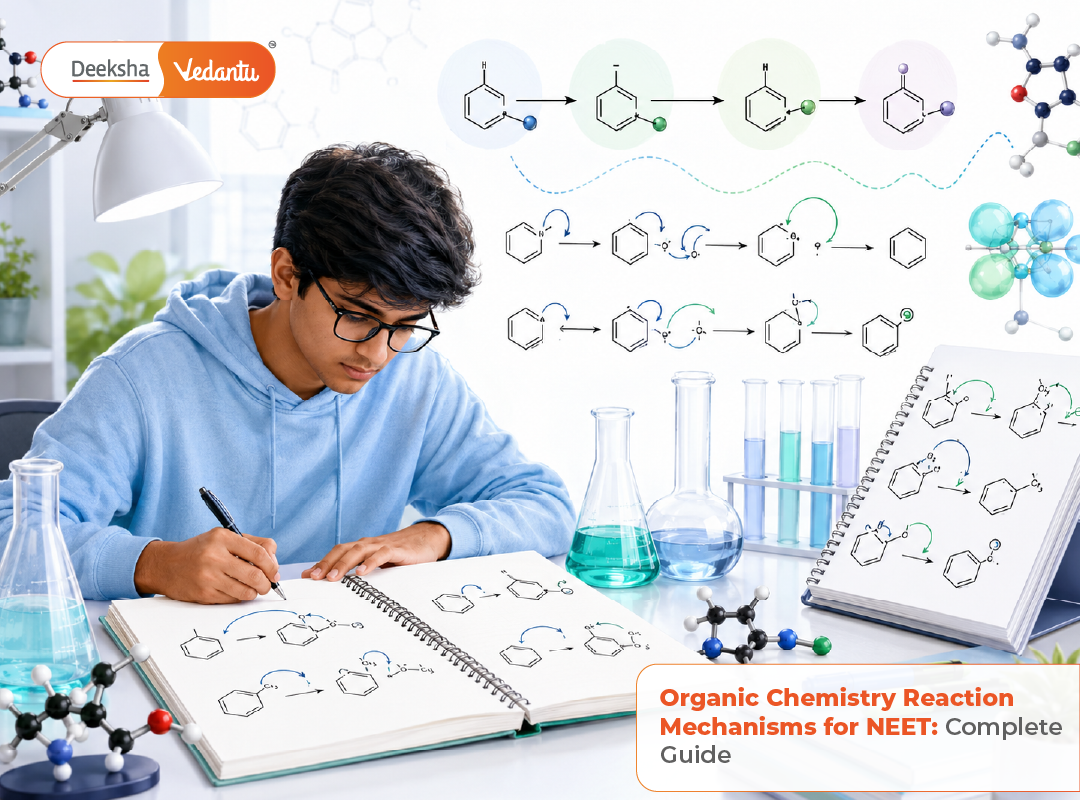

You see “Friedel-Crafts” in your textbook and panic. Another name reaction to memorize? Here’s the truth that’ll change your NEET organic chemistry game: Students must understand the process of reaction and the ways reaction is proceeding in the process rather than thinking “why” or “How” they occur. You’re not memorizing 50 random reactions. You’re learning 5 mechanism types that explain everything.
The Strategic Reality of NEET Organic Chemistry
Approximately 45–50% of the questions in the NEET Chemistry Syllabus section are from Class 11, while 50–55% are from Class 12. Within this, organic chemistry typically yields 15-18 questions worth 60-72 marks. That’s a massive ROI if you nail the mechanisms.
But here’s what separates 160+ scorers from 120 scorers in Chemistry: mechanism understanding over rote memorization. When you understand why a carbocation forms, you can predict what happens next in ANY reaction-not just the one you memorized.
The 5 Core Mechanism Types (Master These First)
1. Nucleophilic Substitution (SN1 & SN2)
What Actually Happens: A nucleophile (electron-rich) attacks an electron-deficient carbon, kicking out a leaving group.
SN1 (Two-Step):
- Step 1: Leaving group departs → carbocation forms
- Step 2: Nucleophile attacks carbocation
- Happens with tertiary halides (stable carbocations)
- Example: (CH₃)₃C-Br + OH⁻ → (CH₃)₃C-OH
SN2 (One-Step):
- Nucleophile attacks from back → leaving group exits simultaneously
- Happens with primary halides (less steric hindrance)
- Causes inversion of configuration
- Example: CH₃-Br + OH⁻ → CH₃-OH
NEET Trick: If question gives tertiary halide → think SN1. Primary halide → think SN2. This alone solves 3-4 questions yearly.
2. Electrophilic Addition (Alkenes to Alkanes)
The Pattern: Alkene’s π-bond electrons attack electrophile → carbocation forms → nucleophile attacks.
Markovnikov’s Rule in Action: When HBr adds to propene, H⁺ goes to the carbon with MORE hydrogens (forms MORE stable carbocation).
Real Example: CH₃-CH=CH₂ + HBr → CH₃-CHBr-CH₃ (NOT CH₃-CH₂-CH₂Br)
Why? Secondary carbocation (CH₃-CH⁺-CH₃) is more stable than primary (CH₃-CH₂-CH₂⁺).
Anti-Markovnikov (Peroxide Effect): Add H₂O₂ → reverses the rule → Br goes to less substituted carbon.
3. Electrophilic Aromatic Substitution (Benzene Reactions)
Universal Mechanism:
- Electrophile generated (E⁺)
- Benzene’s π-electrons attack E⁺
- Carbocation intermediate (resonance-stabilized)
- H⁺ leaves, aromaticity restored
The Named Reactions (Same Mechanism, Different E⁺):
| Reaction | Electrophile | Product | NEET Frequency |
| Friedel-Crafts Alkylation | R⁺ (from RCl + AlCl₃) | R-Benzene | ⭐⭐⭐ |
| Friedel-Crafts Acylation | RCO⁺ (from RCOCl + AlCl₃) | RCOC₆H₅ | ⭐⭐⭐ |
| Nitration | NO₂⁺ (from HNO₃ + H₂SO₄) | Nitrobenzene | ⭐⭐ |
| Sulfonation | SO₃H⁺ (from H₂SO₄) | Benzene sulfonic acid | ⭐ |
Deactivating Groups (Meta Directors): -NO₂, -CN, -COOH Activating Groups (Ortho-Para Directors): -OH, -NH₂, -CH₃
4. Nucleophilic Addition (Carbonyl Reactions)
The Universal Attack: Carbonyl carbon (C=O) is electron-deficient → nucleophile attacks → tetrahedral intermediate.
Aldol Condensation (High-Frequency NEET Reaction): Two aldehydes/ketones with α-hydrogen → β-hydroxy carbonyl → heat → α,β-unsaturated carbonyl
Mechanism Shortcut:
- Base removes α-H → enolate ion forms
- Enolate attacks another carbonyl
- Dehydration gives final product
NEET 2025 Pattern: Given two molecules, predict aldol product → appears 1-2 times yearly.
Cannizzaro Reaction (No α-Hydrogen): Aldehydes WITHOUT α-H undergo disproportionation: 2HCHO + NaOH → CH₃OH + HCOONa
Recognition Trick: If aldehyde has NO hydrogen on α-carbon (like benzaldehyde) + strong base → Cannizzaro.
5. Elimination Reactions (E1 & E2)
What Happens: Molecule loses a small molecule (H₂O, HX) → forms a double bond.
E1 (Two-Step):
- Leaving group departs → carbocation
- Base removes β-H → alkene forms
- Competes with SN1 (both form carbocation)
E2 (One-Step):
- Base removes H while leaving group exits
- Requires anti-periplanar geometry
- Competes with SN2
Zaitsev’s Rule: More substituted alkene is a major product.
The Top 10 “Must-Know” Named Reactions
NEET often tests specific named reactions (e.g., Williamson Ether Synthesis, Sandmeyer Reaction, Grignard Reaction). Here’s the priority list:
Tier 1 (Appear Almost Every Year):
- Williamson Ether Synthesis: R-ONa + R’-X → R-O-R’
- Grignard Reaction: RMgX + carbonyl → alcohol after H₃O⁺
- Sandmeyer Reaction: Ar-N₂⁺Cl⁻ + CuCl → Ar-Cl
Tier 2 (Appear Frequently):
- Reimer-Tiemann: Phenol + CHCl₃ + NaOH → Salicylaldehyde
- Haloform Reaction: Methyl ketone + X₂ + OH⁻ → CHX₃ + carboxylate
- Hoffmann Bromamide: RCONH₂ + Br₂ + KOH → R-NH₂ (one carbon less)
Tier 3 (Important for Conversions):
- Wolff-Kishner Reduction: Carbonyl + NH₂NH₂ + KOH → CH₂ (removes C=O)
- Clemmensen Reduction: Carbonyl + Zn-Hg + HCl → CH₂ (removes C=O)
- Hell-Volhard-Zelinsky: Carboxylic acid + Br₂ + P → α-bromo acid
- Kolbe’s Electrolysis: 2RCOONa → R-R + 2CO₂
The Memory Strategy That Actually Works
Instead of: “Grignard gives alcohol” Think: “Nucleophile (R-) attacks electrophilic carbonyl carbon → adds R group → alcohol forms after workup”
The Pattern-Based Approach:
- All Grignard, aldol, Cannizzaro → involve carbonyl attacks
- All Friedel-Crafts, nitration → electrophilic aromatic substitution
- All SN1, SN2 → nucleophile replaces leaving group
Group by mechanism, not by name. This cuts your memorization load by 70%.
Common NEET Question Patterns
Type 1: “Which reagent converts benzene to nitrobenzene?”
- Answer: HNO₃ + H₂SO₄ (generates NO₂⁺ electrophile)
Type 2: “Product when propene reacts with HBr in presence of peroxide?”
- Answer: CH₃-CH₂-CH₂Br (anti-Markovnikov)
Type 3: “Mechanism of aldol condensation involves?”
- Answer: Enolate ion formation → nucleophilic attack on carbonyl
The 48-Hour Before Exam Checklist
✅ Can you draw the mechanism for SN1 vs SN2?
✅ Can you predict Markovnikov vs Anti-Markovnikov products?
✅ Do you know which directing groups are meta vs ortho-para?
✅ Can you write 10 name reactions with reagents?
✅ Can you differentiate E1 vs E2 conditions?
If yes to all → you’re targeting 60+/72 in organic chemistry.
The Bottom Line
Organic chemistry isn’t about memorizing 100 reactions. It’s about understanding 5 mechanisms and recognizing patterns. Mastering basic principles, reaction mechanisms, functional groups, and important named reactions like Aldol Condensation or Diels-Alder is crucial.
When you understand WHY carbocations form, WHERE nucleophiles attack, and HOW leaving groups exit, you stop memorizing and start predicting. That’s when organic chemistry transforms from your weakness into your highest-scoring section.
















Get Social