
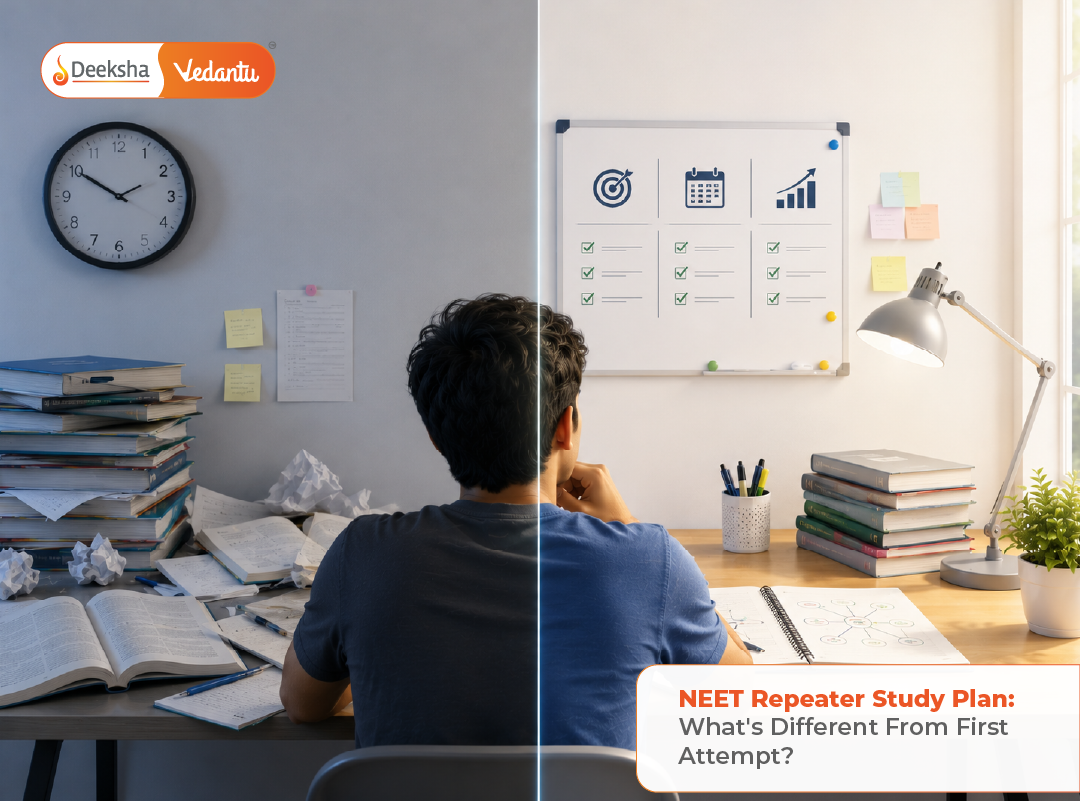

You’re starting your repeater year. You want to avoid the exact mistakes that cost you marks last time. But here’s the confusion: Should you study the SAME way but with MORE effort? Or do you need a completely different strategy?
The answer: Different strategy, not just harder effort.
Here’s the exact breakdown of how repeater preparation differs from first-attempt preparation.
The Major Differences: First Attempt vs Repeater Year
| Factor | First Attempt (12th Pass) | Repeater Year | Why It’s Different |
| Study Duration | 12-18 months (from Class 11 end) | 12 months (dedicated, no board pressure) | Repeaters have full focus, but less time to recover from mistakes |
| Goal Setting | “Learn everything, hope it works” | “Fix SPECIFIC mistakes, improve EXACT weak areas” | You have data now – your NEET scorecard tells you exactly where you lost marks |
| Content Coverage | 100% syllabus equally | 60% revision of strong areas, 40% deep work on weak areas | Most repeaters know 70-80% of content. Focus on closing gaps. |
| Mock Test Frequency | 1-2 mocks per month (usually late prep) | 2-3 full mocks per week (starting Month 3) | Repeaters need velocity. You’re training execution, not learning concepts. |
| Time per Chapter | Read NCERT fully, then practice | Read NCERT selectively, 70% practice time | You don’t need to relearn everything. You need to practice applying what you know. |
| Error Analysis | Generic “solve more questions” | Categorize EVERY mistake: Careless, Conceptual, Time pressure | This single change multiplies your improvement. First-timers skip this. |
| Weak Area Strategy | Spread equally across all topics | Concentrate 40% time on 5-6 weakest chapters | If Physics Chemistry Biology were 100-90-120, spend 60% of Physics time fixing it |
| Revision Cycles | 1-2 full revisions | 4-5 full revisions | Repeaters need cementing, not initial learning |
| Mock Test Difficulty | Fixed from start | Adaptive: Start harder (650-level), drop to 600-level as needed | Don’t waste time on 500-level mocks. Train at your target level. |
| Speed Training | Emphasis on “complete all 180 questions” | Emphasis on “attempt 160-165 with 90%+ accuracy” | Repeaters learn: Fewer questions with quality beats all questions with quantity |
| Accuracy Improvement | “Solve more to improve from 50% to 70%” | “Systematic error fixing to jump from 70% to 90%” | Focus shifts from breadth to precision |
| Mental Health Support | Minimal (first timers are optimistic) | Intensive (peer support, counselling, regular check-ins) | Repeaters battle self-doubt, isolation. Structure matters. |
| Study Material | “Complete NCERT, solve all reference books” | Selective: NCERT + high-weightage problem books, skip low-frequency topics | Repeaters can afford to skip topics that NEET never asks. First-timers can’t. |
| Coaching Approach | General classes covering full syllabus | Focused modules on error patterns, speed drills, accuracy workshops | A repeater doesn’t need “what is photosynthesis” class. They need “common photosynthesis mistakes” class. |
| Timetable Structure | 6-8 hours/day spread across subjects | 6-8 hours/day with 90 min blocks, timed problem-solving sessions | Repeaters train exam execution, not content absorption |
The Month-by-Month Comparison
FIRST ATTEMPT:
- Months 1-4: Learn concepts, complete NCERT
- Months 5-8: Practice MCQs, take early mocks
- Months 9-12: Revision, last-minute learning
REPEATER YEAR:
- Month 1-2: Error audit, foundation strengthening in weak areas (not full NCERT re-reading)
- Month 3-7: Aggressive mock testing (50+ full mocks), error analysis, speed training
- Month 8-12: Consistency maintenance, velocity optimization, confidence building
The difference: Repeaters compress learning into Months 1-2 (because you already know 80% of it) and use Months 3-12 for execution training.
The Content Strategy Difference
First Attempt: “Read Human Physiology fully because it’s 1.5 chapters” > Takes 60 hours of reading
Repeater Strategy: “I scored 65/150 in Human Physiology before. The high-frequency questions are on: Kidney function, heart regulation, neural control. Spend 30 hours on THESE specific topics.” > Takes 30 hours of focused work
The Mock Test Strategy Difference
First Attempt: “Take mock tests to see where I stand”
- Result: You discover weakness, but it’s Month 11, too late
Repeater Year: “Take mocks to fix execution”
- Month 3: Mock reveals 40-mark gap in Physics
- Month 4: Targeted Physics drills based on that mock
- Month 5: Re-test that weakness with another mock
- Month 6: Verify improvement, move to next weakness
The System: Test > Identify > Fix > Re-test. Not one-time testing.
The Critical Difference: Error Categorization
First Attempt: Wrong answer = Wrong answer (no deeper analysis)
Repeater Year: Wrong answer is categorized:
| Error Type | Solution |
| Careless mistake (knew answer, marked wrong) | Slow down, 10-second re-read before submitting |
| Conceptual gap (didn’t understand) | Revisit that specific concept, 5-hour deep dive |
| Time pressure (knew it, ran out of time) | Time management drill, attempt 165 questions with planned speed |
Why it matters: A repeater with 50 careless mistakes doesn’t need to “study harder.” They need to “execute slower.”
The Books Difference
First Attempt: NCERT + HC Verma + Reference books + Coaching notes = Complete coverage
Repeater Year: NCERT (selective chapters) + High-weightage problem books + 5-year PYQs = Focused depth
The Bottom Line
Repeater preparation isn’t “First attempt preparation with more hours.” It’s a fundamentally different approach.
If you’re a repeater trying last year’s strategy, you’re training the wrong thing. You don’t need more learning. You need better execution.














Get Social