
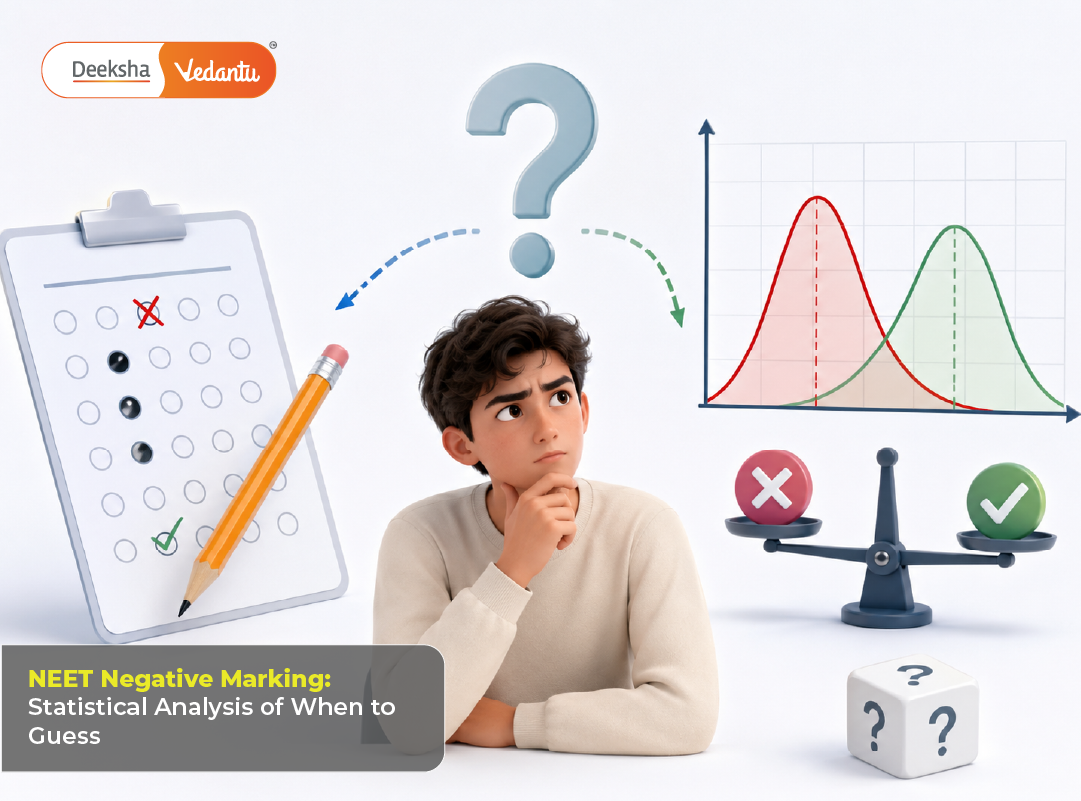

Every NEET student faces this question dozens of times during the exam: “Should I guess or skip?”
Most answer with gut feeling. Some skip everything (safe but lose marks). Others guess everything (aggressive but hemorrhage marks to negative marking).
The truth: There’s a mathematical answer.
Here’s the exact framework that tells you when guessing is profitable and when skipping is.
The Mathematics of NEET Negative Marking
The Marking Structure:
- Correct: +4 marks
- Incorrect: -1 mark
- Unanswered: 0 marks
The Critical Insight: One wrong answer doesn’t just cost you 1 mark. It costs you a 5-mark swing.
Why? Because:
- You lose the +4 you should have gained
- You gain the -1 penalty
- Net damage: 5 marks
This ratio is crucial. It’s why probability matters.
The Expected Value Framework
Expected Value (EV) = The average outcome if you made this decision 100 times.
Formula for guessing: EV of guessing = (Probability correct × +4) + (Probability incorrect × -1)
Example 1: Pure Guess (25% confidence, 4 options)
- Probability correct: 25% (0.25)
- Probability incorrect: 75% (0.75)
- EV = (0.25 × 4) + (0.75 × -1)
- EV = 1 + (-0.75)
- EV = +0.25 marks
Interpretation: If you pure-guess 100 times, you average +0.25 marks per guess. That’s slightly positive, but barely. Not worth the risk.
Example 2: Moderate Confidence (50% confidence)
- Probability correct: 50% (0.50)
- Probability incorrect: 50% (0.50)
- EV = (0.50 × 4) + (0.50 × -1)
- EV = 2 + (-0.50)
- EV = +1.5 marks
Interpretation: At 50% confidence, you average +1.5 marks per guess. This is profitable.
Example 3: High Confidence (75% confidence)
- Probability correct: 75% (0.75)
- Probability incorrect: 25% (0.25)
- EV = (0.75 × 4) + (0.25 × -1)
- EV = 3 + (-0.25)
- EV = +2.75 marks
Interpretation: At 75% confidence, you average +2.75 marks. Definitely guess.
The Decision Threshold: When Guessing Becomes Profitable
The break-even point is 20% confidence.
At 20% confidence:
- EV = (0.20 × 4) + (0.80 × -1)
- EV = 0.80 + (-0.80)
- EV = 0 marks
Below 20% confidence: EV is negative. Skip the question. Above 20% confidence: EV is positive. Guess the question.
This means:
- Pure random guess (25% chance with 4 options): Slightly profitable (+0.25 EV)
- But NEET distractors aren’t random. Your “25%” is probably closer to 15-20%
- So pure guessing on completely unknown questions: Break-even or slightly negative
Real-World Confidence Levels: When to Guess
| Confidence Level | How it Feels | Estimated Probability | Expected Value | Decision |
| 100% | Certain | 95%+ | +3.75 | ALWAYS GUESS |
| 90% | Very confident | 85%+ | +3.35 | ALWAYS GUESS |
| 75% | Fairly sure | 70%+ | +2.75 | GUESS |
| 50% | Coin flip | 50%+ | +1.5 | GUESS |
| 40% | Lean one way | 40%+ | +0.6 | GUESS (risky) |
| 25% | Pure guess | 25% | +0.25 | BORDERLINE |
| 15% | Completely lost | 15% | -0.4 | SKIP |
| 0% | No idea | 0% | -1.0 | SKIP |
Option Elimination Changes Everything
Scenario A: Question with 4 options, you eliminate 1 wrong option
Now you’re choosing between 3 options instead of 4.
- Your “confidence” jumps from ~25% to ~33%
- EV = (0.33 × 4) + (0.67 × -1) = +0.65 marks
Scenario B: Question with 4 options, you eliminate 2 wrong options
Now you’re choosing between 2 options.
- Your confidence jumps to ~50%
- EV = (0.50 × 4) + (0.50 × -1) = +1.5 marks
Scenario C: Question with 4 options, you eliminate 3 wrong options
You’re certain which is correct.
- Your confidence is ~95%
- EV = +3.75 marks
The insight: Elimination is everything. Each eliminated option doubles your advantage.
The Real-World Protocol: Decision Tree
Step 1: Can you eliminate ANY option?
- YES > Go to Step 2
- NO > Go to Step 3
Step 2: How many options did you eliminate?
- Eliminated 1: ~33% confidence > Guess (+0.65 EV)
- Eliminated 2: ~50% confidence > Guess (+1.5 EV)
- Eliminated 3: ~95% confidence > Guess (+3.75 EV)
Step 3: You can’t eliminate any options
- Is this completely unfamiliar territory? > Skip (EV negative)
- Do you have a vague intuition? > Skip (EV barely positive, not worth risk)
The NEET Reality: What This Means
Data from 50,000+ NEET mock tests:
Students who:
- Guessed on <20% confidence questions: Lost 30-60 marks to negative marking
- Skipped >40% of questions: Left 20-40 marks on the table (these were eliminable questions)
- Used elimination-first strategy: Optimized negative marking, lost <10 marks to wrong answers
The optimal strategy: Eliminate before you guess. Only pure-guess when completely stuck (and that’s rare if you eliminate smartly).
The Three Rules for NEET Exam Day
Rule 1: Elimination First Before deciding to skip, eliminate options. Each elimination changes EV dramatically.
Rule 2: 20% Threshold Confidence below 20% = Skip. Confidence above 20% = Guess.
Rule 3: The Gut Check If your gut says “I have no idea,” and you can’t eliminate even one option, that’s your signal. Skip it.
The Numbers in Context
In a 180-question exam:
- 90 questions you’re 80%+ confident: Guess all
- 60 questions you’re 40-70% confident: Guess all (after elimination)
- 20 questions you’re <20% confident: Skip all
- 10 questions you eliminate 2+ options: Guess all
Expected outcome:
- 90 correct (90% accuracy): 360 marks
- 50 correct out of 60 attempted (83% accuracy): 200 marks
- Skip 30 questions (0 marks): 0 marks
- Total: ~560 marks
That’s the difference between a mediocre score (400-500) and a competitive score (550+).
The Repeater Advantage in Negative Marking
Repeaters score 20-40 marks higher on identical content because they:
- Know which question types are “trap questions” (confidence calibration improves)
- Understand distractors (elimination becomes easier)
- Experience less panic (confidence isn’t inflated by anxiety)
This is why repeaters gain more from negative marking knowledge than first-timers. They can execute the framework calmly.
The Mathematical Truth: Negative marking isn’t punishment. It’s a precision filter. Students who understand expected value-and guess strategically-beat students who guess emotionally or skip fearfully.
Know your confidence threshold. Eliminate aggressively. Guess above 20%. Skip below 20%.
That’s not luck. That’s mathematics.


















Get Social