
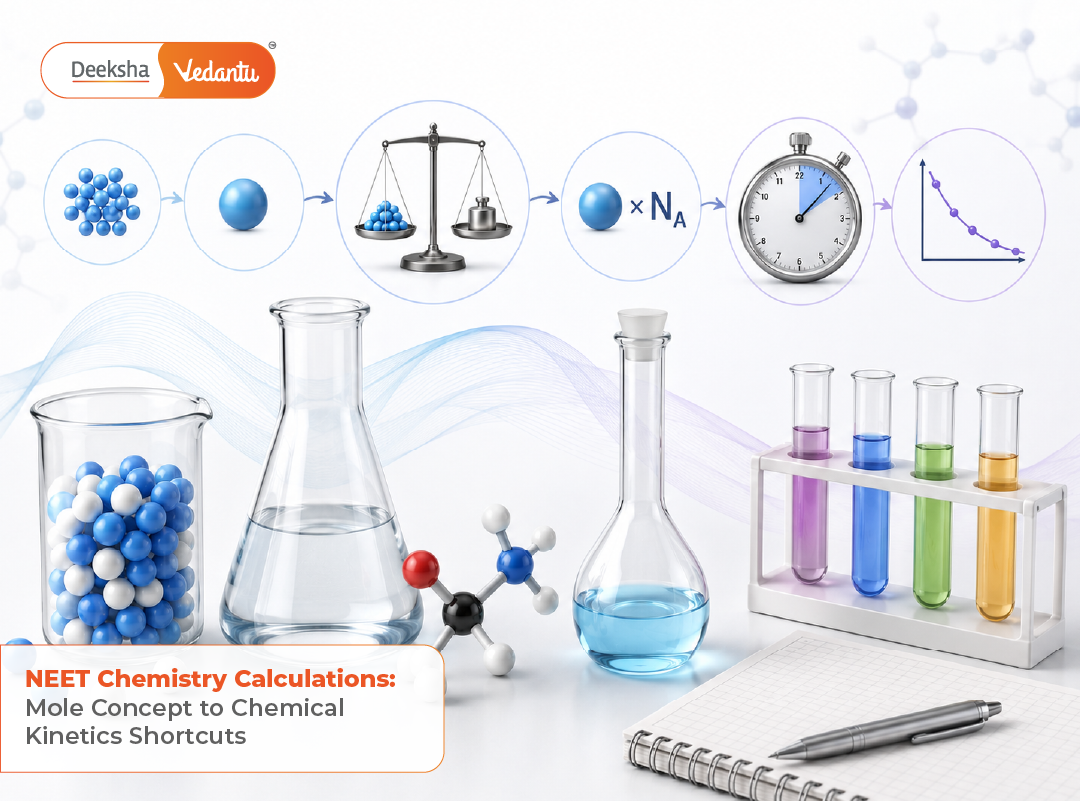

You solve a mole concept question in 3 minutes. Your competitor solves it in 45 seconds. Same answer, same marks. But over 15 calculation-heavy Chemistry questions, they’ve saved 33 minutes-time to attempt 10 more Biology questions or double-check tricky Physics problems.
The difference? They’re not smarter. They’re using shortcuts you don’t know yet.
Physical Chemistry contributes 8-12 calculation questions yearly worth 32-48 marks. These aren’t concept questions-they’re pure calculation warfare. The student with faster calculation techniques wins. Let me show you the arsenal NEET toppers use.
Mole Concept & Stoichiometry: The Foundation Hacks
Shortcut 1: The Molecular Weight Memory Trick
Stop calculating H₂O = 2×1 + 16 = 18 every single time. Memorize the top 20 molecular weights that repeat:
Instant Recall List:
- H₂O = 18 | NH₃ = 17 | CO₂ = 44 | O₂ = 32 | N₂ = 28
- NaCl = 58.5 | NaOH = 40 | H₂SO₄ = 98 | HNO₃ = 63 | HCl = 36.5
- CaCO₃ = 100 | Na₂CO₃ = 106 | KMnO₄ = 158 | K₂Cr₂O₇ = 294
This alone saves 15-20 seconds per question. Over 5 mole concept questions = 90 seconds saved.
Shortcut 2: The Percentage Composition Speed Formula
Traditional Method: Find mass of each element, divide by molecular mass, multiply by 100. It takes 2 minutes.
Speed Method: For compounds like CₓHᵧOᵤ, use ratio shortcuts:
- C% in CH₄: 12/(12+4) = 12/16 = 3/4 = 75% (immediate fraction recognition)
- O% in H₂O: 16/18 = 8/9 ≈ 89% (memorize common fractions)
Train yourself to recognize 16/18, 12/44, 14/17 as fractions, not divisions.
Shortcut 3: Limiting Reagent Without Full Calculation
Question: 10 mol H₂ + 6 mol O₂ → H₂O. Find a limiting reagent.
Traditional: Calculate moles required, compare. Takes 90 seconds.
Speed Method:
- Reaction: 2H₂ + O₂ → 2H₂O (ratio 2:1)
- Given: H₂ = 10, O₂ = 6
- Quick check: H₂ needs 5 mol O₂ (10/2). We have 6. O₂ excess.
- O₂ needs 12 mol H₂ (6×2). We have 10. H₂ deficient.
- Answer in 20 seconds: H₂ is limiting reagent.
The Rule: Divide each reactant amount by its coefficient. Smallest value = limiting reagent.
Solutions: The Concentration Conversion Matrix
Shortcut 4: The Molarity-Molality Quick Switch
Problem: Convert 2M NaOH (density 1.08 g/mL) to molality.
Traditional Method: Use full formula, multiple steps. Takes 2 minutes.
Speed Formula: For dilute solutions (M < 1), Molarity ≈ Molality when density ≈ 1 g/mL.
For concentrated solutions, use: m = (M × 1000) / (d × 1000 – M × MW)
Where d = density in g/mL, MW = molecular weight
But the real hack: NEET rarely asks for this conversion. If they do, options are far apart (2M vs 2.5m vs 3m). Estimate using density adjustment and pick closest.
Shortcut 5: The PPM Magic
Converting mass % to ppm: Multiply by 10,000
- 0.5% = 5,000 ppm (instant)
- 0.001% = 10 ppm (instant)
Why it works: ppm = (mass solute/mass solution) × 10⁶ % = (mass solute/mass solution) × 10² Therefore: ppm = % × 10⁴
Chemical Equilibrium: The Kp-Kc Speed Connection
Shortcut 6: The Δn Determination Trick
Formula: Kp = Kc(RT)^Δn where Δn = (moles gaseous products) – (moles gaseous reactants)
Speed Trick:
- Count only GASEOUS species (ignore solids/liquids)
- If Δn = 0, Kp = Kc (no calculation needed)
- If Δn = 1, Kp = Kc × RT (one multiplication)
- If Δn = -1, Kp = Kc/RT (one division)
Example: N₂ + 3H₂ ⇌ 2NH₃ Δn = 2 – 4 = -2. Answer appears? Check if it’s Kc/R²T² form. Pick immediately.
Chemical Kinetics: The Order & Rate Hacks
Shortcut 7: Integrated Rate Law Selection
Stop deriving every time. Recognize the signature:
| Order | Signature in Data/Graph | Time for 50% Completion |
| Zero | Concentration decreases linearly | t₁/₂ ∝ [A]₀ (varies with initial) |
| First | ln[A] vs time is straight line | t₁/₂ = 0.693/k (constant) |
| Second | 1/[A] vs time is straight line | t₁/₂ ∝ 1/[A]₀ (varies inversely) |
NEET Pattern: They give a graph or half-life behavior. Match the signature, pick order in 10 seconds.
Shortcut 8: The Half-Life Doubling Trick
Question: First-order reaction, t₁/₂ = 10 min. Time for 75% completion?
Traditional: Use integrated rate law. Takes 90 seconds.
Speed Method:
- 50% → 25% remaining = 1 half-life = 10 min
- 25% remaining = 75% completed
- Answer: 20 minutes
For 87.5% completion: 3 half-lives (50→25→12.5, so 87.5% done)
The Rule: n half-lives = (1 – 1/2ⁿ) × 100% completion
- 1 half-life = 50%
- 2 half-lives = 75%
- 3 half-lives = 87.5%
- 4 half-lives = 93.75%
Memorize these. They repeat.
Thermodynamics: The Sign Convention Sanity Check
Shortcut 9: The Spontaneity Decision Tree
Question: ΔH = -ve, ΔS = -ve. Is the reaction spontaneous?
Traditional: Calculate ΔG = ΔH – TΔS at different temperatures.
Speed Decision Tree:
- ΔH = -ve, ΔS = +ve → Always spontaneous (no calculation)
- ΔH = +ve, ΔS = -ve → Never spontaneous (no calculation)
- ΔH = -ve, ΔS = -ve → Spontaneous at LOW temperature only
- ΔH = +ve, ΔS = +ve → Spontaneous at HIGH temperature only
Answer in 5 seconds by matching the sign pattern.
Shortcut 10: The Bond Energy Estimation
Question: Calculate ΔH for: CH₄ + 2O₂ → CO₂ + 2H₂O
Speed Method: Don’t write out all bonds. Use this hierarchy:
- If all bond energies given → calculate (no shortcut)
- If ΔH_f values given → use ΔH = Σ(products) – Σ(reactants) (faster)
- If options far apart → estimate by counting strong bonds broken vs formed
Strong bonds: C=O (799), O=O (498), O-H (464), C-H (414) Weak bonds: single bonds < 350 kJ/mol
Breaking strong bonds = more endothermic. Making strong bonds = more exothermic.
Electrochemistry: The Cell Potential Rapid Fire
Shortcut 11: The E°cell Sign = Spontaneity
E°cell positive → ΔG negative → Spontaneous E°cell negative → ΔG positive → Non-spontaneous E°cell zero → Equilibrium
No Nernst equation needed if they just ask “Is reaction spontaneous?”
Shortcut 12: The n-Electron Transfer Count
Balancing redox without full half-reactions:
Example: Fe²⁺ → Fe³⁺ and MnO₄⁻ → Mn²⁺ in acidic medium
Quick n-count:
- Fe: +2 to +3 = 1e⁻ lost
- Mn: +7 to +2 = 5e⁻ gained
- LCM = 5
- Therefore: 5Fe²⁺ + MnO₄⁻ → 5Fe³⁺ + Mn²⁺
In 30 seconds. Balance rest by inspection.
The Calculation Practice Routine
Week 1-2: Memorize molecular weights, common fractions, signatures Week 3-4: Practice 10 calculation questions daily WITH shortcuts Week 5-8: Time yourself-target 45 seconds per calculation question Week 9-12: Mix calculation + concept questions, maintain speed
Before Exam: Can you solve 5 calculations in 4 minutes? If yes, you’re ready.
Expert Suggestion
NEET Chemistry calculations aren’t about who knows more formulas. They’re about who calculates faster. Memorize the top 20 molecular weights. Learn the pattern signatures. Use decision trees instead of full derivations.
The difference between 140 and 165 in Chemistry? 90 seconds saved per calculation × 12 questions = 18 minutes extra for Biology. That’s 7-8 additional correct answers. That’s 28-32 marks. That’s 2000+ rank improvement.
Speed isn’t optional. It’s survival.
















Get Social