
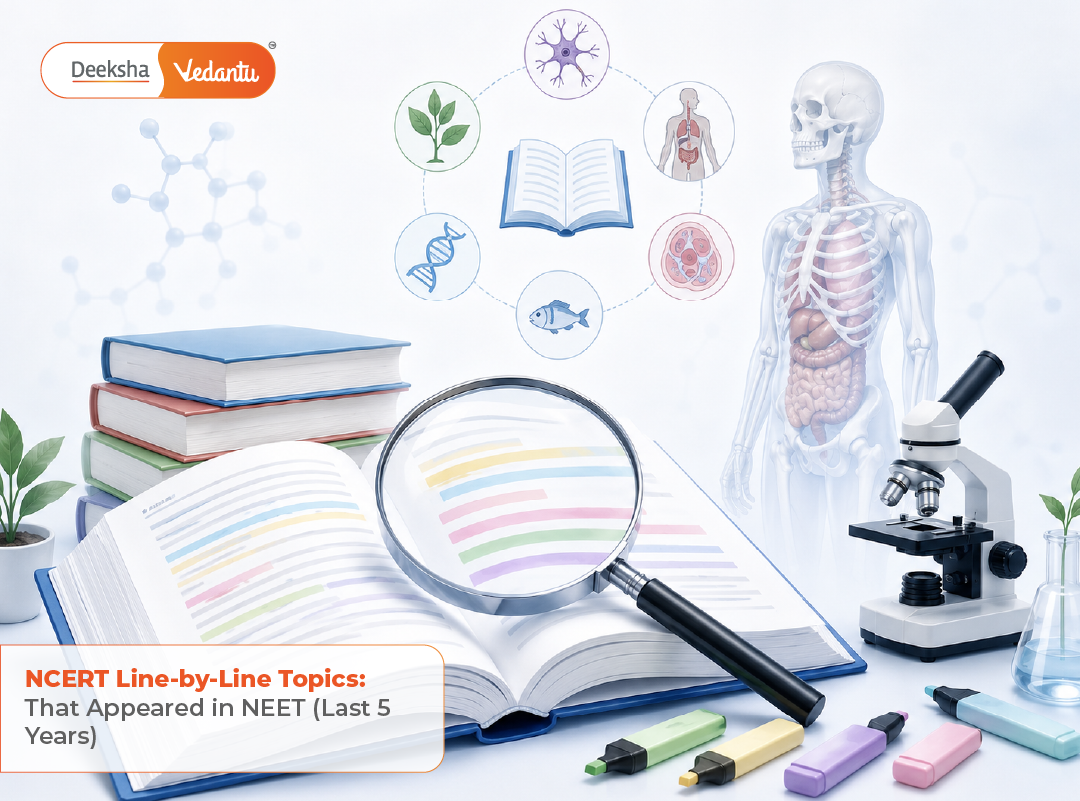

Every NEET topper will tell you the same secret: “85-90% of Biology questions are lifted straight from NCERT.” But here’s what they don’t tell you-not ALL NCERT lines. Specific pages, specific paragraphs, specific diagrams repeat like clockwork.
You could read 2,400 NCERT pages cover to cover. Or you could focus on the 300 pages that NTA loves. The difference between these strategies? 200 hours of wasted time versus surgical precision.
This isn’t theory. This is forensic analysis of 5 years of actual NEET papers (2020-2024) showing you EXACTLY which NCERT lines became questions, which chapters NTA ignores, and which single sentences are worth 4 marks.
Biology: The Direct Lift Pattern
Class 11 Biology Chapter 2: Biological Classification
NCERT Page 28, Paragraph 3: “Bacteria are the sole members of Kingdom Monera.”
NEET 2022 Q14: Which kingdom consists exclusively of prokaryotic organisms? (a) Monera (b) Protista (c) Fungi (d) Animalia
Verbatim. Four marks for reading one sentence.
Class 11 Biology Chapter 5: Morphology of Flowering Plants
NCERT Page 87, Figure 5.8: Diagram of dicot and monocot stem transverse sections with labels.
NEET 2023 Q18: Identify the structure labeled ‘X’ in the given T.S. of dicot stem.
The exact diagram. Changed the label letter. That’s it.
Class 12 Biology Chapter 1: Reproduction in Organisms
NCERT Page 6, Box: “In yeast and Hydra, budding is a method of asexual reproduction.”
NEET 2021 Q9: Which of the following reproduces by budding? (a) Plasmodium (b) Hydra (c) Planaria (d) Amoeba
Direct example from a side box most students skip.
The High-Frequency NCERT Zones (2020-2024 Data)
Biology Chapter Winners:
| Chapter | Direct Questions (5 Years) | NCERT Pages to Master |
| Human Physiology | 18-22 questions | Class 11: Pages 264-320 (entire unit) |
| Genetics & Evolution | 12-16 questions | Class 12: Pages 52-89 (Principles of Inheritance) |
| Plant Physiology | 10-14 questions | Class 11: Pages 180-242 (Transport, Photosynthesis) |
| Cell Biology | 8-10 questions | Class 11: Pages 116-145 (Cell Cycle, Biomolecules) |
| Reproduction | 8-10 questions | Class 12: Pages 2-33 (Sexual Reproduction in Plants) |
What This Means: These 5 chapters alone contribute 56-72 questions out of 90 Biology questions. That’s 80% coverage from 400 NCERT pages.
Chemistry: The Formula + Definition Pattern
Class 11 Chemistry Chapter 1: Some Basic Concepts
NCERT Page 7, Formula: Molarity (M) = Number of moles of solute / Volume of solution in litre
NEET 2024 Q4: Calculate molarity of solution containing 4g NaOH in 500 mL.
Direct formula application with changed numbers.
Class 12 Chemistry Chapter 10: Haloalkanes
NCERT Page 298, Definition: “SN2 reactions proceed with inversion of configuration (Walden inversion).”
NEET 2023 Q31: Which mechanism results in inversion of configuration? (a) SN1 (b) SN2 (c) E1 (d) E2
Word-for-word concept from definition box.
Class 11 Chemistry Chapter 8: Redox Reactions
NCERT Page 245, Table 8.2: Standard reduction potentials with exact values.
NEET 2022 Q26: Given E°(Zn²⁺/Zn) = -0.76V, E°(Cu²⁺/Cu) = +0.34V, calculate E°cell.
Exact values from the NCERT table. Calculation straightforward.
Physics: The Derivation Endpoint Pattern
Class 11 Physics Chapter 5: Laws of Motion
NCERT Page 111, Final Result: “For two bodies connected over a pulley: a = (m₁-m₂)g/(m₁+m₂)”
NEET 2021 Q7: Two masses 3kg and 2kg hang over a frictionless pulley. Acceleration of system?
Direct formula. Insert values. Done in 30 seconds.
Class 12 Physics Chapter 9: Ray Optics
NCERT Page 326, Lens Formula: 1/f = 1/v – 1/u
NEET 2024 Q42: Object placed 30cm from convex lens of focal length 15cm. Image distance?
Same formula every year. Only numbers change.
Class 12 Physics Chapter 13: Nuclei
NCERT Page 446, Half-life Formula: N = N₀(1/2)^(t/T₁/₂)
NEET 2023 Q48: Radioactive sample with half-life 10 days. After 20 days, fraction remaining?
Repeated format. Standard plug-and-solve.
The Verbatim Question Categories
Type 1: Definition Questions (25-30% of Biology)
These are copy-paste from NCERT glossary or bold terms.
Example from NEET 2024: “Plasmids are autonomously replicating, circular, extra-chromosomal DNA.” → Question: “What are plasmids?” Options match exact NCERT line.
Type 2: Diagram Labels (15-20% of Biology)
NCERT has 180+ labeled diagrams. 25-30 appear directly.
Repeating Diagrams (2020-2024):
- Human brain (sagittal section) – appeared 4 times
- T.S. of dicot stem – appeared 5 times
- Human heart structure – appeared 4 times
- Nephron diagram – appeared 3 times
- DNA replication fork – appeared 3 times
Type 3: Example-Based Questions (20% across all subjects)
NCERT gives examples for concepts. Questions ask: “Which of the following is an example of X?”
NEET 2022: “Example of C4 plant?” NCERT Page 224 lists: Maize, sugarcane, sorghum. Answer: Maize
The Golden Pages (Memorize These)
Biology:
- Class 11, Pages 12-15: Five Kingdom Classification (appears every year)
- Class 11, Page 87: Root and stem modifications diagram (3-4 marks)
- Class 12, Pages 62-65: Law of Independent Assortment explanation (calculation questions)
- Class 12, Page 149: Types of ecological pyramids (diagram-based)
Chemistry:
- Class 11, Page 33: Significant figures rules (1 question yearly)
- Class 12, Page 54: Rate law expressions (direct formula question)
- Class 12, Pages 298-302: SN1 vs SN2 table (repeated 4 times in 5 years)
Physics:
- Class 11, Page 111: Pulley system formulas (standard question)
- Class 12, Page 326: Mirror and lens formulas (2-3 questions yearly)
- Class 12, Page 383: Photoelectric effect equations (1-2 questions)
The Smart Reading Strategy
Stage 1: First Reading (60% time) Read entire NCERT normally. Understand concepts, don’t memorize.
Stage 2: Forensic Reading (30% time) Go back through high-frequency chapters. Highlight:
- Every bold term and its definition
- Every diagram with labels
- Every formula in a box
- Every example given for a concept
- Every numerical value in tables
Stage 3: PYQ Mapping (10% time) Solve last 5 years’ questions. For each correct answer, mark the exact NCERT page it came from. You’ll see patterns emerge: certain pages contribute 3-4 questions across years.
What NTA Actually Tests
They Test: ✅ Exact definitions from NCERT glossary ✅ Diagram labels and their functions ✅ Examples given in text for concepts ✅ Formulas in colored boxes ✅ Summary tables at chapter end
They DON’T Test: ❌ Historical background stories ❌ Intext questions (ironically) ❌ “To do” activity sections ❌ Supplementary reading boxes
Time Saved: Skip what they don’t test. Focus multiplies.
The 30-Day NCERT Sprint
Days 1-10: Read high-frequency chapters (listed above) with highlighter Days 11-20: Make diagram flashcards from marked pages Days 21-25: Create definition list of all bold terms Days 26-28: Solve 5 years PYQs, map back to NCERT pages Days 29-30: Revise only highlighted text + diagrams
Result: 90% NCERT coverage from 30% reading effort.
Deeksha’s Line-by-Line NCERT Program
We’ve mapped every NEET question from 2015-2024 back to exact NCERT pages. Our NCERT module includes pre-highlighted books with PYQ frequency markers, diagram drill sessions with the 50 most repeated images, and page-wise importance color coding. Master the 300 pages that give you 600 marks.
The Reality
NEET isn’t testing if you read NCERT. It’s testing if you read the RIGHT parts of NCERT. Every year, 15-20 questions come from less than 50 pages. Another 30-40 come from diagrams you can memorize in 10 hours. The remaining questions need understanding, not memorization.
Read smart. Highlight strategic. Practice mapped. That’s how NCERT becomes 150+ marks, not just “a textbook.”










Get Social