
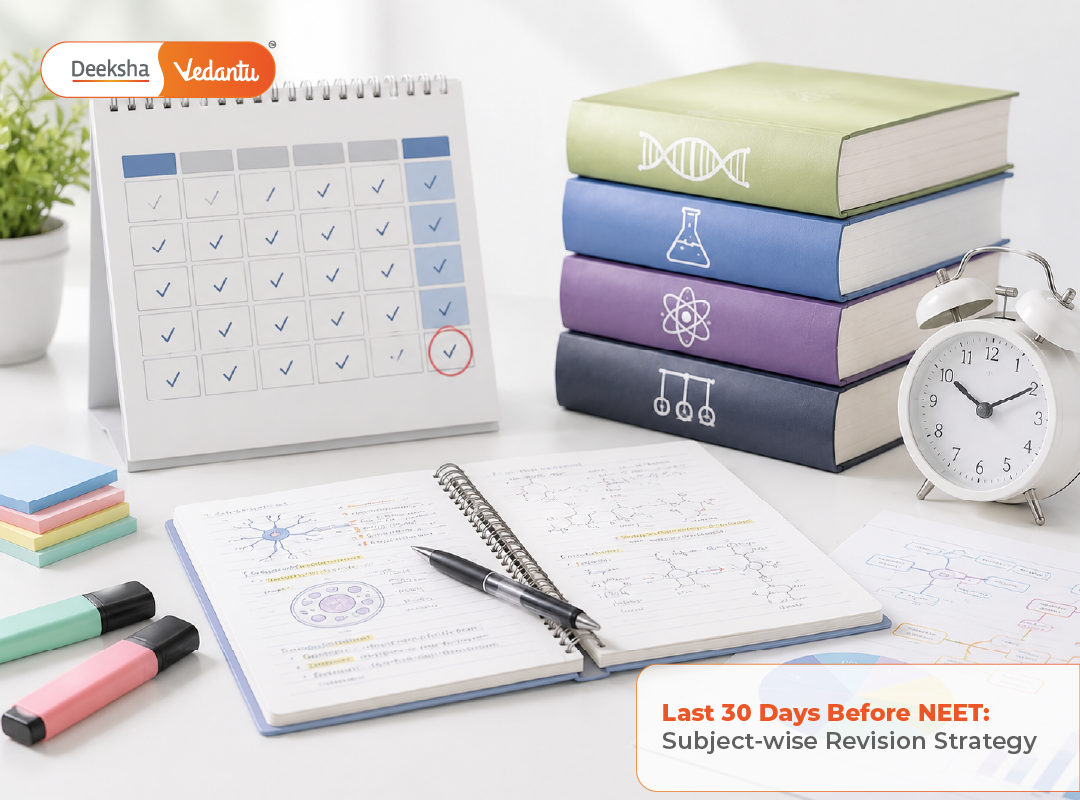

The final 30 days before NEET can make or break your score. This isn’t about learning new topics-it’s about consolidating what you know, sharpening accuracy, and building exam temperament. With NEET 2027 scheduled for May, the last weeks are your highest-leverage period. Here’s the reality: students who follow a structured last-month revision strategy typically improve their mock test scores by 30-50 marks. This guide provides a realistic, subject-wise plan to maximize your performance when it matters most.
🎯 The Golden Rule: No New Topics After This Point
Starting completely new chapters in the last 30 days creates panic, not preparation. If you haven’t covered a topic by now, leave it. Your goal is to perfect what you already know rather than risk forgetting everything by cramming unfamiliar content. The only exception: if a high-weightage topic (like Human Physiology or Organic Reactions) is completely untouched, dedicate the first week to building basic understanding, then move to revision mode.
📅 The 4-Week Framework
Week 1 (Days 1-7): Complete NCERT Revision Round
Daily Goal: Cover 8-10 chapters across all subjects
Focus: Speed-read entire NCERT with emphasis on:
- Biology: Diagrams, bold terms, NCERT exercise questions
- Chemistry: Reaction mechanisms, periodic table trends, formulas
- Physics: Derivations summary, important numericals
Time Allocation:
- Morning (6:00 AM – 10:00 AM): Biology NCERT (4 hours)
- Mid-Day (10:30 AM – 1:00 PM): Chemistry NCERT (2.5 hours)
- Afternoon (2:00 PM – 4:30 PM): Physics NCERT (2.5 hours)
- Evening (5:00 PM – 7:00 PM): Previous year MCQs (mixed subjects)
- Night (8:00 PM – 9:30 PM): Revision of the day’s topics
Key Activity: Create one-page summary sheets for each chapter covering only the most frequently asked concepts. These become your quick-revision tools for Week 4.
Week 2 (Days 8-14): Previous Year Papers Marathon
Daily Goal: Solve 200-250 MCQs from NEET 2019-2026 papers
Focus: Pattern recognition and question-type familiarity
Daily Structure:
- Morning Session: Solve one full previous year paper (3 hours, timed)
- Afternoon Session: Analyze every wrong answer (2 hours)
- Evening Session: Revise chapters where mistakes occurred (2 hours)
Critical Analysis Framework: For every wrong answer, ask:
- Was it a silly mistake (misread question) or conceptual gap?
- Which NCERT page/line contains this information?
- Have I made this same mistake before in mock tests?
Week 2 Target: Complete analysis of 6-7 previous year papers with error categorization. By the end of this week, you should identify your top 5 mistake-prone topics across all subjects.
Week 3 (Days 15-21): Mock Test Intensive Phase
Daily Goal: 1 full-length mock test + thorough analysis
Schedule:
- Morning (2:00 PM – 5:20 PM): Take full-length NEET mock under exam conditions
- Use exact NEET timing (3 hours 20 minutes)
- Practice with CBT interface if NEET 2027 is computer-based
- No phone, no breaks, simulate exam pressure
- Afternoon (5:30 PM – 8:00 PM): Deep analysis session
- Mark every question: Correct/Wrong/Guessed correctly
- Calculate accuracy percentage per subject
- Identify time-consuming questions that ate your minutes
- Night (8:30 PM – 10:00 PM): Revise all concepts from wrong answers immediately
Mock Test Strategy:
- Take tests from different sources (vary difficulty levels)
- Track your scores on a graph-visualize improvement
- Focus on time per question: Physics (1.5 min), Chemistry (1.2 min), Biology (1 min average)
Week 3 Target: Complete 7 full-length mocks with analysis. Your score should stabilize by the 5th mock. If not, revisit Week 1’s NCERT revision.
Week 4 (Days 22-30): Final Consolidation + Mental Prep
Days 22-26: Rapid Revision
Daily Routine:
- 6:00 AM – 9:00 AM: Formula sheets, reaction lists, diagram practice
- 9:30 AM – 11:30 AM: High-weightage topic revision (only topics you’re 80%+ confident in)
- 12:00 PM – 2:00 PM: Solve 100 MCQs from weak areas
- 3:00 PM – 5:00 PM: NCERT one-liners (read aloud for active recall)
- Evening: Light exercise, avoid heavy study
Days 27-28: Mock Test Final Round
Take 2 final full-length mocks to maintain exam temperament. Don’t analyze deeply-just note major mistakes.
Day 29: Complete Rest Day
No studying. Watch a movie, spend time with family, sleep 9 hours. Your brain needs this recovery day before the exam.
Day 30 (Exam Eve): Light Confidence Boosters Only
- Morning: Flip through formula sheets (don’t solve problems)
- Afternoon: Review your one-page chapter summaries
- Evening: Pack exam kit (admit card, ID, stationery, water bottle, transparent pouch)
- Night: Sleep by 10:00 PM (8 hours before exam time)
📚 Subject-Wise Last 30 Days Strategy
Biology (360 marks – Your Safety Net)
Priority Topics for Last Month:
- Human Physiology (20-22 questions guaranteed)
- Digestive System, Circulatory System, Excretory System, Nervous System
- Focus: Process-based questions and diagram labeling
- Genetics & Evolution (10-12 questions)
- Mendel’s Laws, DNA Replication, Genetic Disorders
- Focus: Pedigree analysis and inheritance patterns
- Plant Physiology (12-15 questions)
- Photosynthesis, Respiration, Plant Hormones
- Focus: Pathways and reaction locations
Daily Biology Routine:
- Morning: Read 2 NCERT chapters aloud (improves retention)
- Afternoon: Practice 50 MCQs from those chapters
- Evening: Draw 5 important diagrams from memory
Biology Golden Rules:
- Stick to NCERT language-NEET questions often use exact NCERT wording
- Revise NCERT exercises-many questions repeat with slight modifications
- Use mnemonics for classification and taxonomic lists
Chemistry (180 marks – The Scoring Subject)
Organic Chemistry (45-50 marks):
- Revise all name reactions with mechanisms
- Practice conversion problems daily (15 minutes minimum)
- Memorize reagent-specific reactions (Grignard, Lucas, Tollen’s)
Inorganic Chemistry (40-45 marks):
- Periodic table trends (atomic radius, ionization energy, electronegativity)
- Qualitative analysis (salt analysis group tests)
- Metallurgy processes (extraction methods)
Physical Chemistry (40-45 marks):
- Focus on numerical-heavy chapters: Mole Concept, Equilibrium, Electrochemistry
- Solve 20 numericals daily from previous year papers
- Create formula cards-carry them everywhere
Daily Chemistry Routine:
- Morning: Organic mechanisms practice (1 hour)
- Afternoon: Inorganic one-liners revision (45 minutes)
- Evening: Physical Chemistry numericals (1 hour)
Chemistry Last-Week Focus:
- Named reactions list (one-page summary)
- Important compounds (properties, colors, uses)
- Exception cases in periodic trends
Physics (180 marks – The Differentiator)
High-Yield Chapters (70% of Physics marks):
- Mechanics (30% of Physics):
- Laws of Motion, Work-Energy-Power, Rotational Motion
- Practice: Free body diagrams and energy conservation problems
- Electromagnetism (25% of Physics):
- Electrostatics, Current Electricity, Magnetic Effects
- Practice: Circuit problems and electromagnetic induction
- Modern Physics (15% of Physics):
- Photoelectric Effect, Atoms, Nuclei
- Practice: Numerical on energy levels and decay
Daily Physics Routine:
- Morning: Theory revision (1 hour-concepts only)
- Afternoon: Solve 25 numericals from previous year papers
- Evening: Revision of formulas and derivations
Physics Last-Week Focus:
- Derivation list (don’t memorize steps-understand logic)
- Unit-dimension analysis (helps eliminate wrong options)
- Standard constant values (g = 9.8 m/s², c = 3×10⁸ m/s, h = 6.63×10⁻³⁴)
⚠️ Common Last-Month Mistakes to Avoid
- Attempting New Topics: Learning “Thermodynamics” or “Ecology” from scratch in Week 3 is suicide. If you don’t know it by now, leave it.
- Over-Reliance on Coaching Notes: In the last month, NCERT is your Bible. Reference books are secondary. 80% of questions trace directly to NCERT.
- Marathon Study Sessions: 12-hour continuous study reduces retention. Take 10-minute breaks every 90 minutes-walk, stretch, hydrate.
- Ignoring Sleep: Sleeping 5 hours to “study more” destroys memory consolidation. 7-8 hours sleep is non-negotiable.
- Social Media Comparison: Your friend scoring 680 in mocks doesn’t affect your preparation. Delete Instagram/Twitter until after the exam.
💡 Final Week Mental Preparation Tips
Build Exam Day Confidence:
- Visualize yourself sitting in the exam hall, calm and focused
- Practice deep breathing exercises (5 minutes daily)
- Repeat positive affirmations: “I am prepared. I know my NCERT. I will stay calm.”
Exam Day Strategy:
- Attempt Biology first (50% marks, mostly memory-based-build early confidence)
- Then Chemistry (scoring subject-moderate difficulty)
- Finish with Physics (calculation-heavy-needs fresh mind)
- Reserve last 15 minutes for review and OMR checking
Physical Health Checklist:
- Avoid oily/heavy meals (causes drowsiness)
- Stay hydrated (carry water bottle to exam center)
- Light exercise daily (15-minute walk improves focus)
- No caffeine after 6:00 PM (disrupts sleep)
🎓 Deeksha Learning’s Last 30 Days Support
At Deeksha Learning, we understand that the final month is mentally and academically challenging. Our intensive last-month crash courses provide:
✅ Daily Doubt Clearing Sessions to resolve last-minute concept gaps
✅ 10 Full-Length Mock Tests with expert analysis and rank predictions
✅ Subject-wise Formula Booklets for rapid revision
✅ One-on-One Counseling to manage exam stress and anxiety
✅ CBT Practice Labs for NEET 2027’s computer-based format
Join thousands of students who improved their scores by 40-60 marks in the final month with Deeksha’s structured support system.
Ready to maximize your last 30 days?
🚀 Your Last 30 Days Start Now
These final 30 days aren’t about cramming-they’re about sharpening your existing knowledge into exam-ready performance. Follow this subject-wise strategy, take your mock tests seriously, prioritize NCERT above everything, and maintain your physical and mental health.
Remember: NEET isn’t won in the last month. But it can definitely be lost there if you panic. Stay systematic, trust your preparation, and walk into that exam hall knowing you gave your absolute best.
The countdown begins today. Make every day count.













Get Social