
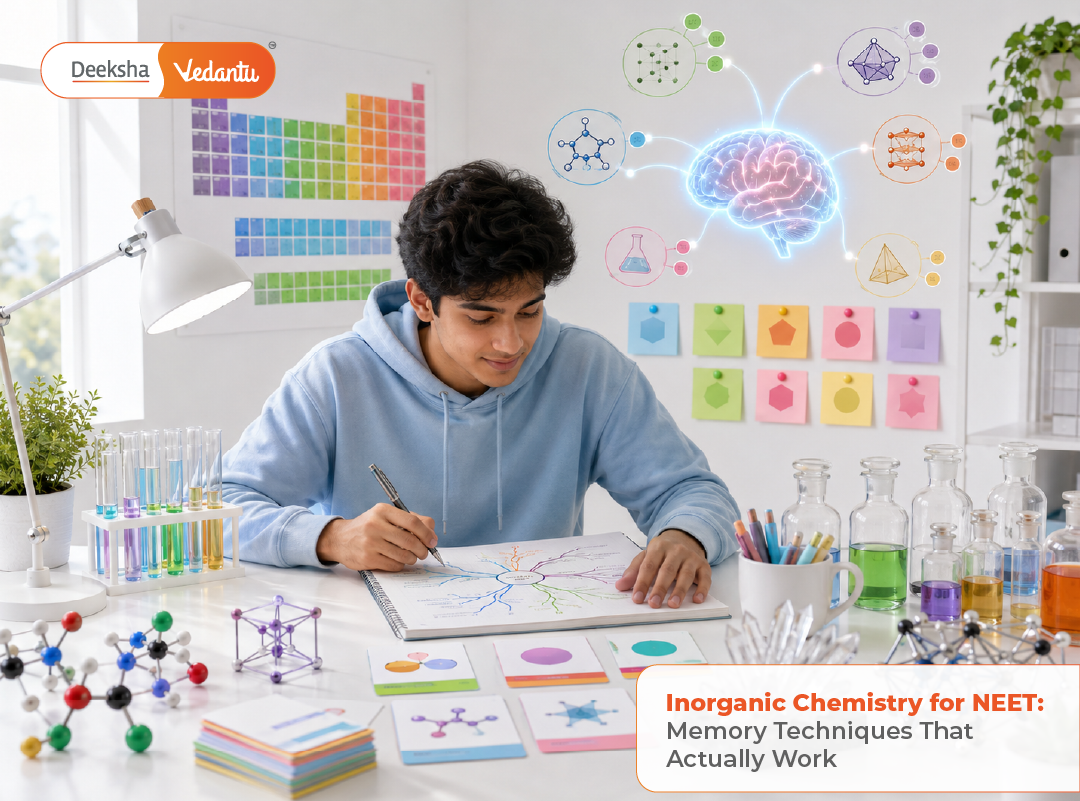

Your Organic Chemistry is decent. Physical Chemistry formulas are manageable. But Inorganic? You’ve read the d-block chapter five times and still can’t recall which metal gives which colored flame. You’ve memorized Group 2 properties… until the exam hall, where your brain goes blank.
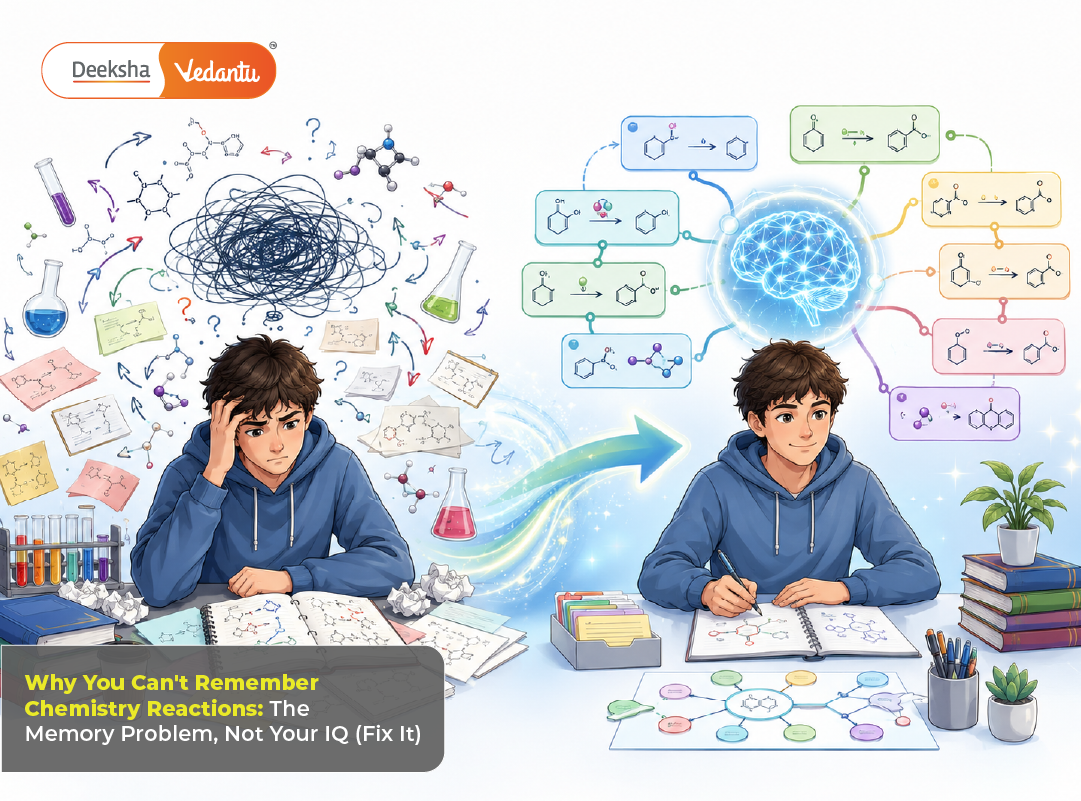
Here’s the truth: Inorganic Chemistry isn’t hard. Your memory method is.
Most students use “read-and-repeat” for inorganic. Read the properties, repeat them ten times, hope they stick. This works for maybe 20% retention. The students scoring 45+ out of 50 in Chemistry aren’t reading ten times-they’re using neuroscience-backed encoding techniques that triple retention. Let me show you exactly what they do.
The Fundamental Shift: Stop Reading, Start Encoding
Your brain doesn’t store raw text. It stores stories, images, patterns, and emotions. When you read “Scandium has +3 oxidation state,” your brain files it as boring text. When you encode it as “Scandal requires 3 people,” your brain files it with a story hook. Three months later, which one survives?
The Encoding Hierarchy (Strongest to Weakest):
- Level 5: Emotional stories (“The greedy copper thief stole +1 and +2”)
- Level 4: Absurd visuals (Imagine manganese wearing 7 hats for +7 state)
- Level 3: Rhythmic mnemonics (“HeLi BeB CNO FNe” flows like music)
- Level 2: Logical grouping (All Group 1 = +1 oxidation state)
- Level 1: Raw text (Reading “Group 1 elements are Li, Na, K, Rb, Cs, Fr”)
Move everything from Level 1 to Levels 3-5. That’s the entire game.
Technique 1: The Story Chain Method (For Sequences)
Challenge: Remember the reactivity series: K, Na, Ca, Mg, Al, Zn, Fe, Pb, H, Cu, Ag, Au
Bad Method: Read it 20 times hoping it sticks.
Story Chain Method:
“King Napoleon Called his Mother and All of his Zebras to Find People who Hide Cute Ages of Authors.”
How to Create Your Own:
- Take first letter of each element
- Build one continuous sentence (absurd = better)
- Add motion verbs (called, find, hide) – motion increases recall
- Practice once: Say the story, write the elements
- Test yourself after 1 hour, then 1 day, then 1 week
Result: One story = permanent sequence memory.
Apply This To:
- Transition metal series (Sc, Ti, V, Cr, Mn, Fe, Co, Ni, Cu, Zn)
- Lanthanide series (Ce, Pr, Nd, Pm, Sm, Eu, Gd…)
- Qualitative analysis groups (I to VI)
Technique 2: The Color-Emotion Tag (For Properties)
Challenge: Remember flame colors for alkaline earth metals
Traditional: “Calcium gives brick-red, Strontium gives crimson-red, Barium gives apple-green”
Color-Emotion Tag:
- Ca = Brick-red: Imagine angry red bricks (Ca) hitting you
- Sr = Crimson-red: Senior citizen wearing crimson lipstick (Sr = Senior)
- Ba = Apple-green: Batman eating green apples (Ba = Batman)
The Rule: Attach the element to a CHARACTER, not just a word. Characters have emotions. Emotions = strong memory anchors.
More Examples:
Copper Solutions:
- CuSO₄ = Blue: Imagine cop (copper) wearing blue uniform crying blue tears
- Cu(OH)₂ = Pale blue: Baby cop (pale = baby) in pale blue onesie
Chromium Oxidation States:
- Cr²⁺ = Blue: Chrome car with blue paint (2 doors)
- Cr³⁺ = Green: Chrome car with 3 green wheels
- Cr⁶⁺ = Orange: Chrome car on fire (6 flames, orange)
Ridiculous? Yes. Unforgettable? Also yes.
Technique 3: The Trend Visualization Map (For Periodic Properties)
Challenge: Remember how atomic radius, ionization energy, electronegativity change across periods and groups
The Bad Way: “Atomic radius decreases left to right, increases top to bottom” ×10 repetition
The Visual Map Way:
Picture the periodic table as a mountain range:
Atomic Radius Mountain:
- Top-left (Cesium) = Peak of mountain (BIGGEST radius)
- Bottom-right (Fluorine) = Valley (SMALLEST radius)
- Visualize: Rolling a ball down from Cs to F
Ionization Energy Cliff:
- Bottom-left (Francium) = Sea level (LOWEST energy)
- Top-right (Helium) = Mountain peak (HIGHEST energy)
- Visualize: Climbing difficulty from Fr to He
Create One Master Visual: Print a blank periodic table. Color it:
- Red gradient (high atomic radius) → Blue gradient (low)
- Draw arrows showing trend directions
- Paste it on your wall, see it daily
Your brain remembers maps better than text.
Technique 4: The Exception Trigger System (For Weird Cases)
Challenge: Most d-block elements follow patterns. But Cr and Cu don’t. How to remember exceptions?
The Trigger System:
Rule: Tag ALL exceptions with “Why is it weird?” stories
Chromium Exception:
- Expected: [Ar] 3d⁴ 4s²
- Actual: [Ar] 3d⁵ 4s¹
- Story: Chromium is a perfectionist-it wants a HALF-FILLED d-orbital (5 electrons). So it “steals” one electron from 4s to complete its perfect 3d⁵ state.
Copper Exception:
- Expected: [Ar] 3d⁹ 4s²
- Actual: [Ar] 3d¹⁰ 4s¹
- Story: Copper is a completionist-it wants a FULLY-FILLED d-orbital (10 electrons). So it “borrows” from 4s to complete 3d¹⁰.
See the pattern? Half-filled and fully-filled orbitals are MORE stable. All d-block exceptions follow this. Remember ONE principle, solve ALL exceptions.
Technique 5: The Comparison Table Method (For Similar Groups)
Challenge: Group 15 elements (N, P, As, Sb, Bi) all have similar but slightly different properties.
The Mistake: Reading each element separately, getting confused about which does what.
The Comparison Table:
Create a visual table with these columns:
- Element | Color | State | Reactivity | Unique Property
Fill it once, in colors:
- Nitrogen = Gas, colorless (write in light gray)
- Phosphorus = Solid, white/red/black (write in actual white/red/black)
- Arsenic = Solid, gray metallic (write in gray marker)
The Hack: Your brain compares faster than it memorizes. When the exam asks “Which Group 15 element is colorless gas?” your brain scans the colored table in your memory and instantly spots the light-gray entry = Nitrogen.
Apply to:
- Group 16 elements (O, S, Se, Te, Po)
- Group 17 halogens (F, Cl, Br, I, At)
- Transition metal triads (Fe-Co-Ni, Ru-Rh-Pd)
Technique 6: The Spaced Revision Frequency
The Science: Memory fades in predictable patterns. Review at specific intervals = move to long-term storage.
The NEET-Optimized Schedule:
- Day 1: Learn 10 new facts using techniques above
- Day 2: Quick 5-min revision (Morning)
- Day 4: 5-min revision (Before sleep)
- Day 7: Test yourself (Write from memory)
- Day 15: Final check
- Day 30: Spot revision
After 30 days, it’s permanent.
The Tool: Use flashcard apps (Anki, Quizlet) or physical cards. Front = Question, Back = Story/Visual/Mnemonic.
Technique 7: The Active Recall Challenge
Passive: Re-reading notes (Retention: 20%)
Active: Close book, write everything from memory (Retention: 70%)
Daily Routine:
- Morning: Study 1 chapter using techniques above
- Evening: Close notes. Write entire chapter from memory (tree diagram format)
- Check what you missed. Those gaps = your weak points
- Re-encode those gaps with stronger stories/visuals
The 80/20 Rule: 80% of NEET questions come from 20% of inorganic topics. Find those 20% through PYQ analysis, encode them first.
The High-Frequency Targets (Encode These First)
Priority Tier 1 (Appear in 8-10 questions yearly):
- Periodic trends (radius, IE, EN)
- d-block: Color, oxidation states, magnetic properties
- Qualitative analysis: Group reagents and confirmatory tests
- Coordination compounds: Nomenclature, isomerism, CFT
Priority Tier 2 (Appear in 4-6 questions):
- s-block: Flame colors, solubility rules, anomalous properties
- p-block: Preparation methods, oxidation states, oxyacids
- Metallurgy: Extraction processes, slag formation
Priority Tier 3 (Appear in 1-3 questions):
- f-block: Lanthanide contraction, oxidation states
- Environmental chemistry: Pollutants, acid rain
Master Tier 1 completely before touching Tier 3.
The 48-Hour Before Exam Strategy
Don’t: Re-read entire NCERT Do: Revise your encoded stories/visuals/tables only
Checklist:
✅ Recite all element mnemonics (Groups 1, 2, 13-18)
✅ Visualize color tags for all compounds
✅ Draw periodic trend maps from memory
✅ Write exception stories (Cr, Cu, Mn configurations)
✅ Review comparison tables (15, 16, 17 groups)
✅ Test with 50 PYQs
Time needed: 6 hours total (not 60 hours of re-reading)
The Reality
Inorganic Chemistry has 500+ facts. Reading them 500 times won’t make them stick. Encoding them 50 times will. The students scoring 48+ in Chemistry don’t have better memories-they have better memory systems.
Your brain is already incredible at remembering. You remember every Marvel character’s backstory, every friend’s birthday drama, every song lyric. Why? Because those came with stories, emotions, and visuals. Give inorganic the same treatment, and watch your scores transform.
90+ in Chemistry isn’t luck. It’s neuroscience. And now you have the blueprint.












Get Social