
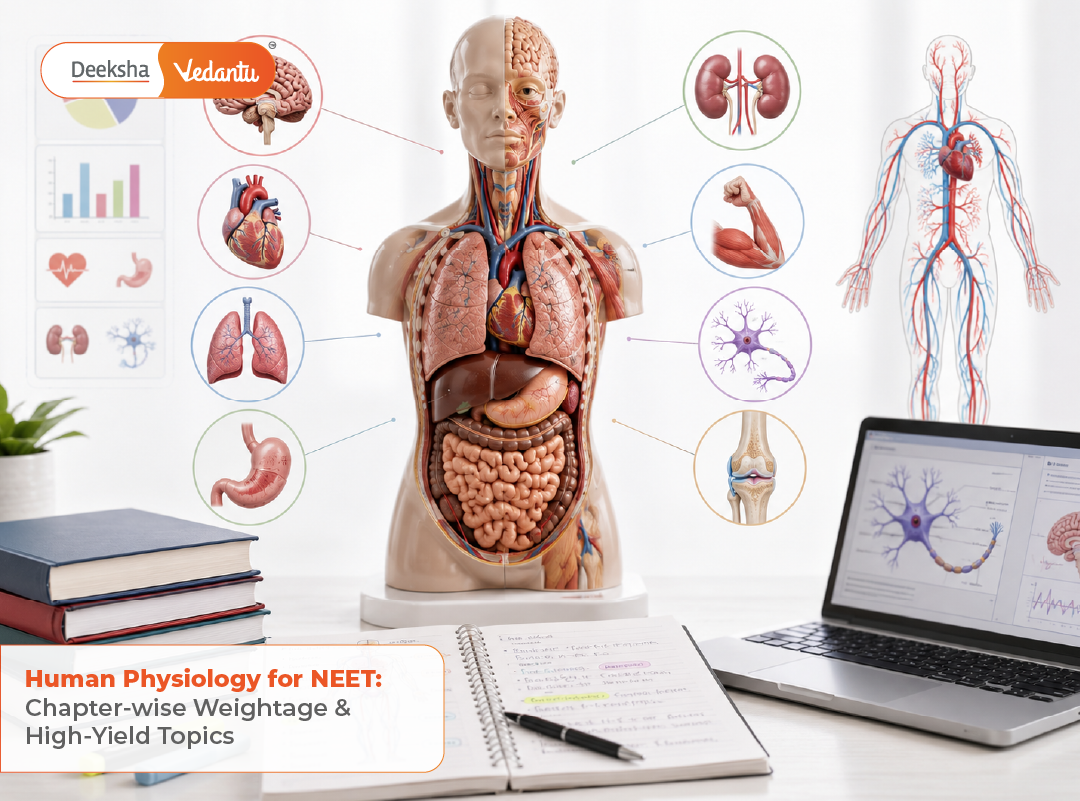

Human Physiology (45%), Human Reproduction (18%), and Animal Kingdom (10%) are the most important Zoology topics. That’s not a typo-Human Physiology alone carries 45% weightage in the entire Zoology section. Yet most students treat it like any other chapter. Big mistake.
Here’s the strategic reality: The weightage of this subject is 45% in the Zoology section in the National Eligibility Entrance Test (NEET). Candidates who prepare well can score 20-24 marks from this subject. That’s 20-24 marks from ONE unit. Miss it, and you’re handing over a 30-40 rank difference to your competitors.
The Weightage Breakdown That Changes Everything
For NEET 2026, the high-yield “powerhouse” units Genetics & Evolution and Human Physiology together contribute nearly 25–30% of the total Biology section. In absolute numbers, Human Physiology yields 7-10 questions worth 28-40 marks in every NEET paper.
Chapter-Wise Mark Distribution (2020-2026 Average):
| Chapter | Questions | Marks | Difficulty | Priority |
| Neural Control & Coordination | 2-3 | 8-12 | High | ⭐⭐⭐ |
| Chemical Coordination (Endocrine) | 2-3 | 8-12 | Moderate | ⭐⭐⭐ |
| Digestion & Absorption | 1-2 | 4-8 | Easy-Moderate | ⭐⭐ |
| Breathing & Respiration | 1-2 | 4-8 | Moderate | ⭐⭐ |
| Body Fluids & Circulation | 1-2 | 4-8 | Moderate | ⭐⭐ |
| Excretory Products & Elimination | 1 | 4 | Easy | ⭐⭐ |
| Locomotion & Movement | 0-1 | 0-4 | Easy | ⭐ |
The Pattern: Neural Control + Chemical Coordination = 50% of Human Physiology marks. These two chapters are non-negotiable for 650+ scorers.
High-Yield Topics by Chapter (What Actually Gets Asked)
1. Neural Control & Coordination (Highest Frequency) ⭐⭐⭐
The Gold Mine Topics:
- Neuron structure & types: Multipolar, bipolar, unipolar classification appears in diagram-based questions
- Nerve impulse transmission: Resting potential (-70 mV), action potential (+40 mV), sodium-potassium pump mechanism
- Synapse: Chemical vs electrical, neurotransmitter examples (acetylcholine, dopamine)
- Reflex arc: Components and pathway-asked 2-3 times in last 5 years
- Brain parts & functions: Cerebrum, cerebellum, medulla, hypothalamus roles
- Eye structure: Retina, rods vs cones, accommodation mechanism
- Ear structure: Cochlea, organ of Corti, semicircular canals for balance
NEET Pattern Questions:
- “Resting membrane potential is maintained by?” → Sodium-potassium pump
- “Part of brain controlling body temperature?” → Hypothalamus
- “Photoreceptor cells for color vision?” → Cones
Time-Saving Tip: NCERT diagrams of neuron, brain, eye, and ear appear directly in NEET. Memorize labels, not just concepts.
2. Chemical Coordination & Integration (Second Highest) ⭐⭐⭐
The Endocrine System Essentials:
- Pituitary hormones: GH, TSH, ACTH, FSH, LH-know what each controls
- Thyroid: T3, T4, calcitonin functions; hypo/hyperthyroidism symptoms
- Pancreas: Insulin vs glucagon (antagonistic pair)-asked EVERY year
- Adrenal: Adrenaline (emergency hormone), cortisol, aldosterone
- Gonads: Testosterone, estrogen, progesterone roles
- Disorders: Diabetes, goiter, Addison’s disease, Cushing’s syndrome
High-Frequency Fact-Based Questions:
- “Hormone increasing blood calcium?” → Parathormone
- “Master gland of the body?” → Pituitary
- “Diabetes insipidus is due to deficiency of?” → ADH (Vasopressin)
The Trick: Make a hormone function table. 70% of endocrine questions are direct hormone-function matching.
3. Digestion & Absorption ⭐⭐
Focus Areas:
- Digestive enzymes & their pH: Pepsin (acidic), Trypsin (alkaline), Lipase, Amylase
- Gastrointestinal hormones: Gastrin, Secretin, CCK (cholecystokinin)
- Absorption mechanisms: Amino acids & glucose (active transport), fatty acids (diffusion)
- Disorders: Jaundice, constipation, diarrhea, PEM (Protein-Energy Malnutrition)
Repeated NEET Questions:
- “Enzyme working in acidic medium?” → Pepsin
- “Hormone stimulating gastric juice secretion?” → Gastrin
- “Site of maximum absorption?” → Small intestine
4. Breathing & Respiration ⭐⭐
Critical Concepts:
- Respiratory volumes: Tidal volume (500 mL), Vital capacity, Residual volume
- Mechanism of breathing: Diaphragm contraction → volume increases → pressure decreases → air enters
- Gas exchange: Oxygen and CO₂ transport (Hb binding, carbonic anhydrase)
- Respiratory center: Medulla oblongata controls breathing rhythm
- Disorders: Asthma, emphysema, occupational respiratory disorders
Expected Questions:
- “Normal breathing rate in adult?” → 12-16 breaths/minute
- “Volume of air breathed in/out in normal respiration?” → Tidal volume (500 mL)
5. Body Fluids & Circulation ⭐⭐
High-Yield Topics:
- Blood composition: Plasma (55%), formed elements (45%)
- Blood groups: ABO system (antigens & antibodies), Rh factor
- Heart structure: Four chambers, valves (bicuspid, tricuspid)
- Cardiac cycle: Systole vs diastole, cardiac output calculation
- ECG waves: P wave (atrial depolarization), QRS (ventricular), T wave (repolarization)
- Disorders: Hypertension, CAD, heart failure, angina
Direct Fact Questions:
- “Universal blood donor?” → O negative
- “Pacemaker of heart?” → SA node
- “Double circulation means?” → Blood passes through heart twice per cycle
6. Excretory Products & Elimination ⭐⭐
Core Topics:
- Nephron structure: Bowman’s capsule, glomerulus, PCT, loop of Henle, DCT
- Urine formation: Ultrafiltration, reabsorption, secretion
- Regulation: ADH (increases water reabsorption), aldosterone, RAAS
- Modes of excretion: Ammonotelism, ureotelism, uricotelism
- Disorders: Kidney stones, uremia, renal failure
Typical NEET Questions:
- “Functional unit of kidney?” → Nephron
- “Maximum reabsorption occurs in?” → PCT (Proximal Convoluted Tubule)
- “Hormone regulating water balance?” → ADH
7. Locomotion & Movement ⭐
Minimal Coverage Needed:
- Types of muscles: Skeletal, smooth, cardiac-structural differences
- Muscle contraction: Sliding filament theory (actin-myosin)
- Joints: Ball-and-socket, hinge, pivot types
- Disorders: Myasthenia gravis, muscular dystrophy, arthritis
Low-Frequency Topic: Usually 0-1 question. Don’t over-invest time here.
The NCERT-First Strategy
Human Physiology is 95% NCERT-based. Here’s the brutal truth: students who scored 340+ in Biology could trace 90% of their Human Physiology answers to exact NCERT lines or diagrams.
The Three-Pass Method:
- Pass 1 (Foundation): Read entire unit once, mark diagrams
- Pass 2 (Deep Dive): Make function tables for hormones, enzymes, organs
- Pass 3 (Rapid Revision): Only tables + diagrams + disorders
Time Allocation: 15 days for complete mastery (3 hours daily)
Diagram-Based Questions (The Easy Marks)
20-30% of Human Physiology questions are diagram identification. Master these 8 diagrams from NCERT:
- Neuron structure
- Human brain (sagittal section)
- Eye structure
- Ear structure
- Human heart
- Nephron
- Alimentary canal
- Types of muscles
Pro Tip: NEET loves asking “label A” or “function of part B” from these diagrams. Practice labeling under 30 seconds each.
Common Mistake Patterns
❌ Mistake: Spending equal time on all 7 chapters ✅ Fix: 40% time on Neural + Endocrine, 60% on remaining five
❌ Mistake: Reading theory without making tables ✅ Fix: Enzyme table, hormone table, disorder table are mandatory
❌ Mistake: Ignoring disorders thinking they’re “not important” ✅ Fix: Every chapter’s disorder section yields 1 direct question
Deeksha’s Human Physiology Mastery Program
At Deeksha Learning, Human Physiology isn’t taught as 7 separate chapters-it’s taught as an integrated system. Our faculty uses clinical correlations, animated videos of physiological processes, and memory techniques for enzyme/hormone functions.
Result: Our 2025 NEET batch averaged 9.2 correct answers out of 10 from Human Physiology (compared to national average of 5-6).
Master the 45%-weightage chapter that decides your Biology score.
The 48-Hour Before Exam Strategy
If you have only 2 days before NEET:
- Revise Neural + Endocrine completely (6 hours)
- Skim diagrams from all chapters (2 hours)
- Review hormone & enzyme tables (1 hour)
- Solve 50 PYQs from Human Physiology (2 hours)
This ensures 6-7 correct answers minimum even with limited time.
The Bottom Line: Human Physiology is the highest ROI chapter in Biology. This chapter covers crucial mechanisms-like digestion, respiration, circulation, excretion, neural regulation, and hormones-tested extensively each year. Master it, and you’re not just scoring marks-you’re building the foundation for your entire medical career.














Get Social