
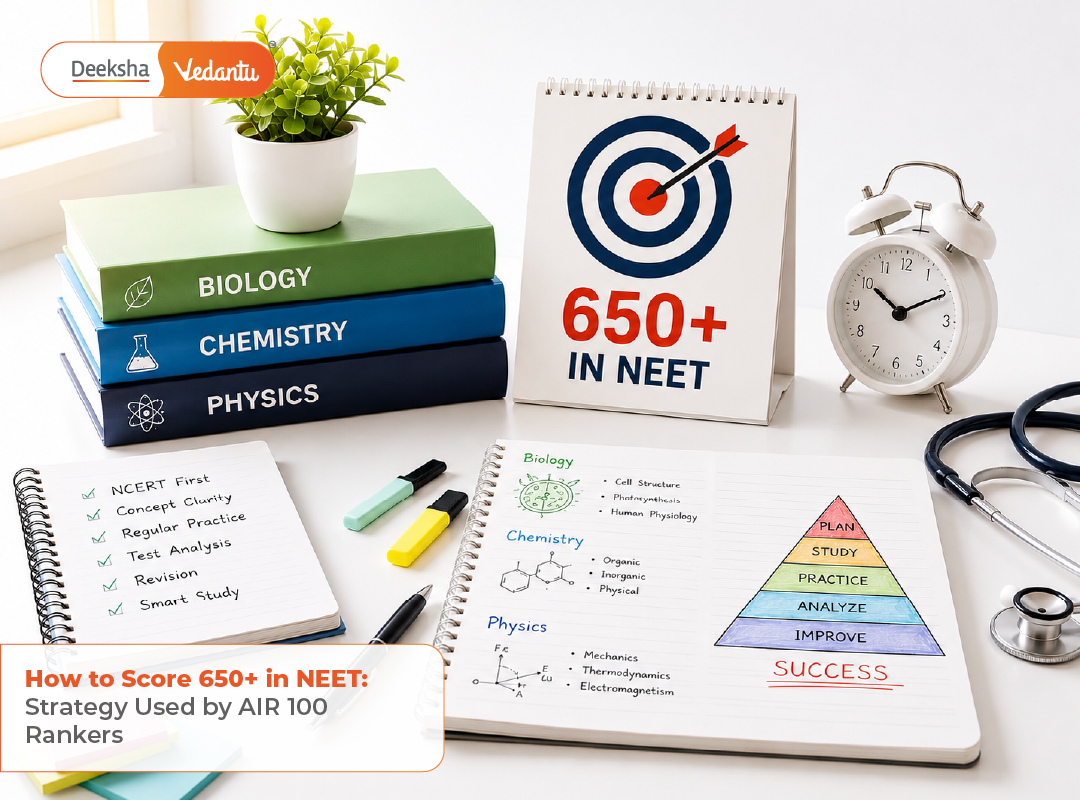

Scoring 650+ in NEET isn’t about studying 16 hours daily or memorizing every textbook word-for-word. It’s about strategic preparation, disciplined execution, and understanding exactly what separates AIR 100 rankers from average scorers. With 650+ marks, you secure an All India Rank between 500-4,000, opening doors to top government medical colleges including AIIMS, JIPMER, and state quota seats in premier institutions. This comprehensive guide reveals the actual strategies used by NEET toppers who consistently score in this elite range.
The 650+ Score Reality Check
Out of 720 marks, scoring 650+ means achieving 90.2% accuracy. This translates to approximately 162-165 correct answers out of 180 attempted questions with minimal negative marking. Here’s what this score breakdown typically looks like for AIR 100 rankers: Biology scores between 340-360 out of 360 marks, which means 85-90 correct answers with near-perfect accuracy. Chemistry scores between 160-175 out of 180 marks, representing 40-44 correct answers. Physics scores between 150-170 out of 180 marks, meaning 37-42 correct answers. The margin for error is razor-thin. Just 5-6 additional silly mistakes can drop your score from 660 to 630, potentially shifting your rank by 2,000-3,000 positions.
Strategy One: Biology Is Non-Negotiable
Every single AIR 100 ranker will tell you the same thing: Biology carries 50% of NEET, and it’s where your rank is made or broken. Unlike Physics which requires problem-solving skills or Chemistry which needs memorization plus application, Biology is purely NCERT-based factual recall. The advantage? It’s the most controllable subject.
AIR 100 rankers target 340-360 in Biology, which means attempting 87-90 questions with 95%+ accuracy. This isn’t luck or genius, it’s systematic NCERT mastery. Here’s their exact approach. Read NCERT Biology Class 11 and 12 a minimum of 5 times before the exam. Not skimming, actual word-by-word reading. The first reading takes 45-50 days. Subsequent readings get faster as familiarity builds. By the fifth reading, you can complete both NCERTs in 10-12 days.
Focus obsessively on diagrams. NEET directly asks 15-18 diagram-based questions every year. Draw every NCERT diagram from memory. Heart structure, nephron, brain sections, flower parts, DNA replication, mitosis stages, photosynthesis pathways-all of them. Toppers dedicate 30 minutes daily just to diagram practice. NCERT exercise questions are goldmines. Many NEET questions are direct lifts or slight modifications from these exercises. Solve every single exercise question without looking at answers first. Mark the ones you get wrong and revisit them weekly.
Human Physiology alone contributes 18-22 questions annually. This single topic can give you 70-88 marks. Toppers prioritize digestive system, circulatory system, excretory system, and nervous system. These four systems typically yield 12-14 questions. Plant Physiology contributes 12-15 questions. Focus on photosynthesis, respiration, plant hormones, and mineral nutrition. The pathway-based questions here are scoring if you’ve memorized the steps and locations correctly.
Strategy Two: Chemistry-The Balanced Scoring Subject
Chemistry is where intelligent preparation meets high returns. It’s divided into three distinct sections, each requiring different approaches. Physical Chemistry demands numerical practice. Organic Chemistry needs reaction memorization. Inorganic Chemistry is pure factual recall.
For Physical Chemistry, AIR 100 rankers solve 25-30 numericals daily from chapters like Mole Concept, Equilibrium, Thermodynamics, and Electrochemistry. They maintain formula sheets listing every single formula with units and don’t rely on memory alone during practice. The key is recognizing problem patterns. NEET Physical Chemistry numericals are highly repetitive. Once you’ve solved 200 problems on Mole Concept, you’ve essentially seen every possible variation.
Organic Chemistry is about reaction mechanisms and named reactions. Toppers create a master list of all name reactions with reagents, conditions, and products. They practice conversion problems daily because these test your ability to chain multiple reactions together. The trick is understanding why reactions happen, not just memorizing them. Understanding electron movement in mechanisms makes retention automatic.
Inorganic Chemistry is NCERT-dominated. Periodic trends, qualitative analysis, coordination compounds, and p-block elements come directly from NCERT lines. Toppers highlight every trend, exception, and property mentioned in NCERT. They use mnemonics extensively for remembering reactivity series, qualitative analysis group tests, and complex compound nomenclature.
The Chemistry target for 650+ scorers is 160-175 marks. This is achievable because unlike Physics which can throw curveballs, Chemistry questions are predictable if you’ve covered NCERT and previous year papers thoroughly.
Strategy Three: Physics-Concept Clarity Over Formula Cramming
Physics separates the 600 scorers from the 650+ scorers. It’s the toughest NEET subject because it demands deep conceptual understanding and application under time pressure. AIR 100 rankers don’t just memorize formulas, they understand the derivations and can apply concepts to unfamiliar situations.
Mechanics contributes 30% of Physics marks. Laws of Motion, Work-Energy-Power, Circular Motion, and Rotational Dynamics are non-negotiable. Toppers solve a minimum of 500 mechanics problems before NEET, covering every variation. They practice free body diagrams daily because most mechanics errors stem from incorrect force identification.
Electromagnetism is the second high-weightage area covering Electrostatics, Current Electricity, Magnetic Effects, and Electromagnetic Induction. These chapters are interconnected. Understanding Coulomb’s Law deeply helps with Magnetic Force. Grasping Ohm’s Law makes Circuit Analysis automatic. Toppers study these chapters together, not in isolation.
Modern Physics typically yields 8-10 questions on Photoelectric Effect, Atoms, Nuclei, and Semiconductors. These are formula-heavy chapters where accuracy matters. Toppers memorize every constant, every formula, and every formula limitation. They know that Photoelectric Effect questions always test stopping potential, threshold frequency, or work function in predictable ways.
The Physics target for 650+ scorers is 150-170 marks. Attempting 42-45 questions with 85-90% accuracy achieves this. The strategy isn’t attempting all 45 questions rashly. It’s attempting 42 questions confidently and leaving genuinely difficult ones untouched to avoid negative marking.
Strategy Four: The Mock Test Marathon
Every AIR 100 ranker has taken 40-60 full-length mock tests before NEET. Not for practice alone, but for analysis. Here’s their exact mock test protocol. Start mocks 6 months before NEET with 1 per week. Increase to 2 per week in the last 3 months. In the final month, take 3-4 mocks weekly.
Always simulate exact exam conditions: 3 hours 20 minutes, no breaks, no phone, use OMR sheet or CBT interface depending on NEET 2027 format. Wear exam-day clothes occasionally to build psychological conditioning. After every mock, spend 2 hours analyzing. For every wrong answer, identify the error type. Was it a silly mistake, misread question, calculation error, or genuine conceptual gap? Track these in an error notebook.
Calculate subject-wise accuracy percentages. If Biology accuracy is below 90%, your NCERT reading is insufficient. If Physics accuracy is below 80%, you’re attempting too many questions or have conceptual gaps. If Chemistry accuracy is below 85%, you’re making avoidable mistakes in easy questions. Monitor time spent per subject. Toppers maintain strict time discipline-50 minutes for Physics, 45 minutes for Chemistry, 90-100 minutes for Biology, and 15 minutes for review and OMR filling.
The goal isn’t scoring 650+ in every mock. The goal is identifying and eliminating recurring mistakes. By your 40th mock test, you should have categorized every mistake type and built strategies to avoid them. This is how toppers achieve 650+ in the actual exam while scoring 580-620 in many of their practice mocks.
Strategy Five: The Error Notebook-Non-Negotiable
This strategy alone can improve scores by 40-50 marks. From Day 1 of preparation, maintain a subject-wise error notebook. Every question you get wrong in practice tests, chapter tests, or mocks goes into this notebook with the question stem, correct answer, your wrong answer, and reason for the mistake.
Categorize mistakes into Silly Mistakes like misreading “except” as “include” or calculation errors. Conceptual Gaps where you genuinely didn’t understand the concept. Time Pressure Mistakes where you knew the concept but rushed and erred. Guessing Mistakes where you eliminated two options but guessed between the remaining two incorrectly.
Review this notebook weekly. Toppers report that 60-70% of their errors are recurring patterns. You repeatedly make the same types of silly mistakes or struggle with the same conceptual areas. Once you identify these patterns, you can build correction mechanisms. If you always misread negative questions, you start underlining “not” and “except” in every question. If you always make calculation errors in Thermodynamics, you slow down specifically in those questions during exams.
By exam day, your error notebook becomes your most valuable revision tool. It’s a personalized list of exactly what you get wrong and how to avoid it. This is far more valuable than any generic study material because it’s customized to your specific weaknesses.
Strategy Six: NCERT Is the Bible, Not a Reference
AIR 100 rankers don’t treat NCERT as optional or supplementary. It’s their primary text. For Biology and Inorganic Chemistry, NCERT IS the syllabus. 80% of Biology questions and 70% of Inorganic Chemistry questions are verbatim from NCERT or slight modifications.
Read every line, every footnote, every diagram caption, every example, and every exercise in NCERT. Toppers highlight NCERT in three colors: green for definitely important high-weightage content, yellow for moderately important, and orange for exceptions and special cases. They don’t skip introductory paragraphs or summary boxes thinking they’re filler. NEET has asked questions from these “skippable” sections repeatedly.
Make NCERT-based notes, not from reference books. Your notes should be condensed NCERT, not expanded coaching material. One-line summaries, diagram thumbnails, and important term definitions. These notes become your quick revision material in the last 15 days before NEET.
Reference books are supplements, not foundations. Use HC Verma or DC Pandey for Physics problem-solving practice after NCERT concepts are clear. Use OP Tandon or MS Chouhan for Chemistry after NCERT mastery. Never start with reference books. The students who score 650+ master NCERT first, then use reference books to deepen understanding and increase problem-solving speed.
Strategy Seven: The Daily Routine That Works
AIR 100 rankers don’t study 14-16 hours daily throughout preparation. That’s a myth that causes burnout. They study 8-10 quality hours with strategic breaks during most of Class 11 and 12, ramping up to 10-12 hours only in the final 3-4 months before NEET.
A typical topper daily routine looks like this. Morning 6:30 AM to 9:30 AM is dedicated to Biology NCERT reading because fresh mind retains factual content better. Mid-morning 10:00 AM to 1:00 PM is Physics problem-solving time when analytical thinking peaks. Afternoon 2:00 PM to 5:00 PM after lunch is Chemistry theory and numericals when moderate focus is optimal. Evening 5:30 PM to 7:30 PM is MCQ practice time mixing all three subjects with 150-200 questions daily. Night 8:30 PM to 10:00 PM is revision of the day’s topics plus error notebook review.
This isn’t rigid. Toppers adjust based on energy levels. If Physics feels foggy in the morning, they swap it with Biology. If evening focus drops, they take longer breaks. The key is consistency, not rigidity. Studying 8 hours daily for 300 days beats studying 14 hours for 150 days every single time.
Strategy Eight: Deeksha Learning’s AIR 100 Ranker Program
At Deeksha Learning Bangalore, we’ve produced 15+ students with AIR under 100 in the last three years. Our success isn’t accidental, it’s systematic. We’ve studied what AIR 100 rankers do differently and built our program around those exact strategies.
Our Elite NEET Batch provides NCERT-focused daily classes where faculty emphasize line-by-line NCERT reading in Biology and Inorganic Chemistry before touching reference books. We conduct 60+ full-length mock tests throughout the year with mandatory analysis sessions after each test. Our faculty helps students build personalized error notebooks and reviews them monthly to identify recurring patterns.
We provide subject-wise accuracy tracking where students know their real-time performance metrics in each subject, helping them focus improvement efforts precisely where needed. Our doubt-clearing sessions are daily, not weekly, because we’ve learned that unresolved doubts compound and create conceptual gaps that show up months later.
Most importantly, we provide mental conditioning and exam temperament training because scoring 650+ isn’t just about knowledge, it’s about performing under pressure. Our students practice with real exam pressure simulations including noise distractions, strict timing, and psychological pressure scenarios.
Join Deeksha Learning’s Elite NEET Batch and get personalized guidance from faculty who’ve mentored AIR 100 rankers. Visit our curated NEET Repeaters program today to learn more.
The Final Truth About Scoring 650+
Scoring 650+ in NEET isn’t reserved for geniuses or students with photographic memory. It’s achievable for anyone willing to follow proven strategies with unwavering discipline. The difference between a 600 scorer and a 650+ scorer isn’t intelligence, it’s execution. It’s reading NCERT five times instead of two. It’s taking 50 mocks instead of 20. It’s maintaining an error notebook religiously instead of casually. It’s treating Biology like it carries 50% of marks because it does.
Start implementing these strategies today. Your NEET scorecard depends not on how much you study, but on how strategically you study. Focus on NCERT mastery, build your error elimination system, take mocks seriously, and maintain consistency over intensity. The 650+ score isn’t a dream, it’s a systematic outcome of doing the right things repeatedly.














Get Social