
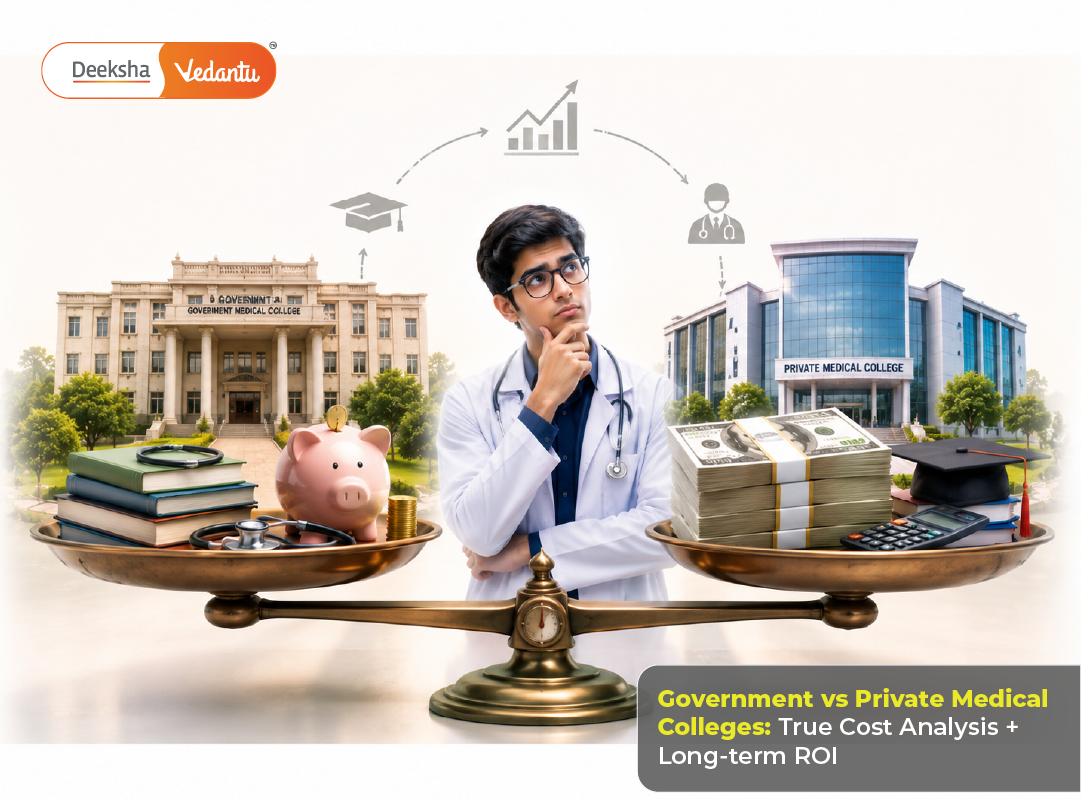

Everyone knows the headline: Government college costs ₹1-2 lakh. Private costs ₹50-100 lakh.
But that’s the surface. The real question is: What’s your actual lifetime wealth difference? And when does private college ROI become positive (if ever)?
Let’s calculate the true cost, including what you don’t see coming.
The Cost Iceberg: What You Actually Pay
Most students look only at tuition fees. That’s the tip. Below the surface is everything that destroys your ROI.
GOVERNMENT COLLEGE
The visible costs:
- Tuition: ₹20,000-₹1 lakh/year × 5.5 years = ₹1.5-5 lakh
- Hostel: ₹2,000-₹5,000/year × 5.5 = ₹12-27 lakh
- Books, lab fees, equipment: ₹50,000/year × 5.5 = ₹2.75 lakh
- Food (beyond hostel): ₹10,000/month × 12 × 5.5 = ₹6.6 lakh (varies)
- Visible total: ₹23-41 lakh
The hidden costs nobody talks about:
- Exam prep (mock tests, supplements): ₹2-3 lakh before MBBS
- Travel during clinical postings: ₹50,000-₹1 lakh
- Professional development (conferences, workshops): ₹1-2 lakh
- Intern year (unpaid): Lost income ₹5-8 lakh (5 year interns earn nothing)
- Hidden total: ₹9-14 lakh
True total cost (government): ₹32-55 lakh
PRIVATE COLLEGE
The visible costs:
- Tuition: ₹15-30 lakh/year × 5.5 = ₹82-165 lakh
- Hostel: ₹3,000-₹7,000/year × 5.5 = ₹16-38 lakh
- Books, lab fees, equipment: ₹2,000-₹5,000/month × 12 × 5.5 = ₹1.3-3.3 lakh
- Visible total: ₹99-206 lakh
The hidden costs:
- Entrance exam coaching: ₹3-5 lakh (some private college students retake NEET)
- Additional private tuition (many students supplement): ₹1-3 lakh
- Student loans interest (if borrowed): ₹20-40 lakh over 10 years
- Intern year unpaid: ₹5-8 lakh (same as government)
- Hidden total: ₹29-56 lakh
True total cost (private): ₹128-262 lakh
The Cost Multiplier: Family Financial Impact
Government college scenario:
- Total spend: ₹40 lakh (middle estimate)
- Family payment method: Savings/small education loan
- Loan burden post-graduation: ₹0-10 lakh
- Monthly EMI if loaned: ₹0-15,000 for 5-10 years
Private college scenario:
- Total spend: ₹150 lakh (middle estimate)
- Family payment method: Large education loan + savings
- Loan burden post-graduation: ₹50-120 lakh
- Monthly EMI: ₹50,000-₹100,000 for 7-10 years
Reality check: For a middle-class family, private college = mortgage-level debt.
Where They Converge: The 10-Year Financial Runway
Government college graduate (10-year career):
Year 1-2 (Intern + Junior Resident):
- Income: ₹8,000-₹15,000/month = ₹1-2 lakh/year
- Loan EMI: ₹5,000-₹8,000/month
- Net after loan: ₹-2,000-₹7,000/month
Year 3-5 (Senior Resident):
- Income: ₹25,000-₹40,000/month = ₹3-5 lakh/year
- Loan EMI: ₹5,000-₹8,000/month (if still paying)
- Net after loan: ₹17,000-₹35,000/month
Year 6-10 (Consultant/Private practice):
- Income: ₹80,000-₹150,000/month = ₹10-20 lakh/year
- Loan: PAID OFF
- Cumulative wealth (10 years): ₹50-80 lakh
Private college graduate (10-year career):
Year 1-2 (Intern + Junior Resident):
- Income: ₹8,000-₹15,000/month = ₹1-2 lakh/year
- Loan EMI: ₹50,000-₹80,000/month
- Net after loan: NEGATIVE ₹-40,000-₹-65,000/month
This is critical: Private college graduates are UNDERWATER for 2-3 years. They’re going deeper into debt while working.
Year 3-5 (Senior Resident):
- Income: ₹25,000-₹40,000/month
- Loan EMI: ₹50,000-₹80,000/month
- Net: Still NEGATIVE. They’re bleeding money.
Year 6-10 (Consultant/Private practice):
- Income: ₹80,000-₹150,000/month
- Loan EMI: Still paying ₹40,000-₹60,000/month
- Cumulative wealth (10 years): ₹10-30 lakh (much lower due to loan repayment)
The hard truth: At year 10, the government college graduate has accumulated ₹50-80 lakh in wealth. The private college graduate has accumulated ₹10-30 lakh.
The government graduate is AHEAD by ₹40-50 lakh after 10 years.
When Does Private College ROI Turn Positive?
It depends on what you do after MBBS.
Scenario A: Government job (AIIMS/GMC faculty, public health)
- Government graduate: Government salary is same regardless of college
- Private graduate: Still paying massive loans on government salary
- Winner: Government college (by ₹60+ lakh)
Scenario B: Private practice (successful clinic)
- Government graduate: ₹15-30 lakh/year income by year 8, debt-free
- Private graduate: ₹15-30 lakh/year income by year 8, still ₹40-60 lakh in debt
- Winner: Government college (until year 15, then depends on practice growth)
Scenario C: Specialization abroad (US/UK fellowship)
- Government graduate: Takes foreign fellowship, earns ₹150,000-₹200,000/month
- Private graduate: Takes same fellowship, but with ₹50 lakh pending debt in India
- Winner: Private college (if fellowship succeeds; if it fails, government wins)
Scenario D: Corporate hospital job
- Both earn ₹80,000-₹120,000/month from year 4
- Private graduate: Still paying ₹50,000/month EMI
- Government graduate: Accumulating wealth
- Winner: Government college (by ₹80-100 lakh over 15 years)
The Real Trade-offs (Not Just Money)
What private college ACTUALLY gives you:
✅ Better infrastructure (sometimes)
✅ More comfortable living
✅ Smaller student:faculty ratio (sometimes)
✅ Networking with wealthy families
✅ Option to start private practice earlier (if you can get loan relief)
❌ ₹100+ lakh debt (catastrophic if practice fails)
❌ 10 years of financial stress
❌ Higher EMI affecting life decisions (marriage, children)
What government college gives you:
✅ Debt-free graduation
✅ Freedom to choose specialty (no pressure to earn fast)
✅ Wealth accumulation from year 6 onward
✅ Peace of mind and financial flexibility
✅ Same MBBS degree (competence = same)
❌ Harder entrance (need higher NEET score)
❌ Sometimes older infrastructure
❌ Government salary is lower (if you choose government job)
The Decision Framework
Choose GOVERNMENT college if:
- You scored 600+
- Your family can’t easily afford ₹100+ lakh
- You want financial peace of mind
- You’re not certain about earning ₹20 lakh/month post-graduation
Choose PRIVATE college if:
- Your family can comfortably absorb ₹100+ lakh debt
- You have HIGH confidence in your earning potential
- You specifically want to study abroad immediately after MBBS
- You’re planning an aggressive private practice from day 1
The honest truth: For most NEET students (80%), government college wins financially. The 10-year wealth difference is substantial. Unless you’re certain you’ll earn exceptional income post-graduation, the debt from private college will haunt you.
True cost of government college: ₹40 lakh (all-in). True cost of private college: ₹150+ lakh PLUS ₹50+ lakh in loan interest. By year 10: Government graduate is ₹50-70 lakh wealthier. Private college ROI becomes positive only if you consistently earn ₹20+ lakh/year from year 6 onward—which 60% of graduates don’t achieve.


















Get Social