
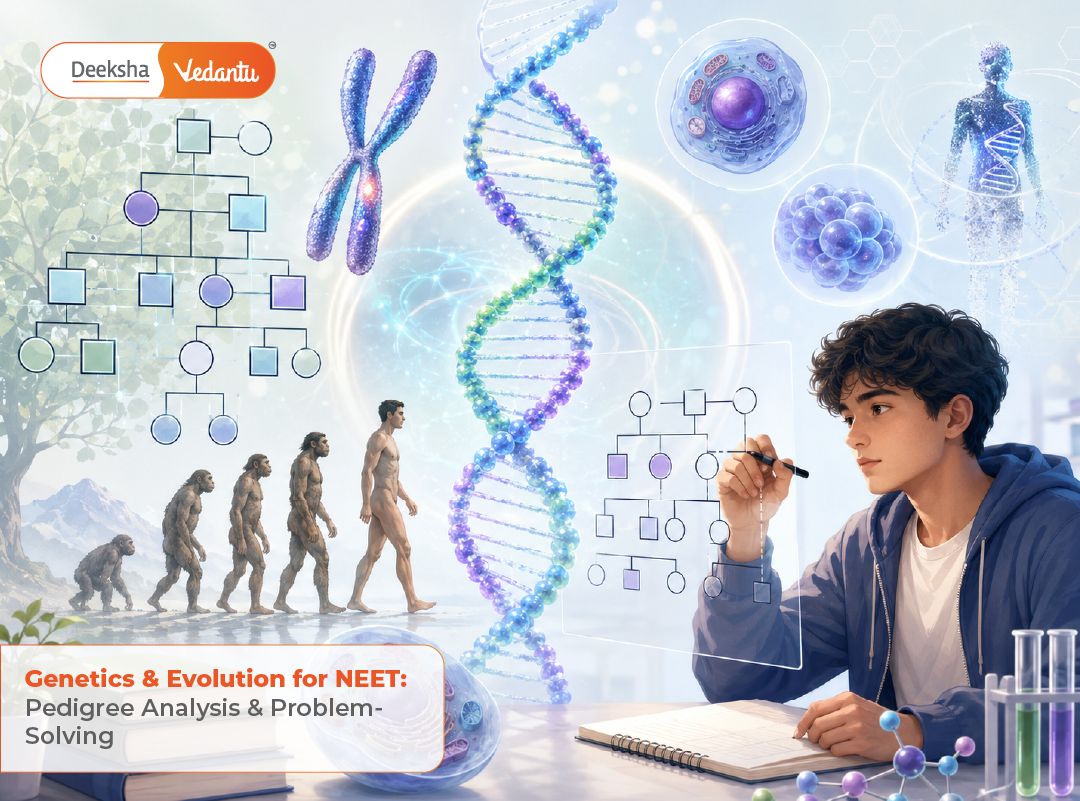

You see a pedigree chart in NEET. Three generations, some filled circles, some half-filled squares. The question asks: “What’s the probability of the next child being affected?” You panic. Your friend finishes in 40 seconds. Both of you studied the same chapter. What’s the difference?
They’re using a systematic 4-step decision tree you don’t know yet.
Genetics & Evolution carries 12-14% weightage in NEET Biology-that’s 6-8 questions worth 24-32 marks. Within this, pedigree analysis alone contributes 2-3 questions (8-12 marks). These aren’t memorization questions. They’re pure logical reasoning under time pressure. Master the system, and you’ve secured 10+ marks that most students fumble.
Understanding the Pedigree Basics (Skip If You Know)
Standard Symbols:
- ⚪ = Unaffected female | ⚫ = Affected female
- ☐ = Unaffected male | ■ = Affected male
- ◐ = Carrier (heterozygous, typically for recessive traits)
- Horizontal line = Mating | Vertical line = Offspring
The 4 Inheritance Patterns You Must Master:
- Autosomal Dominant (AD)
- Autosomal Recessive (AR)
- X-linked Recessive (XR)
- X-linked Dominant (XD) – rare in NEET, usually ignored
The 4-Step Pattern Recognition System
Step 1: Check Male-to-Male Transmission
Rule: If affected father has affected son → CANNOT be X-linked
Why? Fathers give Y chromosome to sons (not X). X-linked traits can’t pass father-to-son.
Conclusion: Must be Autosomal (Dominant or Recessive)
Example: If you see ■→■ (affected father → affected son), eliminate X-linked options immediately. Answer must be AD or AR.
Step 2: Check Generation Skipping
Rule: If trait skips generations → Likely Recessive
Pattern: ⚫→⚪→⚫ (affected → unaffected → affected)
Why? Recessive traits hide in carriers. Dominant traits show up in EVERY generation.
Trap Question: “Two normal parents have affected child.” This CONFIRMS recessive (both parents are carriers Aa × Aa → 25% affected aa).
Conclusion: If skips generation → AR or XR (check Step 1 to differentiate)
Step 3: Check Affected Female Frequency
Rule: More affected males than females → X-linked Recessive
Why? Males need only one recessive X allele (XᵃY) to be affected. Females need two (XᵃXᵃ).
Pattern: ■ ■ ■ ⚪ ⚪ (many affected males, rare affected females)
Classic Example: Hemophilia, Color blindness pedigrees always show this pattern.
Trap: If affected males AND females appear equally → NOT X-linked → Autosomal
Step 4: Check Both Parents Affected
Rule: If both parents affected, ALL children affected → Dominant
Pattern: ■ × ⚫ → All offspring affected (no exceptions)
Why? If either parent is homozygous dominant (AA), all children get A allele → all affected.
Exception: If affected parents have normal child → Both parents must be heterozygous (Aa) → Then it’s still dominant, but incomplete penetrance or both are Aa.
The Decision Tree (Memorize This)
Start Here
↓
Is there ■→■ transmission?
├─ YES → Autosomal (go to A)
└─ NO → Could be X-linked (go to B)
A: Autosomal
├─ Skips generations? → Autosomal Recessive (AR)
└─ Every generation affected? → Autosomal Dominant (AD)
B: X-linked
├─ More affected males? → X-linked Recessive (XR)
└─ Equal males & females affected? → Go back to A
Time to master this: 1 hour of practice on 10 pedigrees. Then permanent.
Probability Calculations (The Scoring Gold Mine)
NEET loves asking: “What’s the probability of next child being affected/carrier/normal?”
The 3 Formulas You Must Know:
Formula 1: Basic Punnett Square (For Simple Cases)
Question: Aa × Aa, probability of affected child (aa)?
Answer: 1/4 (25%)
Trap: Question asks “first two children both normal, what’s probability third is affected?” Answer is STILL 1/4. Each birth is independent event.
Formula 2: Carrier Female × Normal Male (X-linked)
Cross: XᴬXᵃ × XᴬY
Offspring:
- 25% Xᴬᵃ (carrier daughter)
- 25% XᴬXᴬ (normal daughter)
- 25% XᴬY (normal son)
- 25% XᵃY (affected son)
Key Pattern: 50% sons affected, 0% daughters affected, 50% daughters carriers
NEET Pattern Question: “Carrier mother, normal father. Probability of affected son?” → 1/2 × 1/2 = 1/4 (multiply: 1/2 chance it’s a son, 1/2 chance son is affected)
Formula 3: Multiple Conditions (Use Multiplication Rule)
Question: “Probability of next child being normal female?”
Step 1: P(normal) = 3/4 (from Aa × Aa) Step 2: P(female) = 1/2 Step 3: P(normal AND female) = 3/4 × 1/2 = 3/8
Common NEET Pedigree Traps (Don’t Fall For These)
Trap 1: Assuming Homozygous When Heterozygous
Question: Autosomal dominant trait. Affected individual (A_) marries normal (aa). Can they have normal child?
Wrong thinking: Affected means AA → All children affected
Right thinking: Affected could be Aa → 50% children normal (aa)
NEET tests this: “What’s the genotype of individual III-2?” Options include AA and Aa. Check offspring to determine.
Trap 2: Confusing Carrier with Affected
Carrier (Aa): Has allele, doesn’t show trait (for recessive) Affected (aa or A_): Shows the trait
Question pattern: “How many carriers in this pedigree?” Count half-filled symbols + obligate carriers (normal parents of affected children).
Trap 3: Forgetting Gender Matters for X-linked
Question: XᴬXᵃ × XᴬY. “Probability of affected child?”
Wrong: 1/4 (treating like autosomal)
Right: 1/8 (only males can be affected, and only 50% of males: 1/2 male × 1/2 affected = 1/4… wait, that’s wrong too!)
Actually Right: 1/4 total children, but specifically “affected child” = 1/4 (one XᵃY out of 4 offspring)
Read carefully what they ask: child, son, daughter, first child, next child.
Practice Routine for Mastery
Week 1: Pattern Recognition
- 10 pedigrees daily
- Goal: Identify inheritance pattern in 30 seconds
- Use decision tree, don’t guess
Week 2: Probability Calculations
- 10 probability questions daily
- Set up Punnett square, calculate systematically
- Time yourself: Target 90 seconds per question
Week 3: Mixed Practice
- 5 PYQs daily (pattern + probability combined)
- Analyze mistakes: Was it pattern recognition or calculation error?
Week 4: Speed Trials
- 20 pedigree questions in 30 minutes
- Exam simulation conditions
- Target: 90 seconds per question average
The Genetics Problem-Solving Toolkit
Beyond pedigrees, NEET tests:
Mendelian Ratios:
- Monohybrid: 3:1 (F2), 1:1 (test cross)
- Dihybrid: 9:3:3:1 (F2), 1:1:1:1 (test cross)
- Incomplete dominance: 1:2:1
- Codominance: 1:2:1 (both alleles expressed)
Chi-Square Test (Rare but Appears): χ² = Σ[(Observed – Expected)² / Expected]
Link Test: If observed ratio deviates from expected → linked genes
Hardy-Weinberg Equilibrium: p² + 2pq + q² = 1 (genotype frequencies) p + q = 1 (allele frequencies)
NEET Pattern: Given carrier frequency (2pq), find disease frequency (q²)
Example: 2pq = 0.32 → pq = 0.16 → If p ≈ 1, then q ≈ 0.16 → q² ≈ 0.0256 ≈ 2.56%
Evolution Quick-Wins (3-4 Questions)
High-Frequency Topics:
- Natural Selection vs Genetic Drift
- Analogous vs Homologous organs
- Types of evolution (convergent, divergent, parallel)
- Hardy-Weinberg conditions (no mutation, large population, random mating, no selection, no migration)
- Human evolution timeline (Homo habilis → erectus → neanderthalensis → sapiens)
Time Allocation: 10% time on evolution, 90% on genetics. Evolution is mostly NCERT-based facts.
Deeksha’s Genetics Mastery Program
At Deeksha Learning, we don’t just teach pedigrees-we teach pattern recognition systems. Our Genetics module includes:
Decision Tree Flashcards: 4-step system laminated on every desk
100 Pedigree Challenge: Progressive difficulty, timed practice
Error Pattern Tracking: Are you missing X-linked or probability calculations?
Probability Drill Sheets: 50 variations of the same concept
Turn genetics from confusion into guaranteed marks.
The Final Take
Pedigree analysis isn’t memorization. It’s logical pattern recognition under time pressure. Learn the 4-step decision tree. Practice 100 pedigrees. Master probability formulas. Then watch those 8-12 marks become automatic in the exam.
The students scoring 160+ in Biology aren’t solving pedigrees differently. They’re seeing patterns you’re missing. Learn the system, and suddenly every pedigree becomes a 40-second gift.
















Get Social