
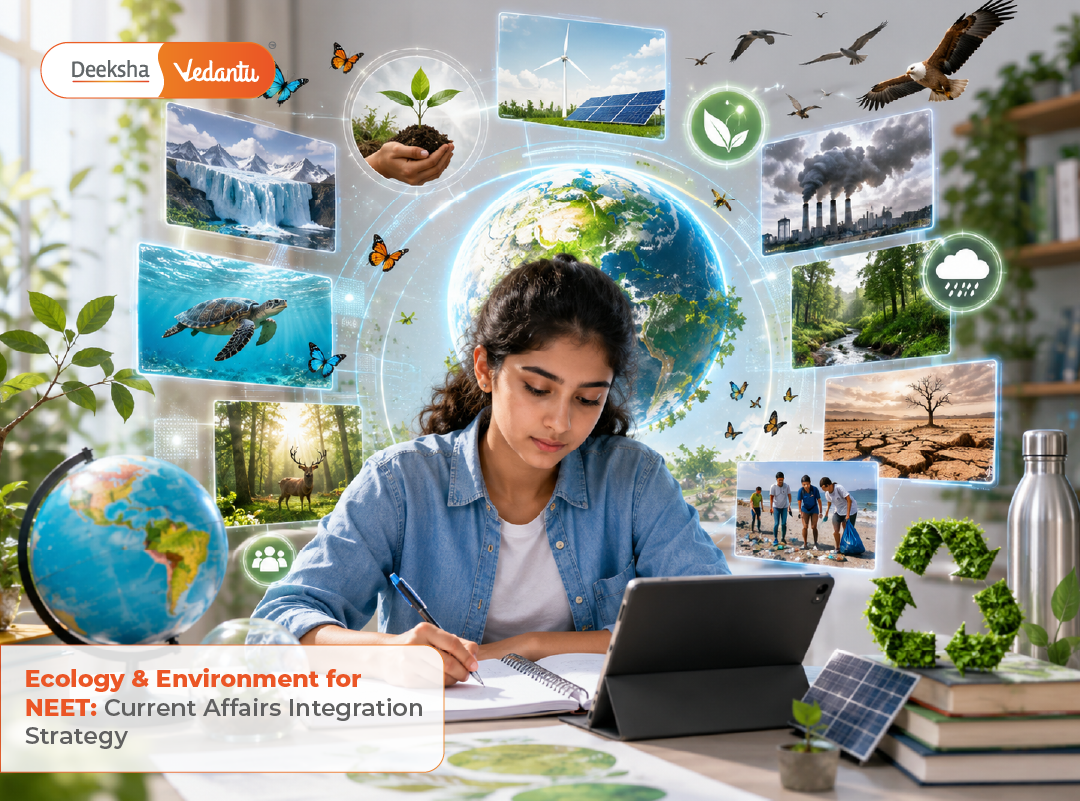

Five years ago: Ecology questions asked “What is succession?” or “Define ecosystem.”
Today: Questions ask “Which UN protocol addresses genetic resource sharing?” or “Name India’s climate resilience program.”
NEET is no longer testing textbook ecology in isolation. It’s weaving current affairs into questions. Students who only memorize NCERT are losing marks to students who read the news.
Ecology & Environment contributes 3-4 questions (12-16 marks) yearly. Here’s how to integrate current events without drowning in information.
The Current Affairs Invasion (2020-2024 Data)
30% of recent ecology questions reference:
- UN agreements (Paris Agreement, Nagoya Protocol, Ramsar Convention)
- India-specific initiatives (NICRA, Project Tiger, Western Ghats)
- Climate events (El Niño, monsoon failures, heat waves)
- Biodiversity hotspots (Amazon fires, coral bleaching, deforestation)
Example (NEET 2024): “NICRA is a network project that addresses?” (a) Water scarcity (b) Climate-resilient agriculture (c) Marine conservation (d) Waste management
The NCERT-Only Problem: NCERT doesn’t mention NICRA by name. Yet NEET asked it. Students who read news articles about Indian agricultural initiatives got it instantly. Textbook-only students guessed.
The Three-Tier Current Affairs System (Easy Implementation)
Tier 1: UN Agreements (High-Frequency, Easy to Remember)
These repeat across NEET papers. Memorize the three below, you’ve covered 80% of agreement questions:
- Paris Agreement (2015)
- Focus: Climate change mitigation
- NEET Pattern: “Which global accord aims to limit warming to 1.5°C?”
- Quick Memory: Temperature target = 1.5°C Paris
- Nagoya Protocol (2014)
- Focus: Genetic resources and benefit-sharing
- NEET Pattern: “International agreement on access to genetic resources?”
- Quick Memory: Nagoya = Nature (genetic resources)
- Ramsar Convention (1971)
- Focus: Wetland conservation
- NEET Pattern: “Which convention protects wetlands globally?”
- Quick Memory: Ramsar = Wet marshlands
India-Specific Additions (For 1-2 Extra Marks):
- CBD (Convention on Biological Diversity)
- CITES (Endangered species trade ban)
Tier 2: India’s Green Programs (2-3 Questions Yearly)
NEET increasingly asks “Which program does what?” Know these five:
| Program | Launch Year | What It Does | Quick Hook |
| NICRA | 2011 | Climate-resilient agriculture | NICRA = Newly Innovative Climate Resilient Agriculture |
| Project Tiger | 1973 | Tiger population recovery | Tiger = Times we see them |
| Mission LiFE | 2023 | Lifestyle for Environment | Life = Lifestyle change |
| Wetlands Mission | 1993 | Ramsar site protection | Wet = Wetlands |
| Green India Mission | 2014 | Afforestation | Green = Growth of trees |
Pattern: NEET asks “Program X was launched in year Y to address?” Pick from the chart above.
Time Investment: 15 minutes to memorize. Solves 1-2 questions guaranteed.
Tier 3: Real-Time Current Affairs (Optional, High-Reward)
The Strategy: Skip deep environmental news. Focus only on NEET-relevant trending topics:
2024-2025 Topics to Know (Quick Bullet Points):
- COP28 & COP29: Global climate summits. Remember: fossil fuel phase-out discussions. If asked “Latest climate summit outcome?” answer relates to coal/oil phase-down targets.
- Melting Ice Caps: Arctic ice declining → rising sea levels → island nations threatened. Easy connection: climate change → sea level rise → endangered species.
- Plastic Pollution: Global plastic treaty negotiations. NEET angle: microplastics in food chains → bioaccumulation.
- Coral Bleaching (2024): Great Barrier Reef, Caribbean reefs affected. NEET angle: Ocean warming → coral symbiosis breaks → ecosystem collapse.
- Monsoon Failures: India-specific. El Niño causing irregular monsoons. NEET angle: Climate disruption → agricultural stress → food security.
Consumption Strategy: Read 1 environmental news article per week. Extract 2-3 bullet points. That’s it.
The Easy-Win Topics (No Current Affairs Needed)
60% of ecology questions remain textbook-based:
Guaranteed Questions:
- Energy flow (10% loss at each trophic level) – memorize the 10% rule
- Biodiversity hotspots (Western Ghats, Amazon, Congo Basin) – simple facts
- In-situ vs Ex-situ conservation (national parks vs botanical gardens)
- Succession types (primary, secondary) – definitions
Time Allocation:
- 40% time: Textbook ecology (succession, energy flow, cycles)
- 30% time: Current affairs integration (programs, agreements)
- 30% time: India-specific conservation (tiger reserves, sanctuaries)
The 20-Minute Quick-Start Plan
Day 1: Memorize the 3 UN agreements (5 minutes) + 5 Indian programs (5 minutes) + 4 biodiversity hotspots (5 minutes).
Day 2-7: Read 1 environmental news article daily (3 minutes daily).
Day 8+: Solve 30 ecology PYQs mixing textbook + current affairs questions.
Result: 95%+ accuracy on ecology questions without drowning in news.
Conclusion
NEET’s ecology section is shifting toward real-world relevance. Pure NCERT preparation leaves you vulnerable to 2-3 questions every exam that reference current initiatives, global agreements, or recent environmental events.
The good news? Current affairs in ecology is surprisingly predictable. Same agreements repeat. Same Indian programs appear yearly. Read one environmental news article per week, memorize five programs, know three UN agreements.
That’s 90% of the current affairs ecology questions solved.












Get Social