
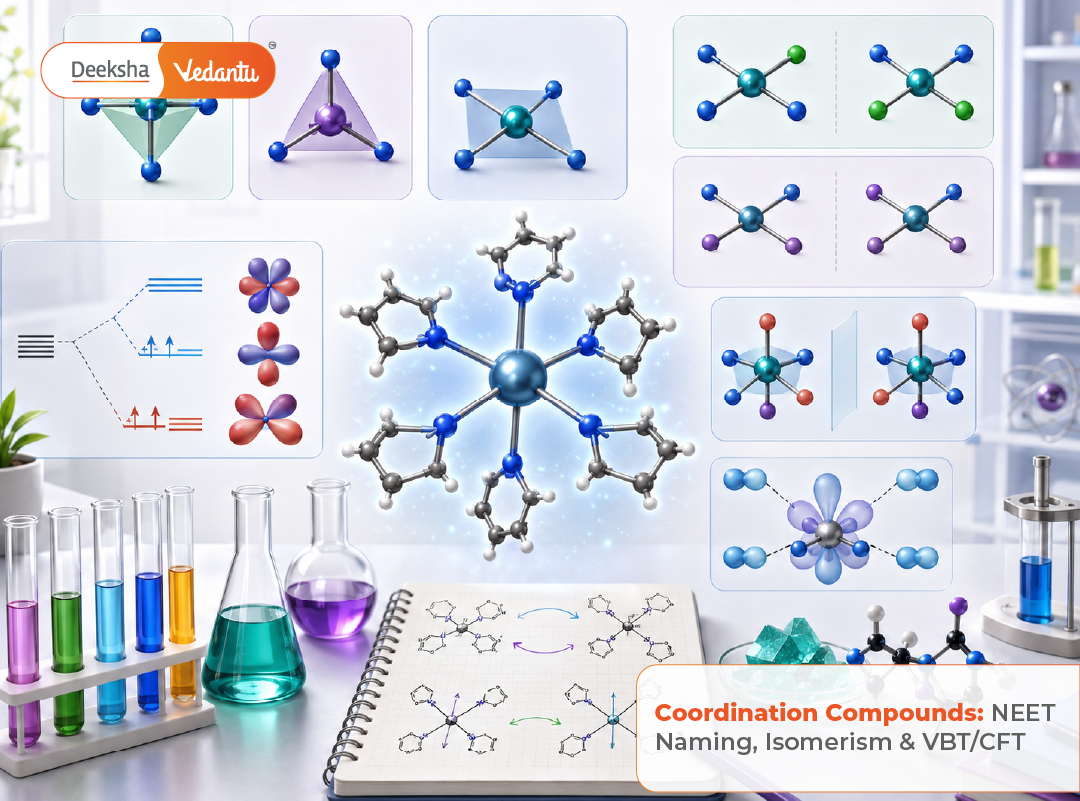

Coordination Compounds is NEET’s “make-or-break” inorganic chapter. Three topics appear every single year: IUPAC naming, isomerism identification, and bonding theories. Master these three, you’ve locked in 12-16 marks.
The bad news? Students treat it like memorization (wrong approach). The good news? It’s pure pattern recognition (once you see the patterns, it’s automatic).
Let me show you the three patterns NTA repeats.
Pattern 1: The Naming Game (40% of Coordination Questions)
NEET loves asking: “Name this complex” or “Identify the complex from this name.”
The IUPAC naming follows ONE rigid sequence. Memorize it once, answer every variation instantly.
The Four-Step Naming System:
STEP 1: Write ligands in ALPHABETICAL order
STEP 2: Add PREFIX for quantity (di-, tri-, tetra-, penta-, hexa-)
STEP 3: Convert anionic ligands to end in “-o” (Cl⁻ → chlorido)
STEP 4: Add metal name + oxidation state in Roman numerals
Live Example: [Co(NH₃)₅Cl]²⁺
Step 1 → Alphabetical: Chlorido comes first (C), then ammine (A)
Wait, that’s wrong. Ammine (A) comes before chlorido (C)
Actually: Chlorido, then Ammine alphabetically
CORRECTION: Chlorido = Cl⁻, Ammine = NH₃
Alphabetically: Ammine THEN Chlorido
Step 2 → Ammine × 5 = pentaammine
Chlorido × 1 = chlorido
Step 3 → Cl⁻ is anionic, so “chlorido” (already done)
Step 4 → Central metal = Co³⁺
FINAL NAME: Pentaamminechloridocobalt(III)
The Alphabetical Trap (Students Always Fail Here):
Alphabetize by FIRST LETTER of ligand NAME, not symbol:
- Ammine (A) comes before
- Chlorido (C) comes before
- Nitro (N)
- Cyano (C)… wait, cyano and chlorido both start with C?
Rule: When both start with the same letter, alphabetize by SECOND letter.
- Chlorido vs Cyano → h comes before y → Chlorido first
NEET Pattern Questions (10-Year Repeat):
| Complex | NEET Question Style | Answer |
| [Cr(H₂O)₆]³⁺ | “Name this complex” | Hexaaquachromium(III) ion |
| [Fe(CN)₆]⁴⁻ | “Identify the anionic ligand name” | Cyano or Cyanido |
| [Pt(NH₃)₂Cl₂] | “Is this cis or trans?” | Need structure (isomerism Q, not naming) |
Speed Tip: Memorize these 8 common ligand names:
- NH₃ = ammine
- H₂O = aqua
- Cl⁻ = chlorido
- CN⁻ = cyano/cyanido
- CO = carbonyl
- NO₂⁻ = nitrito
- SCN⁻ = thiocyanato
- en (ethylenediamine) = ethane-1,2-diamine
That’s 80% of NEET ligands right there.
Pattern 2: The Isomerism Trap (30% of Coordination Questions)
NEET asks: “How many isomers does this complex have?” or “Which isomer is this?”
The trap: Students confuse structural isomerism with stereoisomerism.
The Two Families:
STRUCTURAL ISOMERISM (Different formulas can exist)
├── Ionization isomerism
│ └── [Cr(H₂O)₅Cl]SO₄ vs [Cr(H₂O)₄ClSO₄]Cl
│ ^ Different counter-ion inside/outside
│
├── Coordination isomerism
│ └── [Co(NH₃)₆][Cr(CN)₆] vs [Cr(NH₃)₆][Co(CN)₆]
│ ^ Metal ions swapped
│
├── Linkage isomerism
│ └── [Co(NO₂)(NH₃)₅]²⁺ vs [Co(ONO)(NH₃)₅]²⁺
│ ^ Nitro vs Nitrito (different atom bonds)
│
└── Hydrate isomerism
└── [Cr(H₂O)₆]Cl₃ vs [Cr(H₂O)₅Cl]Cl₂·H₂O
^ Water inside vs outside coordination sphere
STEREOISOMERISM (Same formula, different spatial arrangement)
├── Geometric isomerism (Cis-Trans)
│ └── [Pt(NH₃)₂Cl₂]: Cis (same side) vs Trans (opposite side)
│
└── Optical isomerism (Non-superimposable mirror images)
└── [Co(en)₃]³⁺: d-form and l-form (enantiomers)
NEET’s Favorite: Geometric Isomerism (Cis-Trans)
NEET asks this 2-3 times per exam:
Example Question: “[Pt(NH₃)₂Cl₂] exhibits which type of isomerism?” (a) Ionization (b) Linkage (c) Geometric (d) Optical
The Decision Tree:
- Same formula? Yes → not structural isomerism
- Different spatial arrangement? Yes → stereoisomerism
- Square planar geometry? Yes → can be cis/trans
- Answer: (c) Geometric isomerism
Draw the structures to visualize:
CIS [Pt(NH₃)₂Cl₂] TRANS [Pt(NH₃)₂Cl₂]
NH₃ NH₃
| |
Pt—-Cl Pt—-Cl
| |
Cl NH₃
|
NH₃
(Cl atoms on same side) (Cl atoms on opposite sides)
The Formula: Octahedral complexes Ma₄b₂ or Ma₃b₃ can show cis-trans.
Pattern 3: The Bonding Theory Maze (30% of Coordination Questions)
NEET tests VBT and CFT differently:
VBT (Valence Bond Theory):
- What it explains: Geometry and hybridization
- What it DOESN’T explain: Color, magnetic properties
NEET VBT Questions (Always One of These):
- “What is the hybridization of [Co(NH₃)₆]³⁺?”
- Answer: d²sp³ (octahedral, 6 ligands)
VBT Hybridization Quick Chart:
| Coordination Number | Geometry | Hybridization | NEET Frequency |
| 2 | Linear | sp | Rare |
| 4 | Tetrahedral | sp³ | Common |
| 4 | Square planar | dsp² | Common (Pt, Ni) |
| 6 | Octahedral | d²sp³ or sp³d² | VERY COMMON |
CFT (Crystal Field Theory):
- What it explains: Color (d-d transitions), magnetic properties, splitting of d-orbitals
- What NEET loves: High-spin vs Low-spin complexes
CFT’s Core Concept: Ligands create electric field → d-orbitals split into two energy levels → electrons occupy these levels → unpaired electrons determine magnetism → energy difference between levels determines color.
High-Spin vs Low-Spin (NEET Tests This Every Year):
WEAK FIELD LIGAND (Cl⁻, I⁻, H₂O)
→ Small d-orbital splitting
→ Electrons AVOID pairing
→ HIGH SPIN complex (more unpaired electrons)
→ PARAMAGNETIC (attracted to magnetic field)
Example: [Fe(H₂O)₆]²⁺ = 4 unpaired electrons
STRONG FIELD LIGAND (CN⁻, CO, en)
→ Large d-orbital splitting
→ Electrons PREFER pairing
→ LOW SPIN complex (fewer unpaired electrons)
→ DIAMAGNETIC or less paramagnetic
Example: [Fe(CN)₆]⁴⁻ = 0 unpaired electrons
NEET’s Favorite CFT Question: “[CoF₆]³⁻ is high-spin, [Co(CN)₆]³⁻ is low-spin. Why?”
Answer: F⁻ is weak field (small splitting, electrons don’t pair), CN⁻ is strong field (large splitting, electrons pair).
The 7-Day Mastery Plan
Days 1-2: Master IUPAC naming. Practice naming 15 complexes from structures. Memorize 8 ligand names.
Days 3-4: Structural isomerism. Distinguish ionization, coordination, linkage, hydrate. Practice 10 questions.
Days 5-6: Stereoisomerism. Draw cis-trans isomers for Ma₂b₄ and Ma₃b₃ complexes. 10 questions.
Days 7: VBT/CFT synthesis. High-spin vs low-spin for 5 different complexes. 20 mixed PYQs.
Result: 100% accuracy on coordination compounds.
The Bottom Line
Coordination Compounds tests the same three concept-patterns yearly:
- Can you name a complex correctly?
- Can you identify what type of isomerism it shows?
- Can you predict hybridization and magnetic properties?
Master these three, you’ve solved 80% of possible questions. The remaining 20% are variations of the same patterns.
Stop memorizing. Start seeing patterns.














Get Social