
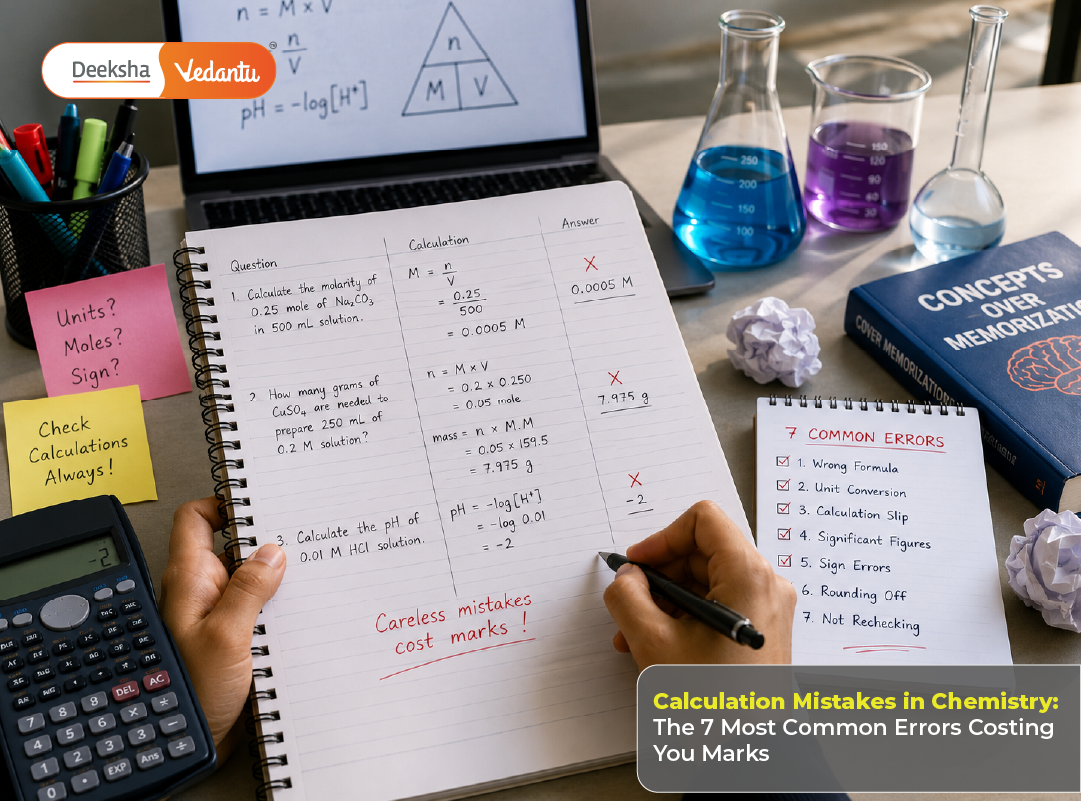

You know the formula. You set it up correctly. Then you lose marks on a calculation mistake.
These are the 7 mistakes that cost NEET students 10-15 marks in chemistry, even when they understand the concept.
Mistake 1: Forgetting to Convert mL to L in Molarity
The Error: Molarity = moles / volume (in liters)
You calculate: M = 0.5 / 500 (instead of 0.5 / 0.5)
Result: You get M = 0.001 instead of M = 1. Wrong by 1000x.
Why it happens: You read “500 mL solution” and use 500 directly instead of converting to 0.5 L.
What happens on exam day: Your answer is completely off. Even if the method is correct, you lose all marks.
How to prevent it: Create a checklist before every calculation:
- ☐ Is volume in liters? (If not, convert: mL ÷ 1000 = L)
- ☐ Is mass in grams? (Check unit)
- ☐ Is molar mass correct?
The fix takes 5 seconds. The mistake costs 4 marks.
Mistake 2: Wrong Molar Mass Calculation
The Error: NaCl: You calculate Na (23) + Cl (35.5) = 58.5 ✓ H₂SO₄: You calculate H (1) + S (32) + O (16) = 49 ✗ (Should be 2(1) + 32 + 4(16) = 98)
You forgot to multiply by subscripts.
Why it happens: You quickly add atomic masses without accounting for subscripts.
Consequence: All downstream calculations are wrong. Moles, concentration, everything cascades.
How to prevent it: Write out the formula expansion:
- H₂SO₄ = H + H + S + O + O + O + O (7 atoms)
- = 1 + 1 + 32 + 16 + 16 + 16 + 16 = 98 g/mol
Takes 10 seconds. Prevents complete calculation failure.
Mistake 3: Decimal Point Errors (Placing It Wrong)
The Error: You calculate: 0.039 g ÷ 39 g/mol = 0.1 moles (correct)
But you write: 0.01 moles (misplaced decimal)
Or you calculate 0.39 g ÷ 39 g/mol = 0.01 (when it’s 0.01, not 0.1)
Why it happens: You do mental math. You’re rushing. Decimals are tricky.
Consequence: Your final answer is off by 10x or 100x.
How to prevent it: Use a calculator for ALL calculations. Don’t do mental math.
If you must do mental math:
- Write intermediate steps clearly
- Double-check decimal placement before writing final answer
- Use estimation: “0.4 ÷ 40 should be ≈ 0.01” to verify
Mistake 4: Mixing Up Molarity and Molality
The Error: Question asks for molality. You calculate molarity.
M (molarity) = moles / liters of solution m (molality) = moles / kg of solvent
Same question, completely different answers.
Why it happens: Both start with “mol-” so students confuse them. Molarity is more common, so you default to it.
Consequence: Completely wrong answer. -4 marks.
How to prevent it: When you see “m” in the question, immediately write:
- “m = molality (not molarity)”
- “= moles / kg solvent (not L solution)”
- “Need solvent mass, not solution volume”
Read the question verb carefully: “Calculate the molarity” vs “Calculate the molality”
Mistake 5: Wrong Stoichiometry Ratios
The Error: Reaction: 2H₂ + O₂ → 2H₂O
You’re asked: “4 g H₂ reacts with O₂. Calculate O₂ mass.”
You use 1:1 ratio (H₂:O₂ = 1:1) instead of 2:1 ratio.
Result: You calculate O₂ needed incorrectly.
Why it happens: You don’t balance the equation carefully. You skim coefficients.
Consequence: Wrong stoichiometry = wrong mole ratio = wrong answer.
How to prevent it: Before any stoichiometry calculation:
- Write the balanced equation
- Underline the coefficients
- Write the mole ratio you’ll use: “H₂:O₂ = 2:1”
- Only then start calculation
Mistake 6: Forgetting Significant Figures / Rounding Too Early
The Error: You calculate 0.345 moles. You round to 0.3 midway.
Then later: 0.3 × 98 = 29.4 g
But correct: 0.345 × 98 = 33.81 g
Why it happens: You simplify numbers to make mental math easier. You lose precision.
Consequence: Your final answer is inaccurate. Depending on options, you pick wrong answer.
How to prevent it:
- Keep ALL decimal places until final answer
- Round only at the END (not midway)
- Use calculator to prevent rounding errors
Mistake 7: Not Checking Unit Conversion
The Error: Question gives: “25 mL of 0.5 M HCl” Question asks: “Moles of HCl”
You calculate: 25 × 0.5 = 12.5 moles
You forgot to convert mL to L.
Correct: 0.025 L × 0.5 M = 0.0125 moles
Why it happens: You see numbers and multiply without checking if units match.
Consequence: Answer off by 1000x. Completely wrong.
How to prevent it: Before every calculation, write units:
- Molarity = 0.5 mol/L
- Volume = 25 mL = 0.025 L
- Moles = (0.5 mol/L) × (0.025 L) = 0.0125 mol
Units guide the calculation. You’ll catch conversions.
The Prevention Checklist (Use Before Every Calculation)
☐ Units: All in standard form (L, g, mol, kg)?
☐ Molar mass: Correct? Subscripts multiplied?
☐ Conversion: mL → L, mg → g done?
☐ Stoichiometry: Coefficients correct, ratio written?
☐ Formula: Right formula for what’s asked (M vs m)?
☐ Decimal: Calculator used? Decimal placement verified?
☐ Rounding: Kept all decimals until final answer?
Use this 30-second checklist. Prevents 10-15 marks of loss.
Chemistry calculations aren’t hard. The errors are predictable. Use a checklist, use a calculator, write units clearly. That’s the difference between losing 10 marks and losing 0.
















Get Social