

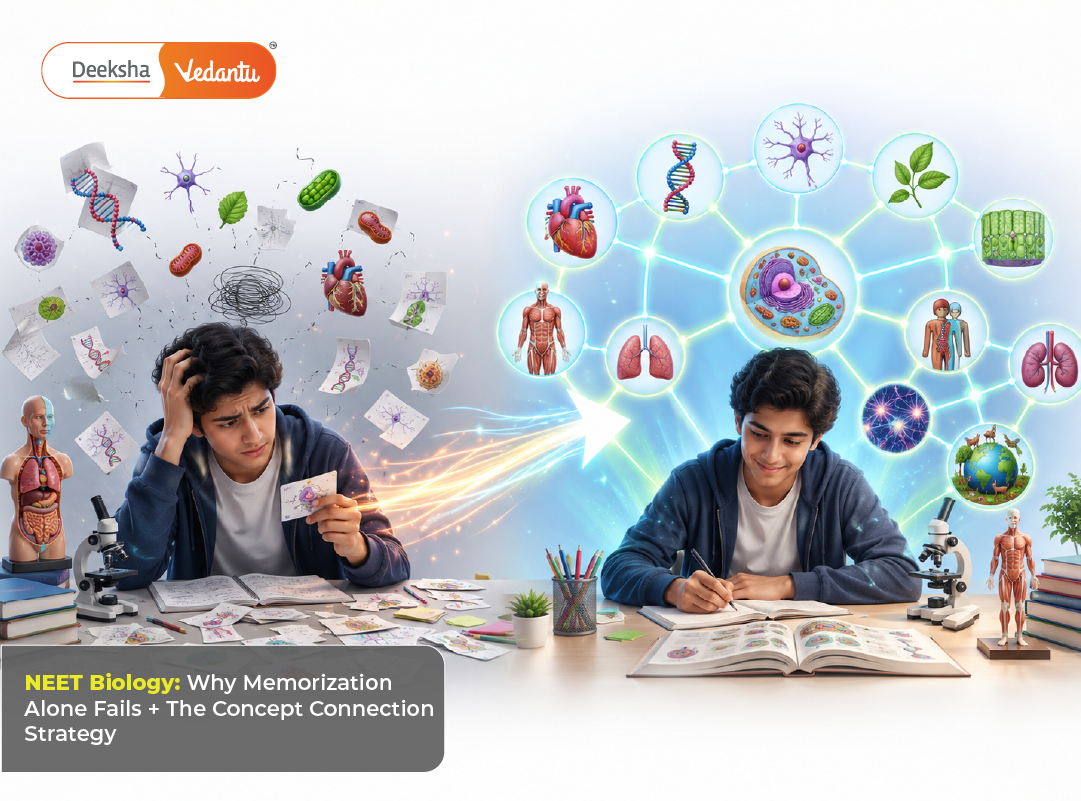
The dirty secret about Biology is this: 90% of students think they “know” Biology because they scored 200+ marks. But they don’t actually UNDERSTAND 40% of what they memorized.
They know “Mitochondria is powerhouse” but don’t know WHY ATP is made there. They know “Photosynthesis happens in chloroplasts” but can’t explain light-dependent vs light-independent reactions. They know “Mendelian genetics” but can’t solve a cross-breeding problem.
This is why your Biology score felt “decent” in the first attempt but wasn’t competitive.
This time, you’re not memorizing. You’re understanding. And then you’re drilling.
The Concept Inventory: Biology’s Core 15 Topics (and What You Probably Missed)
1. CELL BIOLOGY: The Foundation You Skipped
What You Probably Think You Know: “Mitochondria produces ATP. Nucleus has DNA. Ribosomes make proteins.”
What You Actually Need to Understand:
- WHY mitochondria produces ATP: Electron transport chain → Chemiosmosis → H+ gradient → ATP synthase spins → ATP made
- Why nucleus is separate: DNA is fragile, needs protection. Transcription happens here, NOT protein synthesis
- Why ribosomes are the ONLY place proteins are made: They read mRNA codons and match with tRNA anticodons
The Missing Connection: DNA → mRNA (transcription) → Protein (translation)
You probably memorized these steps. But do you understand that:
- Transcription happens in NUCLEUS
- Translation happens in CYTOPLASM
- This separation is crucial for gene regulation
NEET Pattern Questions:
- “Where does transcription occur?” → Nucleus (90% of students answer ribosome)
- “Why is DNA in nucleus but protein synthesis in cytoplasm?” → This tests understanding, not memorization
Your Rework for This Topic:
- Draw the Central Dogma diagram 10 times until you can explain each arrow
- Answer: “Why are transcription and translation separate?”
- Create a concept map: DNA compartmentalization → Allows regulation
2. GENETICS: The Logic System You Memorized Wrong
What You Probably Think: “Mendel’s laws = 3:1 ratio, dihybrid = 9:3:3:1”
What You Actually Need: The LOGIC of inheritance, not the ratios.
The Concept You Missed:
- Law of Segregation: Alleles separate during meiosis (WHY? Because homologous chromosomes separate)
- Law of Independent Assortment: Different traits assort independently (WHY? Because different chromosomes separate independently)
- Test Cross Logic: If phenotype matches recessive parent, the unknown parent MUST be heterozygous
Example Problem You Probably Got Wrong: “An AaBb individual crosses with an aabb individual. What’s the phenotypic ratio?”
Most students:
- Draw Punnett square
- Count 1:1:1:1 (correct, but by luck)
What actually happens:
- AaBb produces 4 gamete types: AB, Ab, aB, ab
- aabb produces only: ab
- Each gamete from first parent has 25% chance
- Result: 25% AaBb (A_B_), 25% Aabb (A_bb), 25% aaBb (aaB_), 25% aabb (aabb)
- Phenotypic ratio = 1:1:1:1
The Repeater Rework: Stop memorizing ratios. Start solving problems from FIRST PRINCIPLES (gamete formation → fertilization → offspring).
NEET Pattern Questions:
- “Predict offspring from cross X × Y” (20-30% of Biology is genetic crosses)
- “Why is the ratio 1:1 instead of 3:1?” (tests understanding of meiosis)
Your Rework Timeline: 3 weeks, 50 cross problems minimum
3. HUMAN PHYSIOLOGY: The System You Half-Learned
What You Probably Know: Digestion: mouth → stomach → small intestine → large intestine Respiration: O₂ in, CO₂ out Circulation: Heart pumps blood
What You Probably Don’t Know:
- WHY stomach acid is necessary: Not just “to break down protein” but “pepsinogen needs HCl to become pepsin”
- WHY small intestine absorbs nutrients: Large surface area (villi) + capillary network nearby
- WHY left ventricle is thicker than right: Left pumps to whole body (high pressure), right pumps to lungs only (low pressure)
The Concept System: Each organ system is OPTIMIZED for its function:
- Stomach: Acidic + muscular → Protein digestion + mixing
- Small intestine: Long + folded + capillary-rich → Maximum absorption
- Kidney: Countercurrent multiplier system → Concentration of urine
NEET Pattern Questions:
- “Why does the left ventricle have thicker walls than right?” → 30% of students can’t explain
- “Which intestine absorbs maximum water?” → Easy. But “WHY?” → Harder.
- “What happens if enzymes in small intestine were destroyed?” → Tests system understanding
Your Rework: For EACH organ system, ask three questions:
- What’s the INPUT? (e.g., stomach: proteins)
- What’s the PROCESS? (e.g., digestion by pepsin)
- What’s the OUTPUT and WHY? (e.g., peptides for absorption)
This creates a LOGIC MAP, not just memorization.
4. PLANT PHYSIOLOGY: The Boring Topic You Skipped
What You Probably Think: “Photosynthesis = Light + CO₂ → Glucose + O₂”
What You Actually Need:
- Light-dependent reactions (thylakoid, produces ATP + NADPH)
- Light-independent reactions (Calvin cycle, uses ATP + NADPH to make glucose)
- Why they’re separate: Different compartments (thylakoid vs stroma), different timing (day vs night not exactly)
The Concept System: Light reactions = Energy capture (ATP + NADPH) Calvin cycle = Energy use (builds glucose)
They’re like:
- Light reactions = Charging a battery
- Calvin cycle = Using that battery to do work
Missing Concept You Probably Had: “What happens if light reactions fail?” → No ATP/NADPH → Calvin cycle stops → No glucose → Plant dies
NEET Pattern Questions:
- “In what part of chloroplast does Calvin cycle occur?” → Stroma (not thylakoid)
- “If CO₂ increases, what happens to glucose production?” → Depends on light availability
- “Why is photosynthesis more efficient than respiration?” → Tests thermodynamic understanding
Your Rework: Draw the photosynthesis flow 5 times: Light (thylakoid) → ATP + NADPH (used in) → Calvin cycle (stroma) → Glucose
This single diagram should explain everything about photosynthesis.
5. MOLECULAR BIOLOGY: The Hardest Concept System
What You Probably Know: “DNA replication is semi-conservative. Transcription makes RNA. Translation makes protein.”
What You Missed:
- WHY replication is semi-conservative: Each new DNA has one old strand + one new strand (ensures accuracy)
- WHY RNA is made: mRNA carries genetic info to ribosomes. tRNA brings amino acids. rRNA is part of ribosome.
- WHY translation needs all three RNAs together: mRNA (template) + tRNA (carriers) + rRNA (ribosomes) = Protein synthesis
The Concept You’re Missing: This is a SEQUENTIAL SYSTEM:
- DNA holds information (stable)
- mRNA copies information temporarily (messenger)
- tRNA translates information to proteins (worker)
- Proteins do the work
Each step has a purpose. Nothing is random.
NEET Pattern Questions:
- “If transcription is blocked, what happens to translation?” → Stops (mRNA unavailable)
- “What’s the role of tRNA?” → Carry amino acids AND recognize codons via anticodons
- “Why is DNA double-stranded but mRNA single-stranded?” → Tests concept of complementary strands
Your Rework: Create a “Central Dogma” poster. Draw it daily. Write explanations for each arrow: DNA → mRNA (transcription, nucleus) mRNA → Protein (translation, ribosome) Protein → Function (work)
The High-Yield Topics Tier List (For Repeaters)
Tier 1: Must-Understand (30% of Biology, 108 marks)
- Human Physiology (20%)
- Genetics (18%)
- Cell Biology (12%)
Tier 2: Should-Understand (20% of Biology, 72 marks)
- Plant Physiology (10%)
- Reproduction (10%)
- Evolution (8%)
Tier 3: Nice-to-Understand (15% of Biology, 54 marks)
- Ecology (12%)
- Molecular Biology (10%)
- Diversity (8%)
Tier 4: Low-Yield (5% of Biology, 18 marks)
- Biotechnology
- Human Health & Diseases
- Conservation
Repeater Strategy: Spend 70% time on Tiers 1-2. Tiers 3-4 are bonus marks.
The 12-Week Concept Mastery Plan
- Weeks 1-2: Cell Biology deep dive (transcription + translation + ATP)
- Weeks 3-4: Genetics logic system (solve 60 cross problems)
- Weeks 5-6: Human Physiology Tier 1 chapters (digestion, respiration, circulation)
- Weeks 7-8: Plant Physiology (photosynthesis + respiration + transport)
- Weeks 9-10: Human Reproduction + Evolution
- Weeks 11-12: Ecology + Biotechnology + Review
Daily Requirement: 2 hours Biology concept understanding + 1 hour diagram practice
The Concept Card System (Your Secret Weapon)
For EACH concept, create a card:
Front: “What is ATP?” Back: “Energy molecule made in mitochondria through electron transport chain. Formed when H+ gradient drives ATP synthase. Used for cellular work. Regenerated 500+ times daily.”
Not just the definition. The MECHANISM.
Make 100+ cards across all topics. Review daily.
Deeksha’s Biology Concept Mastery Program
We don’t teach “Biology facts.” We teach concept SYSTEMS:
- Cell Biology Mechanisms – Transcription + Translation + ATP synthesis fully explained
- Genetics Logic Engine – Solve problems from first principles, not memorization
- Human Physiology Pathways – Understand WHY each system works the way it does
- Plant Physiology Integration – See photosynthesis as an energy conversion system
Each concept has a “mechanism diagram” you’ll understand (not memorize).
Biology repeaters who understand concepts instead of memorizing facts score 280-320+. Those who memorize score 220-260. The difference? Concept clarity.
This time, understand first. Memorize second. Drill third.










Get Social