
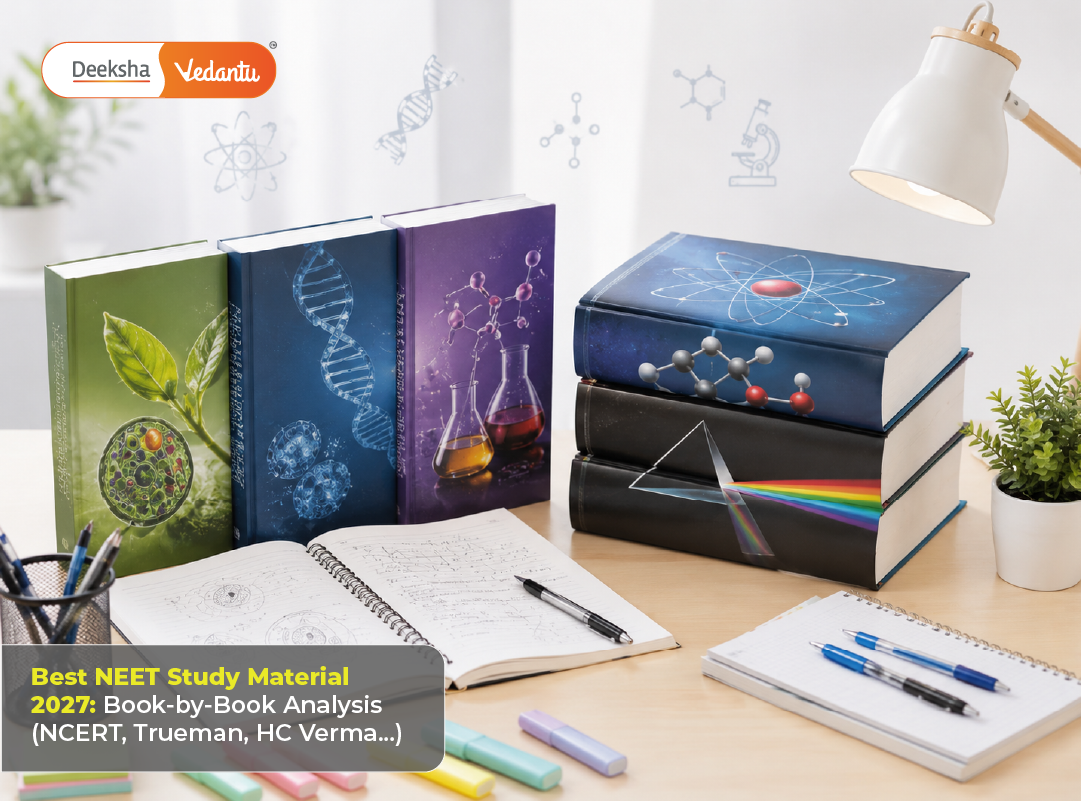

Choosing NEET study books is like choosing tools. A hammer is perfect for nails but useless for screws. Similarly, the best NEET books depend on your phase of preparation-not all books work equally well for foundation-building vs problem-solving vs revision.
Here’s the exact book strategy that works, by phase and subject.
The Three-Phase Study Material Framework
Phase 1: Foundation Building (Months 1-3)
- Purpose: Concept clarity, not problem-solving
- Book requirement: 1 source per subject
- Time allocation: 100% NCERT
Phase 2: Concept Deepening + Problem Practice (Months 4-8)
- Purpose: Understand deeply + solve applications
- Book requirement: NCERT + 1 reference book per subject
- Time allocation: 60% reference books, 40% practice
Phase 3: Speed + Accuracy (Months 9-12)
- Purpose: Timed problem-solving, high accuracy
- Book requirement: Practice books + previous year papers
- Time allocation: 80% practice, 20% revision
Physics: The Book Stack
Phase 1: NCERT (Non-Negotiable)
- Coverage: 100% of NEET concepts
- Quality: Adequate explanations for foundational understanding
- Time needed: 40 hours total (both volumes)
- Rating: 10/10 for foundations, 5/10 for problem-solving
Phase 2 Option A: Concepts of Physics by H.C. Verma
- Coverage: Deeper explanations than NCERT + solved examples
- Quality: Excellent for conceptual clarity, moderate problem difficulty
- Time needed: 60 hours for complete study
- Verdict: Best for understanding-first students
- Rating: 9/10 overall, 8/10 for NEET-specific practice
Phase 2 Option B: Objective Physics by D.C. Pandey
- Coverage: NEET-focused problems, less theory
- Quality: Direct to NEET-level questions, good time management
- Time needed: 50 hours focused problem-solving
- Verdict: Best for speed-oriented students
- Rating: 8/10 overall, 9/10 for NEET practice
Phase 3: 10-Year Previous Year Papers (DC Pandey or Arihant)
- Coverage: 180 questions from 10 years NEET/AIPMT
- Quality: Identifies repeat patterns, actual difficulty
- Time needed: 20 hours timed practice
- Rating: 10/10 for exam readiness
Honest take: Don’t buy both HC Verma and DC Pandey. Pick ONE based on your style. HC Verma if you want deep understanding. DC Pandey if you want direct NEET preparation.
Chemistry: The Book Stack
Phase 1: NCERT (Non-Negotiable)
- Coverage: 100% concept foundation
- Quality: Adequate for inorganic + organic basics
- Time: 50 hours (3 volumes)
- Rating: 10/10 for foundations, 4/10 for problem depth
Phase 2: Split by Chemistry Type
Inorganic Chemistry: Concise Inorganic Chemistry by J.D. Lee
- Coverage: All inorganic topics + practice questions
- Quality: Industry standard, comprehensive reaction coverage
- Time: 40 hours
- Rating: 9/10
Physical Chemistry: Problems in Physical Chemistry by Narendra Awasthi
- Coverage: Numerical problems with solutions
- Quality: Builds calculation speed (mole concept, equilibrium, electrochemistry)
- Time: 30 hours practice
- Rating: 9/10 for practice
Organic Chemistry: Elementary Problems in Organic Chemistry by M.S. Chauhan
- Coverage: Reaction mechanisms + practice problems
- Quality: Best for understanding mechanism (not memorization)
- Time: 35 hours
- Rating: 9/10
Phase 3: 10-Year Previous Year Papers (Arihant Chemistry)
- Coverage: 450 questions from 10 years
- Time: 25 hours timed practice
- Rating: 10/10
Honest take: Chemistry is 45 questions (180 marks). Inorganic is easiest to score (memorization), Physical is fastest to improve (practice), Organic is most time-consuming (mechanism understanding). Allocate accordingly.
Biology: The Book Stack
Phase 1: NCERT (Mandatory)
- Coverage: 100% of NEET biology
- Quality: Diagrams + theory sufficient for 80%+ of questions
- Time: 60 hours (2 volumes)
- Rating: 10/10 – Biology is NCERT-centric
Phase 2: Quick Revision Guide
- Option: Objective Biology by Dinesh (MCQ-based)
- OR: 40-Day Biology for NEET (quick topic-wise coverage)
- Coverage: NCERT concepts in MCQ format
- Time: 25 hours
- Rating: 8/10 for quick revision
Phase 2 Deep Dive: Trueman’s Biology Vol 1 & 2
- Coverage: In-depth coverage with diagrams
- Quality: Excellent for anatomy + physiology understanding
- Time: 40 hours (if weak in biology)
- Rating: 8/10 for detailed understanding
Phase 3: 10-Year Previous Year Papers
- Coverage: 900 questions from 10 years (biology = 90 questions/year)
- Time: 30 hours
- Rating: 10/10
Honest take: Don’t over-prepare biology. It’s 50% of marks but also highest-accuracy section. Two reads of NCERT + one reference book + previous papers = 80% Biology score. Your effort here should be 40% reading, 60% memorizing diagrams.
The Complete 12-Month Book Stack
| Phase | Physics | Chemistry | Biology | Total Time |
| Phase 1 (Months 1-3) | NCERT (40h) | NCERT (50h) | NCERT (60h) | 150 hours |
| Phase 2 (Months 4-8) | HC Verma OR DC Pandey (60h) | Inorganic + Physical + Organic (105h) | Trueman/Dinesh (30h) | 195 hours |
| Phase 3 (Months 9-12) | 10-yr PYQ (20h) | 10-yr PYQ (25h) | 10-yr PYQ (30h) | 75 hours |
| TOTAL | 120 hours | 180 hours | 120 hours | 420 hours |
Reality check: 420 hours ÷ 12 months = 35 hours/month = 8 hours/week = 1-2 hours daily. This is achievable with focused study.
The Critical Rule: Don’t Buy Multiple Books for Same Purpose
❌ Wrong: HC Verma + DC Pandey + BM Sharma (3 physics books)
✅ Right: NCERT + HC Verma OR DC Pandey + 10-year papers
Buying multiple books dilutes focus. Master ONE reference book per subject, then move to practice problems.
The best NEET study material isn’t the most expensive or the most popular. It’s the book stack that matches YOUR learning phase. Phase 1 = foundational books (NCERT). Phase 2 = reference books (one per subject). Phase 3 = practice + papers.










Get Social